12 Syrian refugees drown off Turkish coast as crisis deepens
Five kids among dead, three people still missing; migrants hold protests in Budapest
At least 12 Syrian migrants trying to reach Greece drowned Wednesday when two boats sank in Turkish waters, the Turkish coastguard and media said, as an image of a toddler’s lifeless body washed ashore sparked horrified reactions on social media.
The Turkish coastguard said in a statement that two boats had sunk after separately setting off from Turkey’s Bodrum peninsula for the Greek Aegean island of Kos early Wednesday.
The corpses of 12 migrants, including five children and one woman, were found and 15 people were rescued, with some surviving after reaching the shore in life jackets.
The coastguard, backed by helicopters, was continuing its search for three people still missing, the statement said.
The Dogan news agency published an image of a corpse of a little boy wearing a red T-shirt lying face-down on the beach near Bodrum, one of Turkey’s prime tourist resorts.
The hashtag “#KiyiyaVuranInsanlik” (“Humanity washed ashore”) made it to Twitter’s top world trending topics after the image was widely shared.
Dogan said that most of the refugees were from the Syrian Kurdish town of Kobane who fled to Turkey last year to escape violence by Islamic State (IS) extremists.
There has over the last week been a dramatic spike in the numbers of migrants — mainly from Syria, Afghanistan, Pakistan and Africa — seeking to leave Turkey by sea for Greece in the hope of finding new lives in the European Union.
The Turkish government said this week that the coastguard had rescued over 42,000 migrants in the Aegean Sea in the first five months of 2015 and more than 2,160 in the last week alone.
A coastguard official told AFP around 100 people had been rescued by Turkish rescue teams overnight Tuesday to Wednesday as they tried to reach the island of Kos.
The United Nations refugee agency UNHCR said more than 2,500 people have died trying to cross the Mediterranean so far this year.
Migrants, many of whom have paid over $1,000 to smugglers for the risky passage, are taking advantage of the calm summer weather which makes this the best time for the crossing.
Protests in Hungary
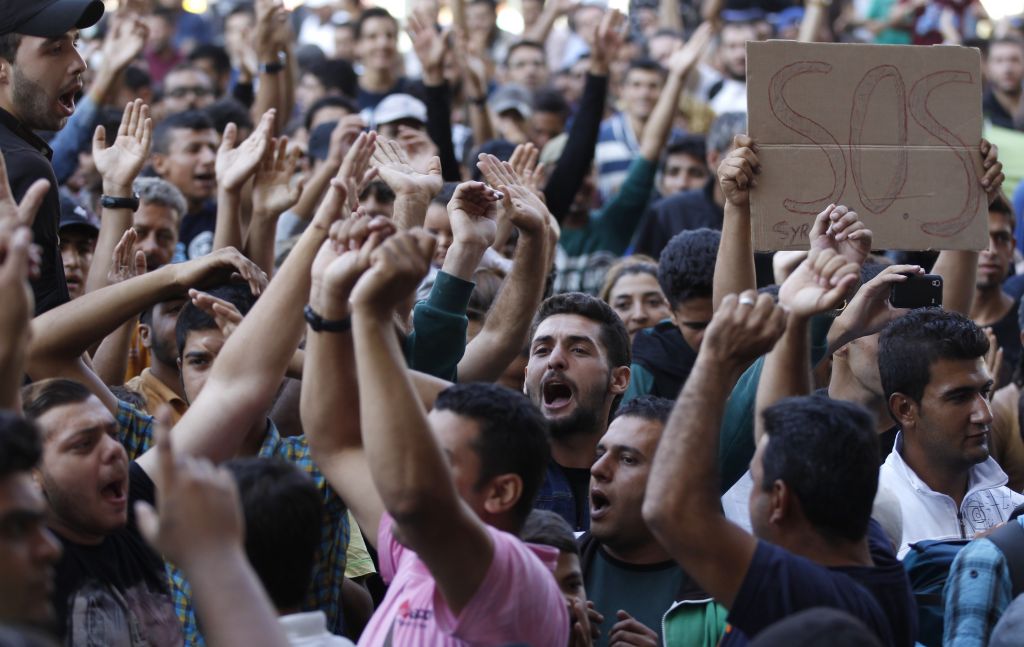
In Hungary, hundreds of migrants chanted defiant slogans outside Budapest’s main international train station Wednesday as Hungarian police blocked them for a second day from seeking asylum in Germany and other wealthy European Union countries.
“What we want? Peace! What we need? Peace!” the migrants shouted outside the cavernous Keleti train station, the latest focal point for European tensions over the unrelenting flow of migrants from the Middle East, Asia and Africa fleeing war and poverty.
Hungary’s prime minister, Viktor Orban, will take a “clear and obvious message” to his meeting Thursday with EU chiefs in Brussels about migrants, a government spokesman said.
“We have to reinstate law and order at the borders of the European Union, including the border with Serbia,” Zoltan Kovacs said. “Without re-establishing law and order, it will be impossible to handle the influx of migrants.”
The Hungarian government did not explain why hundreds of migrants were allowed to leave Budapest by train on Monday but not Tuesday or Wednesday. It insisted it was complying with EU rules on migration.
“(Migrants) are not entitled to move freely within the European Union even after entering Hungary,” Kovacs told The Associated Press. “If the migrants don’t comply with the very basic rules that are in place in the European Union, there is no solution to this problem.”
Kovacs also defended Hungary’s 4-meter (13-foot) fence being built on the border with Serbia and the tougher migration laws it expects to enact in a couple of weeks. Those new laws allow authorities to fast-track decisions on asylum requests and make it illegal to cut through the fence or cross the border except at designated areas.
“We’re going to thwart any effort to come to Hungary by illegal means,” Kovacs said.
The clampdown has had an immediate effect in the migrants’ primary target country, Germany. German police reported Wednesday that only about 50 migrants arrived on the morning trains to Munich, compared to 2,400 on Tuesday.