A pyre of words for a giant of a man
The death of Shimon Peres unleashes an avalanche of remembrances, from intensely intimate to warmly detached, and they say as much about ourselves as about the late leader
There’s a small corner of Israel’s print media Thursday morning, bathed in white on page 2 of Haaretz: a cartoon by Amos Biderman showing Shimon Peres walking up to heaven, where David Ben-Gurion, Yitzhak Rabin and Golda Meir are waiting for him. “We started to think you would never come,” Ben-Gurion quips. The scene is cutesy, maybe even a little funny, and sad, but in a nice way, all those emotions over the passing of the country’s ninth president wrapped in a spare 3×5 box, nestled into the avalanche of words that began to pour forth upon Peres’s death early Wednesday.
Can enough be said about Peres, one of its greatest leaders, a founder who kept striving for peace and for Israel well past his 90th birthday? Can too much be said about him? The funeral pyre of eulogies, memorials and remembrances that make up the near-singular focus of the Israeli press Thursday, a full day after he died, at least raises the question, if not answers it outright.
Even the most devoted student of Peres would have a hard time wading through every single article written about him from intensely intimate personal memories to warmly detached musings. Yet the pure volume of words amid the jostle for everyone to give their two cents, to pay their last respects, is a testament to one singular fact: Shimon Peres touched a lot of people.
By Thursday morning, some Internet news outlets were already transitioning from the immediate postmortem honeymoon — when no ill is spoken of the dead — to the hot takes and cool takedowns of some of what Peres did, asking if all the lionization is befitting.
But there is little of that in the print press, a product of Wednesday’s still-raw emotions, with heartfelt commentaries, remembrances and eulogies on nearly every page accompanying news reports of funeral plans and reactions from family, friends and local politicians as well as world leaders.
Yedioth Ahronoth’s front page eschews the black background that has become de rigeur for major obituaries, instead suffusing its front page with light, using a picture of Peres releasing doves while surrounded by children in a meadow on a sun-dappled day. The picture is a caricature in some ways, sure, but it is also an excellent embodiment of the Shimon Peres we want to remember, the Shimon Peres we do remember.
But what the picture cannot telegraph is the sadness over his passing, the twinge of bitterness left after a full life that had its fair share of challenges, and that is where the words come in.
“A lot of people speak about Pere’s optimism. Boundless optimism. Really, behind this optimism was the stubborn hope that understanding, words and courage could change reality. Sometimes this was a naïve hope, but it’s a thousand times better than salty cynicism,” writes novelist Amoz Oz in Yedioth, telling of how any time he tried to ask Peres about the past he would only want to talk about the future. “Indeed the man was a dreamer par excellence, both innocent and sophisticated, but his dreams came true many more times than the skepticism of others. Maybe being a dreamer is a recipe for a tough life, but there’s nothing to envy in one who has lost the ability to dream. The man was full of curiosity, busting with curiosity, and I love him.”
Likewise in Israel Hayom, opposition leader Isaac Herzog pens a column recalling Peres as someone who was larger than life, both in his dreams and what he did to build the country.
“Shimon was a man who knew how to tell the story of Israel with large drama and with small details. His stories were always captivating and would cause the listener to understand that the Zionist enterprise was built stone by stone. He knew how to instill in the boy or girl he was talking to the immense appreciation he fully expressed for the marvel known as the State of Israel,” he writes. “I will carry with me forever that same amazement, the same love, the same higher commitment to its security and well-being, and continue to walk in his way in the hopes of having the merit to make his dreams and vision a reality.”
If that sounded like a political stump speech for Herzog, it’s not the only one. Indeed the papers are filled with reports of reactions from fellow politicians and world leaders looking to both honor Peres and latch onto his legacy.
But while Peres as a founding father, as a man who worked himself to the bone for the distant dream of peace and coexistence is beyond questioning, the ups and downs of his seven-decade political career is ever present in many of the obituaries and memorials in the papers.
In Haaretz, obituary writer Ofer Aderet writes that “his life was woven between Dimona and Oslo,” a reference to his work to create Israel’s reported nuclear program as well as to forge peace with the Palestinians.
Picking up the thread, analyst Chemi Shalev also writes of Peres’s contradictions, and of the fact that the remembrances now and his unparalleled standing in his later years were an aberration.
“Peres was abundantly rich in contradictions. It made him fruitful and fascinating, complicated instead of straightforward, multilayered rather than direct. It was his greatest strength but also his biggest weakness. Throughout most of his life, the Israeli public shied away from Peres’ complexity. It was misinterpreted as a sign of deviousness and even corruption. It sparked fear and hostility, before these emotions evolved, in the twilight of his life, to appreciation and admiration,” he writes. “In his latter years, Peres was Israel’s fig leaf. The man who was always depicted as a foreign entity miraculously metamorphosed into a poster boy for the Zionist entity. He was the Israel that everyone wanted it to be, rather than the country that actually is. He epitomized an innovative, forward-looking, peace-seeking cosmopolitanism, an Israel that is a member in good standing in the international community, a beacon onto the nations rather than a recalcitrant occupier and subjugator of the Palestinians. He was unappreciated and undermined, by Israeli politicians as well as American Jewish leaders, when he needed help and was in a position to make history; he was embraced and placed on a pedestal only when it made no difference at all.”
Shalev and some others at Haaretz, though, are pretty much alone in putting cracks in the hagiography-sodden landscape. Even Israel Hayom’s Boaz Bismuth, sitting across an ideological divide from Peres, writes of his appreciation for him. The column is strange in that it’s not really about Peres, but in many ways it’s still about Israel and its contradictions in dealing with a man like him.
“I learned to appreciate Shimon Peres, like many others, with the years. It didn’t come automatically,” he writes, telling of his love for Menachem Begin and how as an ambassador to Mauritania he was only able to find three journalists from there willing to meet with Peres. “Peres believed in peace, but our neighbors not so much… In a Middle East so violent and bloodied, Peres taught us that despite everything, one can and should dream. Thank you Shimon Peres. It took us time, but we, the generation of Begin, salute you.”
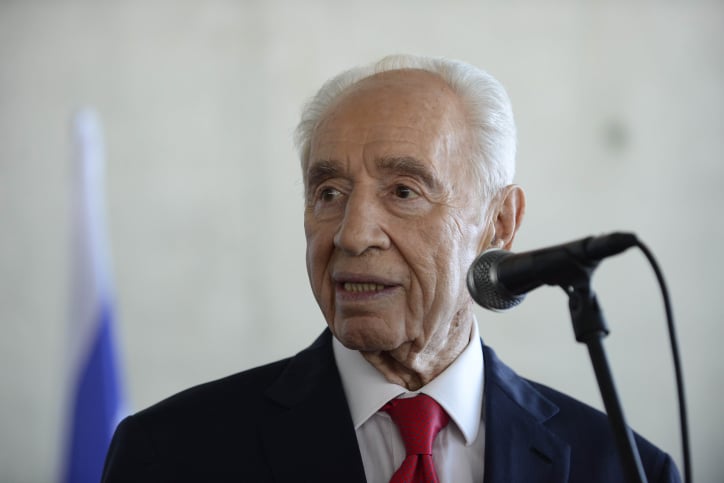
Yet despite all the eulogies and the tales of his work from Europe to Dimona to the peace accords, it’s easy to forget that he was just a man, a man with feelings and emotions, and perhaps his greatest trait was that he seemed larger than life when he actually was not. He was human, he was just like us and he showed us what we could be as well. Sometimes, as Yitzhak Rabin’s son Yuval Rabin writes in Yedioth, he was just a friend.
“He and my father were two giants cut from material not seen today. People who knew how to make decisions and do the right thing, even if it was not popular. Entebbe, Oslo, the Nobel Peace Prize, and the rally in the square where they sang ‘Shir shel shalom’ – of all the events and stories, the one moment that comes to my mind is Peres’s meeting with my mother in October 2000. This was just a few months before she passed, and I remember him sitting next to her and speaking with her about worries for the future of the state. And I, standing on the side, saw how large he was. Despite all the history, the tensions and disagreements with my father, he made sure to come and visit with my mom and keep in touch. Now, dozens of years after those tensions, arguments and joint work, the two leaders will be able to lie side by side in the restful forever.”