A US charity plans to use AI to monitor its Gaza classrooms for ‘hateful’ speech
Plan by Gaza Children Village opposed by educators in Gaza, with some fearing surveillance could be intercepted by Israel, while others object to efforts to censor teachers
AP — A US charity in Gaza is worried that teachers at its schools might stray from a curriculum it says promotes peace and tolerance, so it plans to record classroom conversations and use artificial intelligence to flag speech deemed “hateful” or “inciting.”
The plans laid out by the founder of the Gaza Children Village in a webinar last month have elicited ethical, safety and privacy concerns from some Palestinian and advocacy groups and at least one of the charity’s partners.
There is no indication the charity intends to share its classrooms’ recordings with anybody else, but fears about the potential misuse of surveillance technology are heightened in Gaza after three years of war. The Israeli military has used AI to sift through intercepted communications and find suspicious speech, including to identify targets for strikes.
Palestinian rights groups have been critical of the charity’s education agenda more broadly, saying it is unaccountable to local and UN agencies that have long managed Gaza’s schools. Who controls education in Gaza is one of many unresolved questions about its postwar governance.
It is unclear when the classroom monitoring is supposed to begin, what specific language will be flagged, and whether teachers, students and their families have been told about the plans.
The charity’s founder says he seeks the ‘de-radicalization’ of Gaza
The charity’s founder and CEO is Dr. David Hasan, a neurosurgeon born in Kuwait to Palestinian parents who now teaches at Duke University School of Medicine in Durham, North Carolina.
People claimed to care about Gaza. But when doctors were asked to volunteer, only 18 stepped forward.
Palestinian-American Dr. David Hasan decided to be one of them. He went to Gaza to help.
العالم زعم الإهتمام بغزة. لكن عندما فُتح باب التطوع للأطباء، لم يتقدم سوى 18 طبيباً.… pic.twitter.com/Z1eQ3je5Yz
— Yalla يلا | The Good News (@WatchYalla) October 2, 2026
He conceived the idea for the charity after volunteering at hospitals in Gaza during the war and wanting to end generations of violence between Palestinians and Israelis. Hasan says he was taught at an early age to look unfavorably upon Jews and Israelis, and that it wasn’t until he attended college in the US that he learned other perspectives; he wants kids in Gaza to gain these perspectives early in life.
The charity has raised money largely from individual donors, including American Jews, and says it’s partnering with North American, Israeli and European aid organizations and hospitals. Its schools, called Academies of Hope, provide meals and medical and psychological care. The first school opened last summer.
The schools’ lessons are mostly built around the Palestinian Authority curriculum, but language that he says glorified violence or encouraged anti-Israel or antisemitic beliefs was removed, Hasan has said.
Hasan declined to comment for this story or provide examples of curriculum changes. But a 2026 report by the US Government Accountability Office that examined “problematic textbook content” flagged by the UN in Gaza identified the kinds of issues that Israel has long complained about: the use of “the number of martyrs” to teach a mathematical concept, a reference to “Jerusalem as the capital of Palestine,” and a description of a boy shot while demonstrating in support of Palestinians held in Israeli prisons.
On a webinar last month with humanitarian groups, Hasan said the reason to monitor classrooms is to help train teachers in how to uphold a curriculum that he had previously said was aimed at “de-radicalization.”
“I know it’s controversial, but trust me, it’s the only way we feel for us to survive and deliver this curriculum,” Hasan said.
Monitoring classrooms opens ‘Pandora’s box’
This isn’t the first organization to face such difficulties. The UN agency for Palestinian refugees, UNRWA, has attempted to modify the PA curriculum to remove content that doesn’t align with values of neutrality, nonviolence and nondiscrimination; but it, too, was met with teacher and community resistance, according to the GAO report.
Israel has also long accused UNRWA of teaching content that fostered antisemitism and anti-Israel feelings and accused the UN agency of employing dozens of Hamas operatives among its staff.

A Gaza Children Village staffer said some teachers and other employees are afraid of being questioned by Hamas about the curriculum or are uncomfortable working for an organization supported by Israeli aid groups. The staffer spoke on condition of anonymity because they were not authorized to speak to the media.
Two people affiliated with the charity expressed concerns when notified about the possibility of classroom monitoring.
“Cameras to monitor the performance of students and teachers are acceptable. But cameras to silence students and teachers from being able to have a free exchange in a classroom are not acceptable,” said Bishara Bahbah, a Palestinian American political activist on the charity’s board. He said he wasn’t aware of the monitoring plans and that they haven’t been raised with the board.
Bahbah said that with so few functioning schools in Gaza, the charity’s top priority is getting more kids in classrooms.

An official at an aid group that partners with the Gaza Children Village said the use of cameras could prompt it to reconsider working with them. Using AI to monitor people’s words opens a “Pandora’s box,” said the official, who spoke on condition of anonymity for fear of jeopardizing the group’s work in Gaza.
Six current and former teachers at Academies of Hope declined to comment.
The system will flag language deemed ‘hateful’
UNICEF estimates that hundreds of thousands of children in Gaza are not in school, and that most schools were destroyed or damaged during the war. The Gaza Children Village says its schools in central and southern Gaza serve thousands of children, many of whom lost parents or other relatives during the war.
Under the plans outlined by Hasan in various communications, recordings of classroom conversations will be analyzed by an AI-powered system to detect “antisemitic,” “inciting” or “hateful” language.
If problematic language is detected, a warning will be sent to Hasan, who can then contact the teacher to understand the context and provide feedback, Hasan said in the September webinar. He said recordings are stored for 72 hours.
The monitoring technology has been tested and the plan is to deploy it in dozens of classrooms, according to a text message Hasan sent sometime before August that was seen by The Associated Press.
In the text, Hasan said the system was created in collaboration with PollyLabs, a New York-based nonprofit that promotes the use of technology to solve problems in crises. PollyLabs says it has had no role in developing or deploying such technology.
Palestinians in Gaza are especially fearful of surveillance technology
Fears about surveillance technology are strong in Gaza after three years of war with Israel’s high-tech army.
“Israel has weaponized information to such a dystopian degree that many Palestinians feel they cannot utter a word, type a thought, or twitch an eye without fearing it could be seized upon,” said Amjad Iraqi, senior Israel and Palestinian Territories analyst for the International Crisis Group.
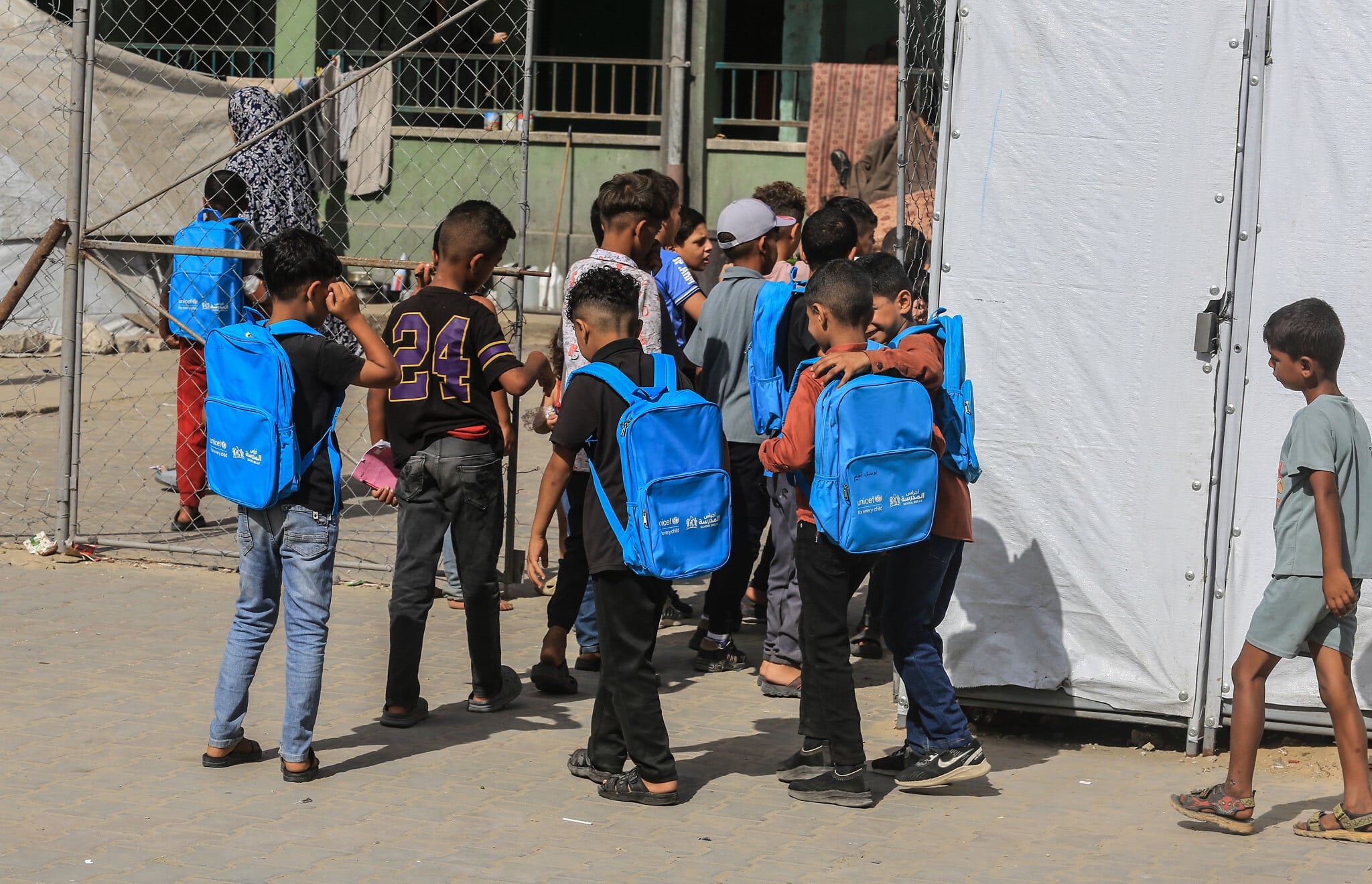
Groups opposed to the charity’s curriculum say Palestinians are being stripped of their autonomy in deciding what to teach their children.
“It is very concerning, they’re trying to control the minds of new generations,” said Ines Abdel Razek, co-director of the Palestine Institute for Public Diplomacy, an advocacy group.
The Palestinian Authority, which has limited autonomy in parts of the West Bank, and UNRWA should be supported in rebuilding schools in Gaza, she said.
However, a recent study found that PA textbooks continue to glorify terror, demonize Israelis, traffic in antisemitic themes and advance exclusivist nationalist rhetoric despite promises to implement reforms.
A Palestinian government spokesperson, Mohammad AbuAlrob, says the PA curriculum focuses on tolerance and justice. He said he doesn’t have enough information about the charity’s curriculum to comment on it. But he said using surveillance in classrooms would cross “an important line.”
Times of Israel Staff contributed to this report