After day of death and destruction, papers search for meaning
A rocket on Israel, a massive Israeli reprisal campaign, a dead jet pilot, a bruised diplomatic relationship -- all as fleeting as a passing shade, but enshrined in ink in Thursday's papers
If one ever wanted to explain the meaning of futility to a child, they could do little better than to show them the news of October 5, 2016, as viewed through the spyglass of the next morning’s papers, where the pointlessness of it all is bared for all to see.
A day that began with a pointless rocket shot for no reason that shattered some glass and some calm gave way to dozens of airstrikes against Gaza, which seemingly destroyed minor pointless “terror infrastructure” and ended with the pointless death of an air force pilot reportedly returning from one of those bombing runs, killed as he ejected or tried to save his plane, depending on whom you read.
And then for a cherry on top, the US issued another pointless condemnation of Israeli settlement building, denouncing the pointless building of new units to replace the pointless razing of an illegal outpost nearby, notching another wound in the already bruised relationship.
By next week, all will be largely forgotten by most, the news nothing but a broken shard, withering grass, a fading flower, a passing shade, a dissipating cloud, a blowing wind, flying dust, and a fleeting dream.
But leave it to the Israeli press to do its darnedest to try to give meaning to the seemingly meaningless.
While Haaretz leads with the US telling Israel that it’s not acting like a good friend, the other two papers put the sad story of killed air force pilot Ohad Cohen Nov front and center, wrapping it up with the escalating tensions in the south.

While the army said Cohen Nov was killed after ejecting from his F-16I fighter jet, returning from a bombing run, Yedioth’s headlines tells the story that he was killed “in the cockpit,” “trying to save the plane” while a navigator escaped with light injuries after a problem with the plane as it attempted to land.
The stories, though, are couched in less certain terms.
“An initial probe shows that the navigator decided to abandon the plane with the ejector seat, but Ohad didn’t eject and stayed in the plane,” the paper’s Yossi Yehoshua writes in an unsourced report. “According to assessments, it’s possible he stayed to try and gain control of the plane and land it – but for naught. Within seconds, the plane caught fire and crashed.”
(A military spokesperson told The Times of Israel Thursday that much in the Yedioth report was incorrect.)
The reason behind the crash aside, the tabloids play up the human element as well, reporting that Cohen Nov’s wife was pregnant with their second kid, and Yedioth fills pages with pictures of him and his wife and baby.
In Israel Hayom, a neighbor of Cohen Nov’s parents in the small farming town of Mazor says the tragedy has hit not only his family, but the whole moshav.
“He was a mischievous kid, but a good kid, the kind you love,” a neighbor tells the paper. “We can’t believe that just a few years ago we danced with him at his wedding. He was so happy. Now we all need to go to his funeral and accompany him on his final journey. It’s just unbelievable. This is a huge tragedy for all of us. We also can’t take it in.”
The death of Cohen Nov is inexorably linked to the bombing campaign over Gaza, which itself in inexorably linked to the rocket attack on Sderot.
In Haaretz, military analyst Amos Harel writes that the rocket was shot by a small Salafi group and not Hamas, raising questions about whether Israel’s policy of carrying out bombing runs against Hamas in response is doing any good.
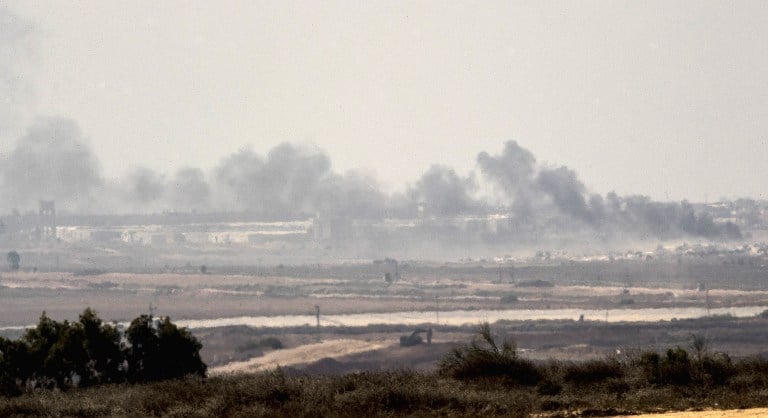
“Hamas may be deterred, but the Salafis seem less so. Moreover, Israel is attacking Hamas targets because it insists that Hamas, as the sovereign power in Gaza, is responsible for keeping the peace. But what about the Salafi groups? Are they devoid of responsibility,” he writes. “This is the second time a Salafi group has managed to fire a rocket into the heart of Sderot. By comparison, it took Islamic Jihad several years to bring its accuracy up to that level. … The bottom line is that small, almost insignificant factions are now dictating the rules of the game in Gaza to both major players, Israel and Hamas. They can set off explosives at will that, via a chain of harsh responses, could ignite the next war.”
Yedioth’s Yossi Yehoshua, who apparently attended the same briefing as Harel, covers much the same ground, warning that the IDF must start thinking differently about how to deal with the Strip and its Salafists. But perhaps more interesting is what he can’t write, about the IDF “taking advantage” of the flare-up to hit… something.
“The number of sites struck was smaller [than a previous large campaign], but the tons of explosives landed exactly where they were needed,” he writes. “For a while Hamas, the IDF and politicians have kept from speaking about this publicly, and the military censor has drawn lines over the issue, but one can assume that as the damage piles up and gets more significant, Hamas won’t hold back and will work to change the equation.”
Those tons of bombs, while not killing or injuring anyone, were enough to scare the bejeezus out of people in Sderot, some of whom are quoted in Israel Hayom saying they are worried about the specter of war and leveling some uncharacteristic criticism at the army’s response.
But perhaps haunting the residents of the Gaza border area even more is the fact that the Iron Dome anti-missile system didn’t shoot down the rocket.
“We rely too much of Iron Dome. Also the last time, the system didn’t shoot down a rocket and it landed between two houses and only by a miracle nothing happened. Too many miracles and it’s not healthy,” a Netivot resident is quoted telling the paper. “Now we are in a period of school in session, and the Tishrei holidays, and there are many people about, in the streets, shopping and nobody wants to return to living in fear or returning to the days of being scared of explosions like we experienced in a massive way in the past.”
Another thing nobody wants is to see besties Washington and Jerusalem fighting, but Haaretz’s lead story makes it clear that is happening, calling the US statements on settlement plans “harsh condemnation.”
However, the paper reports that the rebuke should not have caught Israel off-guard, after US Ambassador Dan Shapiro warned National Security Adviser Yaakov Nagel not to go ahead with the plans earlier this week.
“A senior American source who requested anonymity due to the sensitivity of the issue, said that Shapiro told Nagel that the US considers it unacceptable that in order to solve the illegality of the Amona outpost, the Israeli government has created a much larger problem,” the paper reports. “Shapiro stressed to Nagel that despite Israel’s claims that the plans are only to expand an already existing settlement, the U.S. recognizes the action as the creation of a new settlement, which contradicts commitments made by Netanyahu to the US government.”