Argentine Jews to boycott official Holocaust commemoration
Community to hold its own ceremony in protest over suspicious death of prosecutor Alberto Nisman
Jewish leaders in Argentina announced over the weekend they would boycott Tuesday’s state Holocaust Remembrance Day ceremony in protest of the death of prosecutor Alberto Nisman.
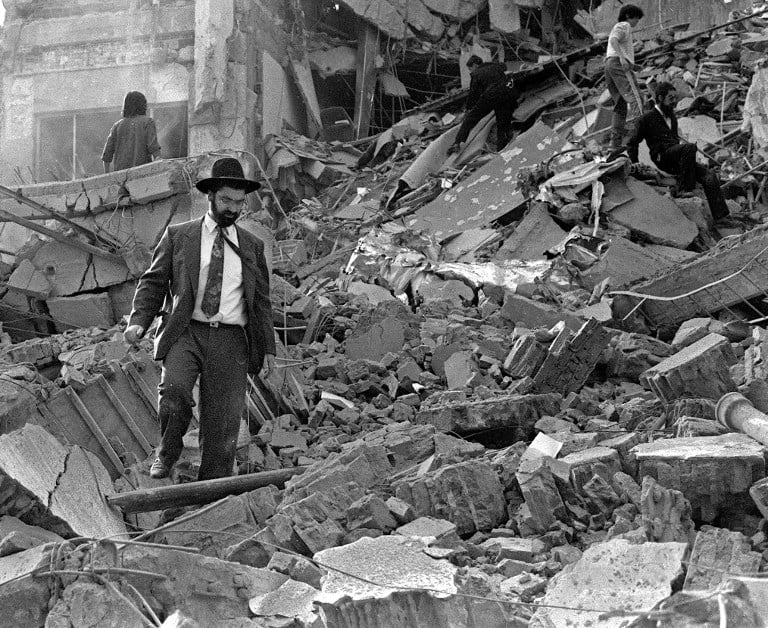
The boycott of the official event, organized by the Foreign Ministry, was prompted by Nisman’s accusations against Foreign Minister Hector Timerman which implicated him in a government cover-up of Iran’s involvement in the deadly bombing of the AMIA building in 1994.
The January 27 memorials also coincided with the two-year anniversary of an agreement between the Argentine and Iranian governments to establish a much-maligned “truth commission” into the bombing — the same attack that Nisman had investigated for a decade.
Nisman was found dead hours before he was set to testify on Iranian involvement in the bombing, which killed 85 people, and an alleged cover-up by the Argentine government.
He was found slumped in the bathroom of his apartment last Sunday night with a bullet wound in his head and a .22 caliber handgun beside his body.
An initial forensics exam showed Nisman was shot from a distance of at least 15 centimeters, a source in the country’s Federal Police told local media on Saturday. The finding completely contradicts the government’s initial claims that Nisman had committed suicide, an assertion President Cristina Fernandez Kirchner has since backtracked from.
The AMIA, the DAIA, the Holocaust Museum of Buenos Aires, and other Jewish groups will hold their own Holocaust remembrance event and will not attend the official ceremony organized by the Foreign Ministry, the Guardian reported on Friday.
“The charges are so gruesome and extend to so many areas of government that it would be an insult to the memory of our victims of the Shoah to attend,” Waldo Wolff, the vice president of the DAIA, said.
Diana Wang, head of the Children of the Shoah association, denounced Timerman for his alleged complicity in the cover-up.
“I am horrified by the charge that someone who is both an Argentinian and a Jew is suspected of plotting to cast darkness on an investigation undertaken in his own country to solve the Amia bombing,” she said.
Since Nisman’s death, the Jewish community had held several rallies countering the initial reports that the prosecutor had committed suicide.
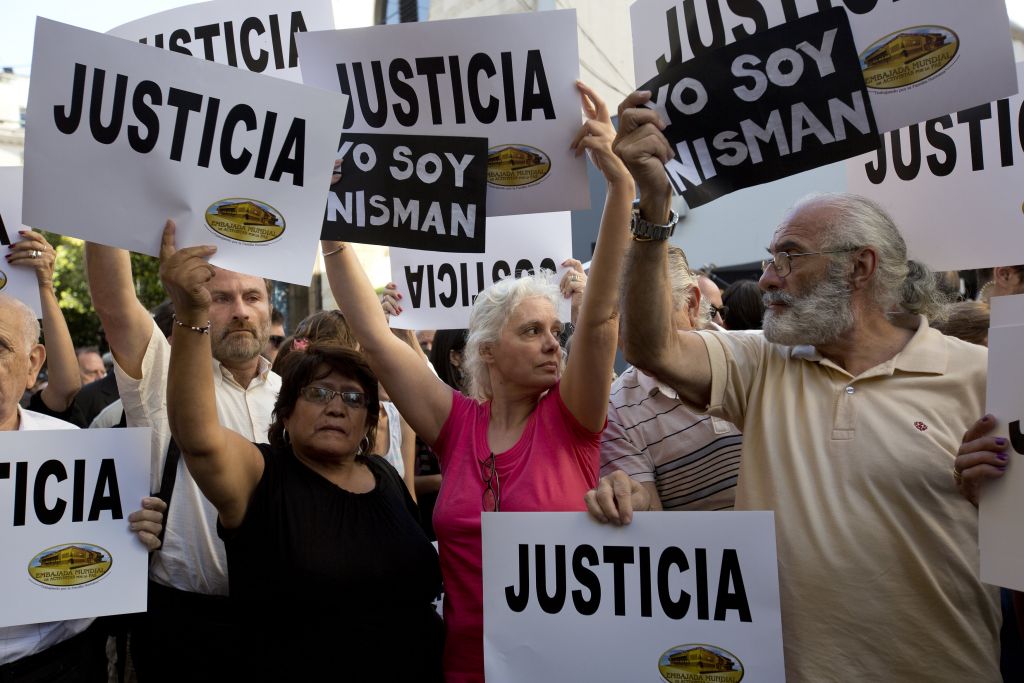
On Thursday, some 2,000 protesters gathered at the site of the AMIA bombing demanding “truth and justice.” The protesters rallied to chants of “Argentina” and “justice.”
Julio Schlosser, the head of the DAIA Jewish leadership group, told The Times of Israel Thursday that Nisman’s death was “a complete shock.” Speaking by phone from Buenos Aires, he said Nisman “didn’t have the character of a person who would commit suicide. When I saw him last Wednesday afternoon (January 14), there was nothing different about him. He behaved exactly as he has behaved every time I have seen him during the last eight years.”
On International Holocaust Remembrance Day in 2013, President Kirchner announced the government had signed a memorandum of understanding with Tehran to create a “truth commission” into the AMIA bombing, in a move condemned by Jewish groups.
At the time, the American Jewish Committee likened it to “asking Nazi Germany to help establish the facts of Kristallnacht.”
Four days before his death, Nisman, who had fingered Iranian officials in the attack, had given a judge a 289-page report alleging President Kirchner had secretly reached a deal to prevent prosecution of former Iranian officials accused of involvement in the 1994 car bombing of the country’s largest Jewish center.
Nisman was set to give his testimony at a congressional hearing the next day.
Nisman contended that the government had agreed to swap grain for oil with Tehran in exchange for withdrawing “red notices” to Interpol seeking the arrests of the former and current Iranian officials accused in the unsolved case.
On Friday, the 10 police officers assigned to protect Nisman were being investigated for their actions on the day the prosecutor was found.
The officers, along with two supervisors, are being looked at as part of an internal police investigation into the handling of Nisman’s death, a person close to the investigation told The Associated Press on Friday on condition of anonymity. The officers are not considered suspects.
In particular, the source said, investigators are looking into the time it took two officers assigned to the door of Nisman’s building to advise their superiors that they had not been able to reach him by telephone.
Earlier this week, those two officers made declarations to lead investigator Viviana Fein, who would ultimately decide whether to try them for anything. All 10 have been suspended during the investigation, the person close to the case said.
Also on Friday, justice officials said they have been unable to locate the man who loaned Nisman the gun used in his death despite “repeated attempts,” and were ordering that he be barred from leaving the country without first getting permission from Argentine authorities.
Diego Lagomarsino, who spoke to authorities soon after Nisman’s death, said he had given a .22-caliber pistol to Nisman because the prosecutor wanted it for protection. Lagomarsino has not been named as a suspect.
Kirchner, who has dismissed Nisman’s allegations of a cover-up in the bombing, published two letters on social media this week about the prosecutor’s death — the first saying it appeared he had killed himself, then a second saying she was now convinced it wasn’t a suicide.
Nisman’s allegations, she said, were based on false information given to him by the former head of the intelligence services. In her second letter, published Thursday, she portrayed Nisman’s death as a way to damage her administration.
Iran’s government has long denied any involvement in the bombing, and Iranian Foreign Minister Javad Zarif on Friday rejected Nisman’s accusation that his country had conspired with Kirchner’s government.
“It’s unfortunate that certain people try to keep this alive in Argentina in order to make political mileage out of it. It has nothing to do with Iran,” Zarif said in Davos, Switzerland.
Nisman had produced sufficient evidence of Iran’s involvement in the 1994 bombing as to have several senior Iranian officials placed on Interpol watch lists.
Nisman had traced the evidence, in what remains the worst-ever terrorist attack in Argentina, all the way back to an August 1993 meeting of the Iranian leadership in Mashad. Nisman said he had been subject to death threats, and warnings from Iran, throughout his years investigating the case.
AP and Times of Israel staff contributed to this report.