Babes in terrorland
The wounding of a baby in a Jerusalem terror attack rivets the press, while a decision to probe the shooting of a teen attacker gains an unlikely backer
Unfortunate as it is to say, Monday was not the first time a baby was caught in the crossfire of the Israeli-Palestinian conflict, wounded or felled by a fight as old as it is young.
On Monday, the baby in question may not have been killed in the car-ramming attack near the entrance of Jerusalem, but the wounding of the boy (papers can’t agree on whether he is a year old or a year and a half) send shockwaves through the press just the same.
Though the terrorist who mowed down 14 people at a bus stop Monday afternoon likely had no idea baby Yotam was there (not that that in any way excuses his actions) the tabloids make it seem as if he were aiming for the boy, with headlines likes “Terrorist vs. baby” (Yedioth Ahronoth) and “terror against a 1-year-old” (Israel Hayom).
Despite the drama, father Benjamin Setboun tell Israel Hayom that everything will be hunky dory. “His leg is broken, but my kid will be okay. He’s healthy, and he’ll smile again and that’s what’s most important,” he’s quoted saying.
Commentator Haim Shine notes angrily in the paper that for the terrorist, the important thing isn’t a child’s smile, but a child’s blood, penning a passage that could likely qualify as hate speech in another country.
“These are our enemies: Savages who sanctify death,” he fumes. “Monsters who have no ethical compunction against hurting babies, women, the elderly and anyone else who gets in their way. The important thing for them is to kill Jews and to become the heroes of the society they grew up in. For a society that sanctifies death, there will be no life.”
Papers also make much of the fact that an ax was found in the car used in the ramming attack, apparently intended to be used by the terrorist to spread more mayhem and destruction. The existence of the ax was apparently no surprise to Hodaya Klon, who was lightly injured in the attack.
“I sat at the station and a car suddenly came up and threw me. I understood right away that this was an attack, and I knew I needed to get up and start to run because the terrorist was coming out with a knife or a gun,” she tells Yedioth. “I ran and heard shots. I didn’t know they were from security guards so I hit the ground. After everything was over I saw I was injured. Around me were screams and people running in hysterics.”
Winning the misleading headline of the day award, Haaretz’s Amos Harel pens a piece whose title tells readers that “There’s an increase in attempts to organize terror cells,” marking a shift in the conflict from lone wolf attacks to more complicated planned assaults. The story, though, is a bit less exciting.
“The defense establishment is on the lookout for any signs of a shift to organized cells carrying out shooting and bombing attacks on orders from above. There have recently been some signs in this direction, but so far, the shift hasn’t materialized,” he writes.
It’s not necessarily a good thing, though. Harel notes that after over two months of attacks, Israel has yet to unlock the lone wolf puzzle.
“All these attacks resemble each other. It’s been two and a half months since the attack that the army defines as the start of the current violence, the murder of Eitam and Naama Henkin near Nablus, but the security services still haven’t figured out how to cope with a lone Palestinian terrorist,” he writes. “Even more systematic monitoring of posts on social media networks has produced at most a few warnings about the possibility of attacks. When the interval between a decision to attack and its implementation is sometimes a mere half hour, according to the testimony of several assailants who were arrested, it’s very hard to provide hermetic protection.”
Even if Israel hasn’t figured out how to thwart attacks before they happen, once they do, security forces have gotten pretty good at neutralizing the threat, to borrow the term favored by police flacks which usually means somebody shot the attacker to death.
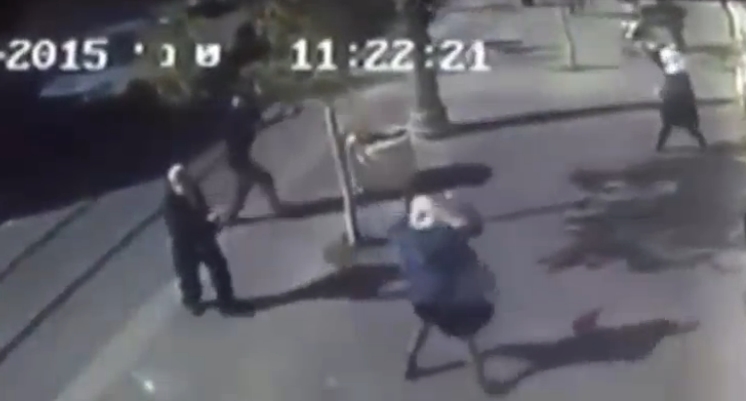
Yedioth reports that while there was a public outcry over the decision to investigate a policeman who shot and killed two scissors-wielding girls in central Jerusalem last month, the cop’s lawyer is actually welcoming the decision to give him a chance to explain his side of the story, after a video appeared to show him shoot and kill an attacker after she was already disarmed and posed no threat.
“My client will explain to investigators why he opened fire, and I’m sure they will accept his explanation justly,” lawyer Ofer Bartel tells Yedioth. “If there were no probe, we would be on a slippery slope. Even in a country like ours, which deals with severe incidents, when there is gunfire that always needs to be a check into the circumstances. We need to show the whole world that the shooting was justified, and all the other countries will accept and understand what happened.”
Even if the cop is for the probe, Israel Hayom reports that his boss, Public Security Minister Gilad Erdan, is in the camp of shoot first, don’t ask questions later.
“I cannot understand why every time they try to judge decisions that need to be taken in a split second, as if we are talking about lab conditions,” Erdan is quoted saying. “I hope the investigation will end swiftly and the case will be closed, because we need to support our security forces that are saving our skin time after time.”
It’s likely one other person not in agreement with Erdan is former MK Nitzan Horowitz, who looks to France and sees the repudiation of Marine Le Pen and her far-right posse, and expresses fears in a Haaretz op-ed that the Israeli right, which he says has abandoned human rights, is sliding toward the extreme end of the spectrum..
“This was a choice between the values of the republic and those who seek to destroy it…” he writes. “The right doesn’t necessarily have to become more radical and emulate the extreme right; it should distance itself from it. There is a democratic and liberal right and it helped win the day. Once there was such a right wing in Israel, but it let the left take over support for human rights and liberalism, leaving itself vulnerable to the claws of the extreme right. This is the tragedy of Israeli politics that France has managed to avoid so far.”