Bennett, Golan pledge to back Eisenkot as PM, as bloc mulls which coalition to seek
Anti-Netanyahu's bloc's final member, Avigdor Liberman, said to criticize Yashar party head over push for government with Arab parties; PM reportedly says no unity talks if Knesset speaker replaced
Parties in the bloc seeking to replace Prime Minister Benjamin Netanyahu continued their jockeying for position on Sunday, ahead of high-stakes coalition negotiations in which the group of parties will have to choose between partnering with Arab-led parties, Haredi parties or Netanyahu’s party, options that would each involve breaking electoral promises.
Yashar party chief Gadi Eisenkot took a major step in consolidating his control of the bloc, after the heads of the B’Yachad party, Naftali Bennett, and reportedly of The Democrats party, Yair Golan, both pledged to recommend that Eisenkot be tasked with forming the next government when they meet with President Isaac Herzog, who will decide who to task and who has publicly backed a unity government with Netanyahu.
A statement from B’Yachad said that Bennett “made it clear throughout the election campaign that he would respect the decision of the voter, and that’s what he is doing.”
Among the members of the so-called change bloc, comprised of four Zionist parties staunchly opposed to Netanyahu, Eisenkot’s party received 21 votes compared to just 12 for B’Yachad.
Golan’s left-wing Democrats, which received 8 seats, will also recommend Eisenkot as premier, some unsourced media reports said Sunday.
And Hebrew media also reported Sunday that Eisenkot had met a day earlier with Avigdor Liberman, the leader of the fourth and final bloc member, the seven-MK Yisrael Beytenu.
Liberman had also reportedly been expected to meet with B’Yachad No. 2 Yair Lapid later on Sunday.
Eisenkot has also met in recent days with Golan and Bennett, while Liberman had reportedly not been responding to calls from both Eisenkot and Bennett.
Following last week’s election, neither the change bloc nor the Netanyahu-led bloc appear to have the majority necessary to form a coalition.
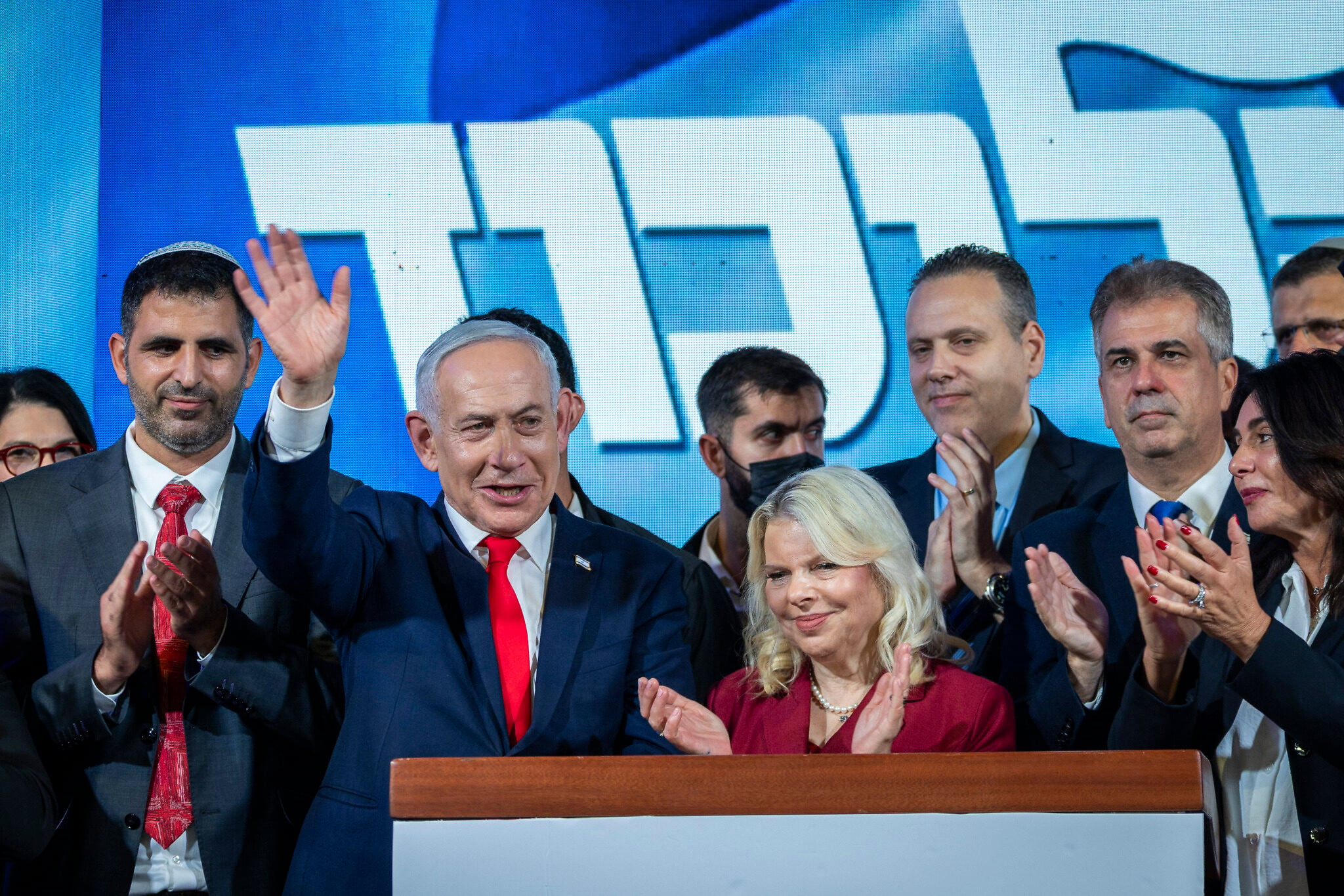
Liberman has been vocal — both before and after the election — about his opposition to Eisenkot’s mulling of a government propped up by Arab-led parties.
According to unnamed sources cited by the Ynet news site, Liberman criticized Eisenkot’s campaign during their Saturday meeting, arguing that the promotion of the minority government option had harmed the bloc electorally.
The leaders of the four-party anti-Netanyahu bloc were reportedly expected to all meet together in the coming days.
They were expected in the first stage to replace Knesset Speaker Amir Ohana, of Netanyahu’s Likud party, in order to gain control of the legislative agenda and pass a raft of bills, including a state commission of inquiry into the failures that enabled the Hamas-led October 7, 2023, onslaught.
However, there is an ongoing standoff regarding who becomes the new Knesset speaker, who further down the line can only be replaced with a virtually unattainable 90-strong majority in the 120-member Knesset. Eisenkot himself is a candidate, since if he becomes prime minister, he would have to give up the speakership, meaning the appointment would be reversible.

Liberman told Eisenkot in their meeting that Yashar party members lack the parliamentary experience needed to be Knesset speaker, according to Ynet.
Meanwhile, the Kan public broadcaster reported Sunday that associates of Netanyahu have conveyed a message to Eisenkot that if Ohana is replaced as Knesset speaker, and as long as there are ongoing efforts to do so, no negotiations will be held on potentially forming a unity government that includes Likud.
The report quoted Eisenkot associates as saying the efforts to replace Ohana will continue, and that joining a Netanyahu government is not on the table.
That isn’t the only immediate plan of action for Eisenkot’s bloc. Channel 12 news reported Sunday that it would attempt to quickly call a repeat election among MKs for the role of state comptroller.
Netanyahu forced through the selection of his personal lawyer Michael Rabello to the role in June, in what has widely been regarded as a tainted vote, and which the High Court of Justice has said must be repeated. The outgoing coalition has refused ever since to hold a repeat vote, and the ombudsman post has been vacant for months.
Apart from the unity government option and the possibility of a coalition propped up by Arab parties, another publicly floated possibility has been a government relying on outside support from the ultra-Orthodox parties, or from both Arab and Haredi parties, in particular United Torah Judaism (UTJ), which says it is no longer part of Netanyahu’s bloc.
The UTJ leaders met Sunday to discuss the faction’s position ahead of <a href=”https://www.timesofisrael.com/netanyahu-lost-his-majority-but-can-the-opposition-form-a-government-a-look-at-possible-paths-ahead/”>coalition talks</a>, with Hebrew media outlets publishing a photo of party chief MK Yaakov Asher meeting with MK Yitzhak Goldknopf and MK Meir Porush.
בכירי יהדות התורה התכנסו ושוקלים שלא להמליץ על איש לנשיא; ההכרעה תתקבל לאחר התייעצות עם הרבנים@eli_hirschmann pic.twitter.com/U16IZOtl77
— החדשות – N12 (@N12News) November 1, 2026
According to several Hebrew media reports, citing a source in the party, the ultra-Orthodox faction is considering not recommending any candidate to form the next government.
Herzog will meet with representatives of every faction in the next Knesset, during which the parties will recommend a candidate as the next prime minister.
UTJ has been considered a staunch member of the pro-Netanyahu bloc, though the party has expressed anger that during the coalition’s four years in power it did not succeed in passing a law to exempt ultra-Orthodox yeshiva students from the IDF.
The party’s leaders reportedly said during Sunday’s meeting that they had yet to receive any concrete offer from Eisenkot, and therefore there was nothing to discuss on that front.
Meanwhile, US Ambassador to Israel Mike Huckabee said it would be “troubling” for a future Israeli government to include Arab lawmakers who have failed to condemn the October 7 massacre, and argued that Israel’s political left has largely disappeared since the 2023 attack.
In an interview with Newsmax over the weekend, days after Tuesday’s inconclusive general elections, Huckabee expressed concern over some of the incoming Arab lawmakers’ critical positions on Israel and refusal to condemn the Hamas-led October 7 invasion, saying that including them in a coalition would be “troubling.”
Enjoyed being with @Tom_Basileon @NEWSMAX
https://t.co/6q1ixeQPpV— Ambassador Mike Huckabee (@GovMikeHuckabee) November 1, 2026
“Some of them have been outspoken in their condemnation of the very nation they want to be a part of… they have expressed no real, I guess, condemnation of what Hamas did on October the 7th,” Huckabee said, adding: “It would be troubling for anyone to include them if that’s going to be their position in a government.”
In a separate interview with NewsNation, Huckabee argued that the October 7 attack shifted Israel’s political landscape largely to the right, leaving little disagreement between major parties on national security.
“I think it’s important for Americans to understand on the issue of national security, there’s not much difference between any of the parties other than perhaps the Arab parties, because, quite frankly, there is no left wing to speak of left in Israel after October 7. That sort of vaporized,” the ambassador said.
In his Newsmax interview, Huckabee described an ongoing Shin Bet investigation into allegations of foreign involvement in the election as “serious,” but acknowledged that its findings were not yet known.
“It is underway and it’s a very serious and a full-level investigation,” he said, adding: “We don’t know the results of that investigation.”
Stav Levaton and Nava Freiberg contributed to this report.