Between never forget and never again
Speeches by leaders point to disputes over how to mark Holocaust Remembrance Day, reflecting a continuing battle of past versus future
“The past is a foreign country,” David Lowenthal wrote in 1985, engaged in a diplomatic tango with the present, pushing and pulling humanity hither and thither, like Virginia’s Woolf’s “capricious seamstress,” even as we do the same to it.
That much at least seems true given the heavily weighted place memory and commemoration of the Holocaust holds in Israeli and Jewish life, but given words spoken at official memorial services Sunday night, it may also be that a civil war is being fought in society on behalf of this foreign country.
The two pillars of how we deal with and relate to the Holocaust — never forget and never again — were on full display at ceremonies in Jerusalem and Poland Sunday night, and while press accounts don’t exactly seize upon the contrast, it’s plain to see in the coverage of Holocaust Remembrance Day in the day’s papers.
The question over whether the day is a time for reflection on the tragedy of the Holocaust or for showing our strength and determination to make sure it never happens again is not a binary one. The answer is both, in degrees. Yet speeches by Prime Minister Benjamin Netanyahu, President Reuven Rivlin and IDF Chief Gadi Eisenkot seemed to retreat into camps of mutual exclusivity, and papers reflect their own political leanings by accentuating one speech versus another.
Haaretz, which is actually the only major paper to lead off with French election results over the annual commemoration, headlines its coverage with Rivlin’s warning that “regarding all criticism of the State of Israel as anti-Semitic is dangerous for the country.”
“According to this approach, the justification for the existence of the State of Israel is the prevention of the next Holocaust. Every threat is a threat to survival, every Israel-hating leader is Hitler,” the paper quotes him saying.
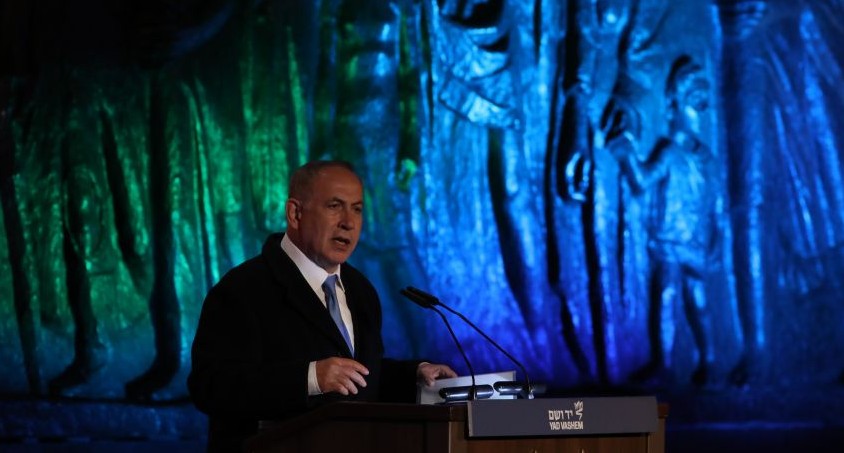
Across the aisle, Israel Hayom highlights the man who likely personifies that approach better than anyone — Netanyahu — whose speech at the Yad Vashem Holocaust Memorial in Jerusalem right after Rivlin’s played up current enemies, like the Islamic State group and Iran, as modern proponents of the Final Solution, accused the UN and the West of anti-Semitism and pointed a finger at the world for not doing enough to stop the slaughter of 6 million Jews.
The paper also highlights a visit to Auschwitz by Eisenkot, with correspondent Noam Dvir writing that “if there’s one picture that tells the story of the Holocaust and our rise from it, it is the picture of the IDF chief of staff passing through the gates of Auschwitz.”
He also quotes heavily from Eisenkot’s entry in the guestbook, which ends with the line: “The understanding is that only an advanced State of Israel with a strong powerful army can prevent similar incidents in the future.”
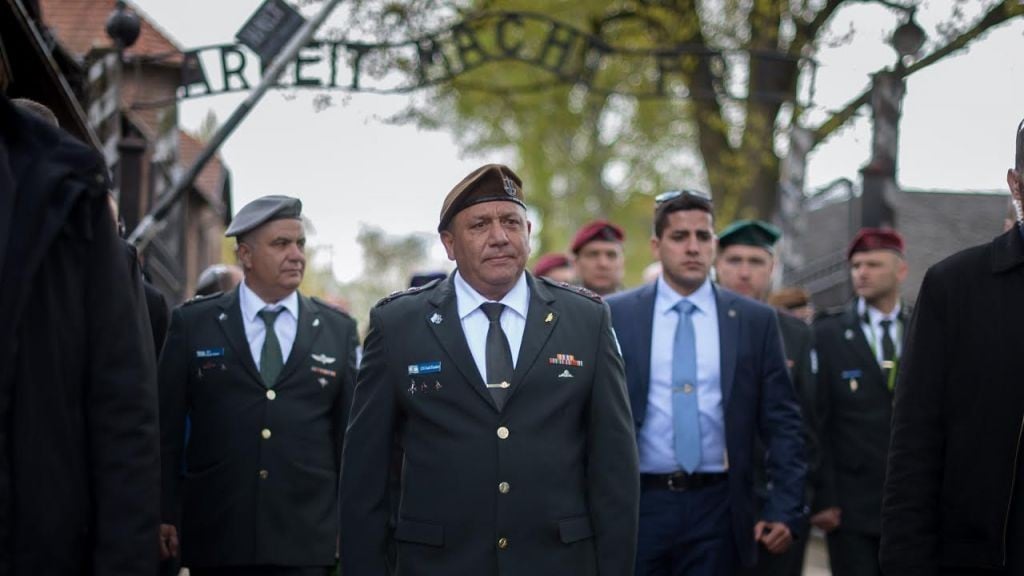
Both the picture and the idea are splattered across the paper’s front page, and by now symbols of renewed Jewish life juxtaposed with the train tracks, crematoria and gates of Auschwitz have become almost cliched, but in Yedioth Ahronoth, survivor Noah Kliger writes of being on the second March of the Living in 1989 and seeing young Poles watching the Jews return to the death camp, amazed since they thought that “they had all been killed.”
“Today, wherever I give lectures, i remember the words of the young Pole who was surprised to see us. Thus in every lecture I normally say that while I talk about what happened at Auschwitz and other camps, practically speaking I am unable to explain a thing,” he writes. “How is it possible to explain that an advanced people, developed and modern, would get up one day and carry out a detailed plan to annihilate another people, the Jewish people? Why? The decision to kill millions of people out of pure hatred is a decision that is impossible to explain.”
The tabloid also covers the speeches, but rather than focus on what bigwigs say, the paper highlights the thoughts and experiences of everyday people caught in the squall of history, like the parents of fallen soldier Hadar Goldin, who accompanied Eisenkot to Auschwitz, and survivors and their children and grandchildren.
Included in those is Hen Kutz, who writes of her talks with her survivor father and how the Holocaust continues to affect him, over 70 years later, in a column titled “My father’s hell.”
“Sometimes he’s quiet, so I ask him what he’s thinking about. ‘Even when I tell you the worst things, I laugh,’ my dad says, ‘even with how much it pushes on me, on the outside I don’t express it in a tragic way. But on the inside I also cry a little.’ Because ‘there are things that you can never erase. Even if you want it won’t go away,’” she writes.

These questions, the ideological and the personal — how to remember, what to tell, how to educate — continue to represent battlegrounds and Israel Hayom columnist Dror Eydar uses the focus on “never again” (a phrase not coincidentally popularized by extremist rabbi Meir Kahane) to wade into another ideological controversy, directly linking the Holocaust to the creation of the State of Israel and calling for Jews worldwide to immigrate “home.”
“This day, when the ’10 days of thanks’ start, from Yom Hashoah to Independence Day, we are reminded of the start of the historical ladder that rises from the crematorium to our realization as an independent people in our ancient homeland,” he writes. “Whoever recalls the Holocaust and promises ‘never again’ is required to also remember the second part of ensuring ‘never again’: Making aliyah, the ingathering of the expelled for the four corners of the world to the only national home we have. From now on say: ‘Never again exile!”
Don’t forget Paris
One of the countries mentioned by Eydar is France, where Sunday saw far-right demagogue Marine Le Pen move into the second round of presidential elections. Yet rather than raise alarmist bells, Haaretz, which runs four columns about the election on its front page, focuses on the victory of centrist Emmanuel Macron getting through to the second round, with Dov Alfon going so far as to anoint him “messiah of the moment.”
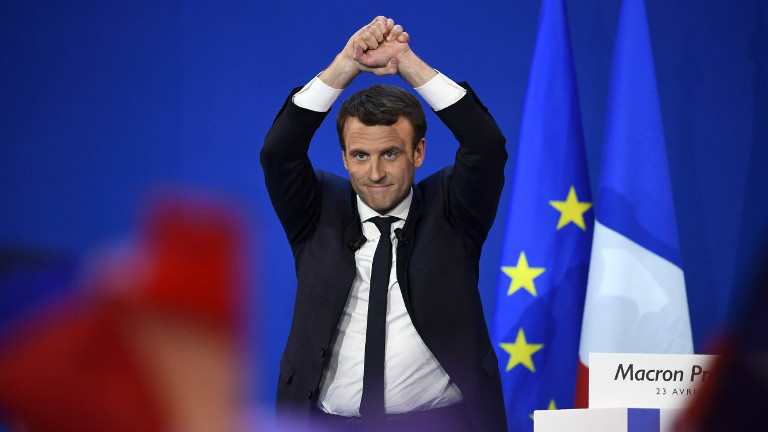
(Eric FEFERBERG / AFP)
Columnist Sefy Hendler warns that despite predictions that Macron will handily defeat Le Pen in the second round, the results Sunday, with Le Pen and her far-left rival Melanchon getting nearly half the votes, show that France’s anti-establishment flirtation may not be over.
“It would be a mistake to think the victory is already in Macron’s pocket. A bloody terror attack, like those France has experienced periodically since January 2015, isn’t the only thing that could change the picture. An erosion of Macron’s support, or a massive movement by supporters of Melenchon and Fillon into Le Pen’s camp, could also cause Macron’s lead to melt away,” he writes.
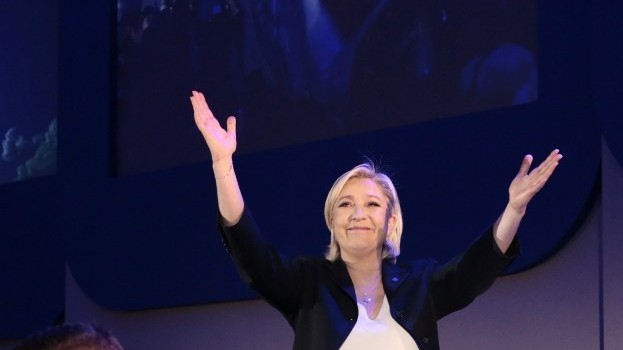
Israel Hayom’s Boaz Bismuth calls Le Pen’s second place finish “A harsh result for Yom Hashoah.”
“France is not embarrassed by the extreme right,” he writes. “The candidate who just a few weeks ago denied the responsibility Vichy France had over the fate of its Jews during the Second World War is just a hop away from the Elysee Palace.”