Boeing and Israel’s Technion to develop clean fuel tech to cut carbon footprints
US aerospace giant backs multi-million-dollar project at institute to advance towards competitive commercial production of sustainable aviation fuel (SAF) for the industry
US aircraft maker Boeing has chosen Israel’s Technion to jointly develop sustainable aviation fuel (SAF), a low-carbon jet fuel alternative, as the global aviation industry faces the challenge of cutting greenhouse gas emissions and meeting cost-effective future energy needs.
Technion President Prof. Uri Sivan hailed the partnership as a “historic collaboration of national importance” for the Israeli economy, energy security, and civil aviation.
“Through this collaboration, Technion experts are taking on a tremendous mission: to develop technologies for producing clean fuels through sustainable processes, thereby making a significant contribution to aviation—and no less importantly, to human health and the environment,” said Prof. Sivan.
As part of a strategic partnership, Boeing and the Haifa-based Technion will advance the production of competitive, commercially viable SAF from feedstocks, including hydrogen, a gas widely seen as a source of green power for the future, and carbon dioxide. SAF is a type of biofuel made from various sources of feedstocks, such as municipal waste, agricultural residues, and cooking oil, rather than fossil fuels.
The collaboration comes as airlines around the world are committing to ambitious decarbonization goals. Boeing has a target to deliver commercial airplanes capable of flying entirely on SAF by 2030. International regulations require the commercial aviation industry to switch to sustainable fuels to achieve zero net emissions by 2050.
SAF has the potential to cut aviation’s carbon emissions by up to 80 percent, compared with traditional jet fuels. However, the key issue is availability and cost, the latter of which is expected to remain two to three times higher than fossil-based jet fuel over the coming years. SAF accounted for a mere 0.6% of total jet fuel consumption in 2025 and translates into an additional $3.6 billion in fuel costs for the aviation industry, according to a report by the International Air Transport Association (IATA), which represents 360 airlines around the world.
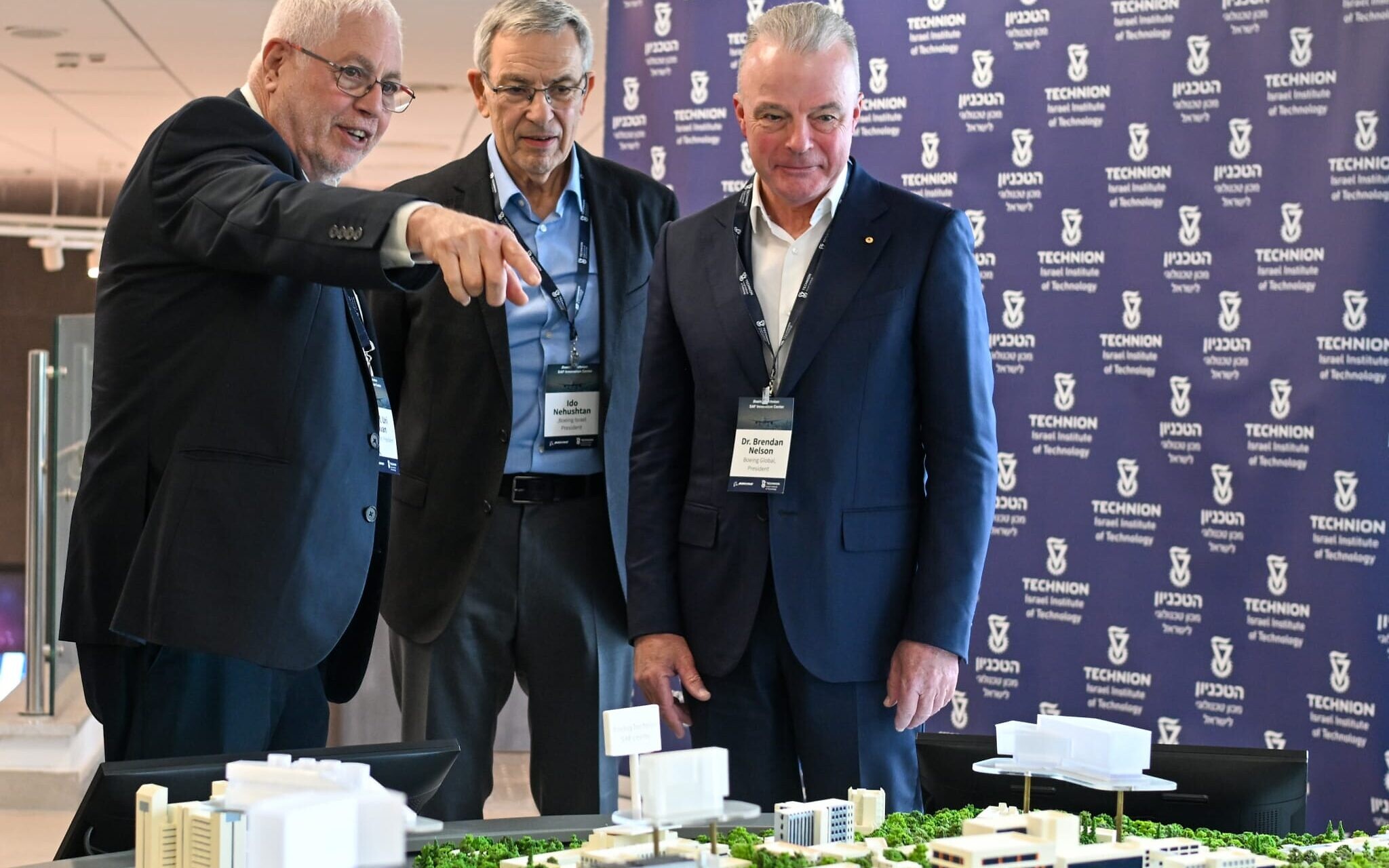
“If there is one country in the world capable of solving civil aviation’s emissions challenge, it is Israel, led by the Technion—the Israeli MIT,” said Dr. Brendan Nelson, president of Boeing Global, during a visit to the Technion last week. “We are pleased to partner with Technion and other stakeholders in the SAF Innovation Center to support Israel’s aerospace industry.”
Boeing Israel President Maj. Gen. (res.) Ido Nehushtan vowed that the collaboration would pave the way for the development of Israel’s most advanced technologies and capabilities with the potential to be integrated into future generations of global aerospace systems.
Financial details of the collaboration were not disclosed. Prof. Gidi Grader of the Technion’s Wolfson Faculty of Chemical Engineering told The Times of Israel that Boeing has committed to multi-million-dollar support for three years.
Boeing first partnered with Prof. Grader in 2023 to establish the Boeing–Technion SAF Innovation Center, which has completed a feasibility study to develop sustainable fuels for the aviation industry. For the coming years, the goal is to develop a continuous process for large-scale commercial SAF production.
“We undertook the challenge to start from CO₂ and hydrogen as we envision that in the future, the cost of green hydrogen is going to come down, just as the cost of a solar cell came down by orders of magnitude over the last 20 years,” said Prof. Grader. “It is also the best raw material for large-scale production, which eventually will be needed, not in the short term, but in 25 years.”
On Earth, hydrogen does not exist in isolation but is bound up with other elements — for instance, with oxygen to form water. Using an electrolyzer, hydrogen can be isolated from water molecules. If the electricity used to do this comes from renewable sources such as the sun, the hydrogen is labeled green.
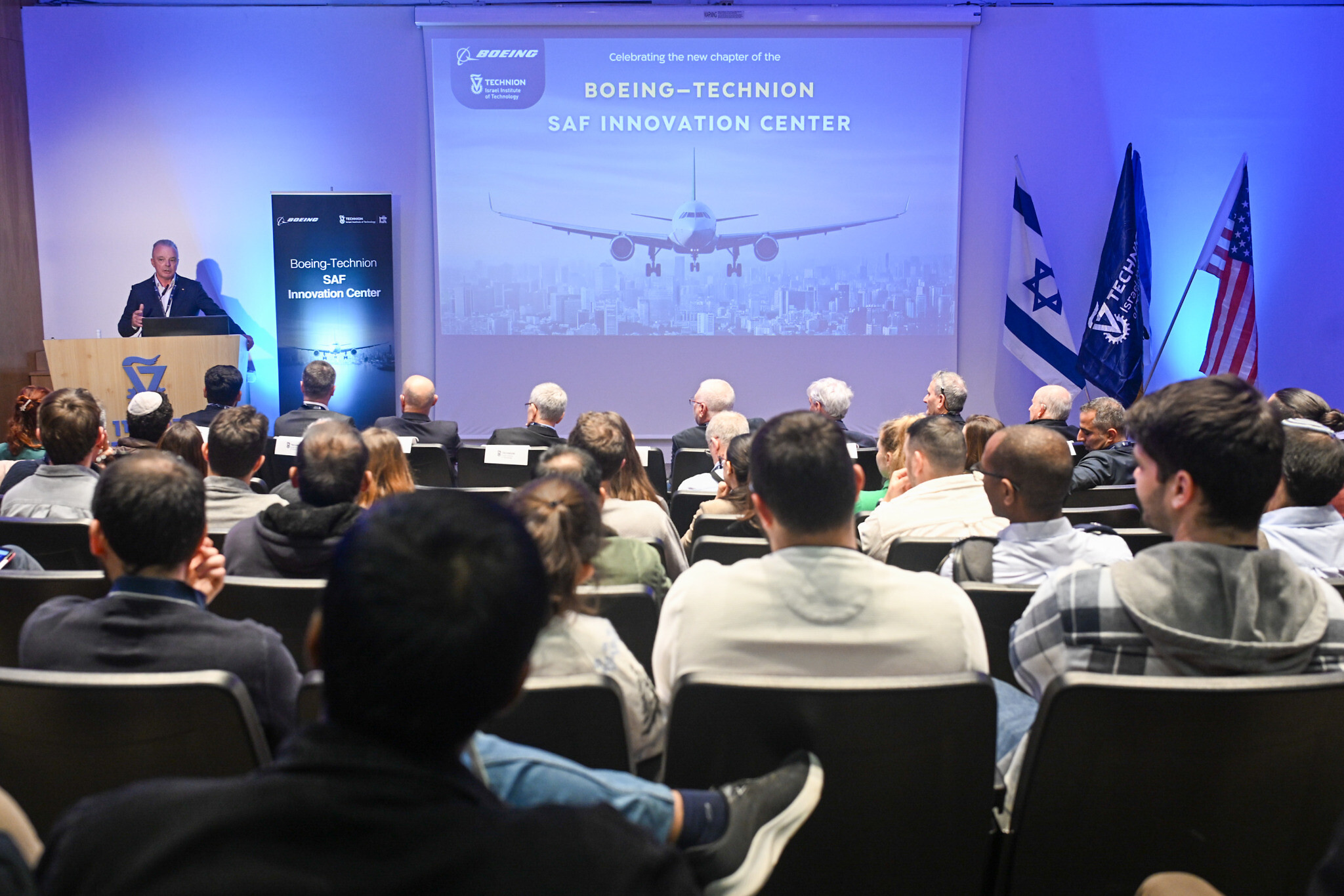
“In the coming three years, we are planning to establish the operation of an experimental fuel-testing facility at the Technion, which will be only the second of its kind in the world,” said Prof. Grader.
As part of the partnership, 11 Technion faculty members and dozens of doctoral students from five different faculties are working on various aspects of aviation fuel production, including efficient and competitive manufacturing, theoretical aspects of catalytic reactions and fuel combustion, and safety considerations.
“It’s a fantastic opportunity to develop a technology that, if successful, could be implemented in a dispersed way and can be exported,” said Prof. Grader. “What we are doing sets the stage not only for SAF output, but for many other needs of the chemical industry, to help reduce our dependence on fossil fuels and oil in a very significant way, which will be beneficial for putting a dent into the problem of tackling climate change.
“For example, the idea of taking CO₂ and hydrogen to generate methanol and dimethyl, which are raw materials for many industries, such as polymer refineries,” he said.
Separately, Boeing and Ben-Gurion University of the Negev announced the establishment of a cybersecurity research center for next-generation aviation and aerospace systems.
“Aviation and space systems are becoming more autonomous, digital, and connected,” said Boeing’s Dr. Nelson. “Partnering with Ben-Gurion University, one of the world’s foremost centers in cybersecurity and advanced engineering, helps us stay at the leading edge of secure aerospace innovation.”
Boeing is a key supplier of passenger planes to Israeli airlines, mainly El Al, and a major supplier of fighter jets, missiles, helicopter gunships, satellites, and other advanced military equipment to the IDF.
“Israeli industries are now leading suppliers to Boeing, and many Israeli systems integrated into Boeing products worldwide generate hundreds of millions of dollars annually,” said Boeing Israel’s Nehushtan.