By crimping Abbas, Israel may be helping Hamas spark a new intifada
It's unclear if the Palestinian leader has enough control to keep his forces from joining growing West Bank protests, and Jerusalem seems loath to toss him a lifeline
It is possible that we are not yet in the midst of a full-blown Third Intifada. It’s possible that the next steps taken by the Palestinian Authority and the Israeli government, respectively, will calm tensions and quell the unrest in the coming days. But the series of events of the past several days do not inspire optimism.
The numerous violent incidents, the riots, the injuries and the deaths on both sides are all already starting to sound — and look — like the beginning of a sustained Palestinian uprising, an intifada.
As recently as Sunday morning, a day after two separate terror attacks in Jerusalem’s Old City claimed the lives of two Israelis and injured three, including a two-year-old, it still seemed that the wider situation was under relative control and that the murderous attacks were the isolated acts of “lone wolves” without the backing of the Palestinian street — a “personal intifada,” as the veteran Palestinian journalist and AP correspondent Mohammed Daraghmeh put it. But the equation seems to have changed since then.
For starters, the riots in Jerusalem have not abated. Since the Jewish New Year last month in fact, the capital has witnessed a sort of urban uprising — violent clashes between Palestinian rioters and Israeli security forces, the hurling of rocks and firebombs. Constant unrest in the streets. But this East Jerusalemite wave of protest stopped at the security barrier and did not reach the West Bank. Palestinian residents there refused to join in the rioting, in no small part because of the Palestinian Authority but also because of public indifference. A similar phenomenon was apparent last year after the murder of Palestinian teenager Muhammad Abu Khdeir; the protests did not make it beyond East Jerusalem.
But over the past two days, things have changed. We’re no longer just talking about lone wolf terror attacks, but also about the participation of hundreds and sometimes thousands in West Bank demonstrations, from Jenin in the north to Hebron in the south.
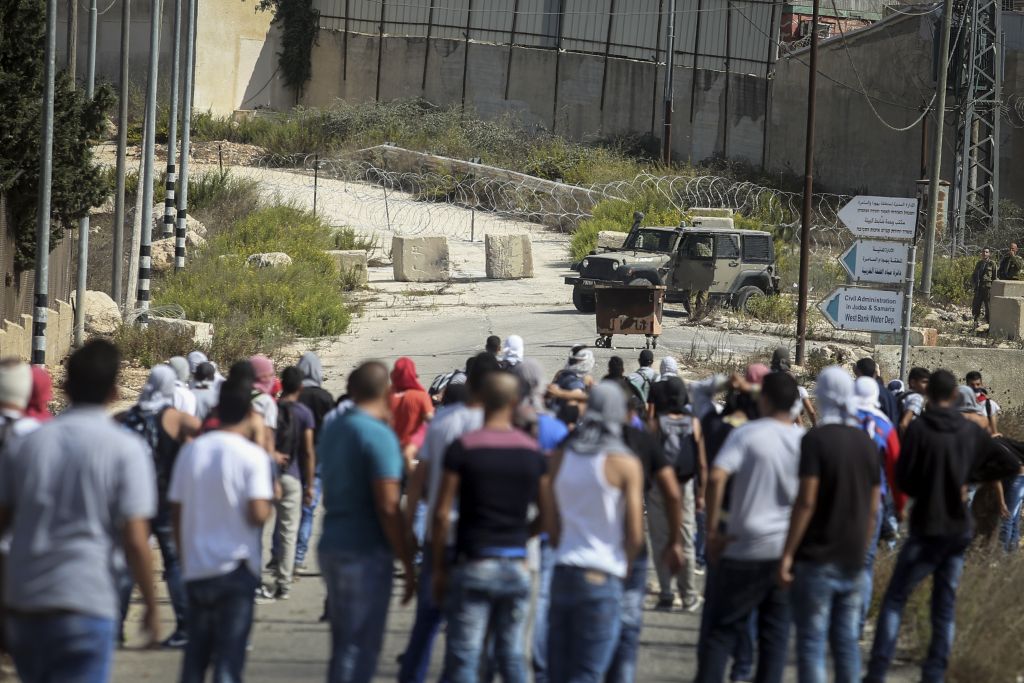
According to Israeli estimates, protests across the West Bank on Sunday-Monday drew over 3,000 people, with Palestinian Authority estimates even higher. A 12-year old Palestinian and an 18-year-old were killed by IDF fire, and scores were injured. According to the Palestinian Red Crescent, hundreds required medical treatment.
This was not “just another day” of protesting in the West Bank. These are numbers that can easily lead to a loss of control on the PA side and a wider conflagration.
Another factor is the involvement of Israel’s Arab community. Although the protests on Monday were relatively quiet, in Nazareth there were a few violent incidents. As we saw during the October 2000 riots, protests within the Green Line can ripple into the West Bank.
The Palestinian Authority has not halted security operations, yet. On Monday Palestinian Authority President Mahmoud Abbas called an emergency meeting of his security chiefs in an effort to restore quiet to the West Bank. Israel and the PA have been exchanging calming messages over the past two days and both sides have expressed a desire to prevent further violent clashes. But it is not clear whether either has the capacity to do so at this stage.
We have not yet reached the point of no return. The two sides can still lower the flames. But at this point, incidents that the PA and Israel have managed to contain in the past — Palestinian or Jewish terror attacks, Temple Mount clashes, etc. — could be the trigger for massive escalation.
Many of the protesters despise the PA and its leadership, and a key question now is whether those serving in the security forces will continue to obey the orders coming out of the Muqata in Ramallah. The majority of shooting attacks in the West Bank have been carried out by Hamas, but most arms in the territories are in the hands of Fatah. Will Fatah choose to join the violence at some point?
On Sunday, the commander of the IDF’s Judea and Samaria Division was fired upon by an unidentified group in Ramallah. Could Abbas be losing control of his own people?
The warnings were always there
These developments have not surprised Israeli security experts. The past year has seen warnings from nearly every official body operating in the territories that an escalation of violence is on the way.
All warned that the status quo in the West Bank was changing and that an increase in terror attacks could be expected.
Many of these agencies stressed the role of Abbas and the PA in keeping the relative calm across the West Bank. But the political echelon has seemingly chosen to ignore the message.
Prime Minister Benjamin Netanyahu and Defense Minister Moshe Ya’alon agreed to ease some economic restrictions on the PA. But they rejected other meaningful steps toward strengthening Abbas’s position, notably including moves that could have enabled renewed negotiations with the Palestinian Authority.
Again and again, including this week, they have described Abbas as an inciter who supports terror. Even when Shin Bet chief Yoram Cohen described the PA head as “part of the solution, not the problem,” they continued to blame Abbas.
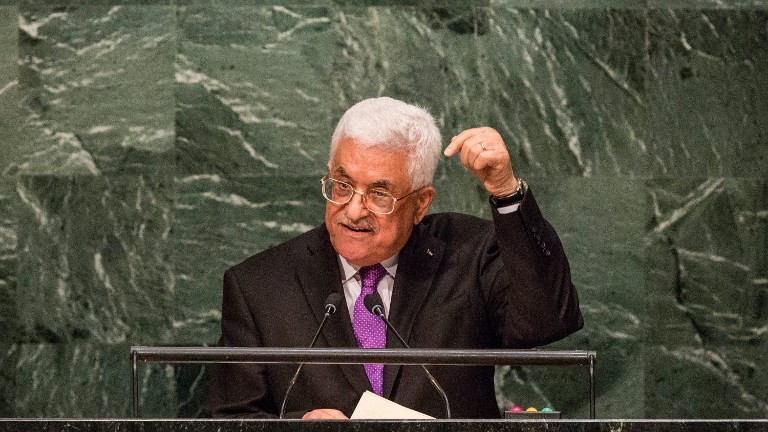
Abbas did not drop his bruited “bombshell” at the UN. He did not announce that he was canceling the Oslo accords, only, vaguely, that he no longer saw the PA as bound by them. He did not announce his resignation. Yes, he blamed Israel for violating the sanctity of the Temple Mount, but he’s delivered far more vitriolic speeches in the past.
But then came last Thursday’s terror attack in the West Bank, in which Na’ama and Eitam Henkin were gunned down in front of their children, and Abbas was again blamed for the violence.
The Hamas terrorists who carried out the attack did not just want to encourage an intifada. They also wanted to damage Israel’s relationship with the PA and to weaken Abbas. So far they have been three for three.