Cameron: Sinai crash ‘more likely than not’ caused by bomb
British PM says he will call Putin to discuss the incident; Russia: 'Shocking' if UK withheld intel on explosive device
British Prime Minister David Cameron said Thursday that it was “more likely than not” that a bomb brought down a Metrojet flight packed with Russian vacationers — a scenario that officials from Russia and Egypt have tried to dismiss as premature speculation — and that he would call Russian President Vladimir Putin to discuss the incident.
Cameron said he had grounded all flights to and from Egypt’s Sinai Peninsula, stranding thousands of British tourists at the Red Sea resort of Sharm el-Sheikh, because of “intelligence and information” indicating that a bomb was the likely culprit in the crash Saturday that killed 224 people.
Russian Foreign Ministry spokeswoman Maria Zakharova said if Britain had information about a bomb on the plane, it’s “really shocking” that hasn’t been shared with Russia. She urged Britain to immediately give any such information to the investigators.
The Islamic State terror group claimed that it brought down the plane in the Sinai, a report rejected by Russian and Egyptian officials as not credible. The group published statements in Arabic and French on Saturday, followed up by an audio message on Wednesday insisting it was responsible and would reveal how at a time of its choosing.
Cameron told reporters Thursday that he would be “calling President Putin in a moment or two to discuss this with him,” adding that he would “explain to him why we’ve taken the action we’ve taken” by suspending passenger flights to and from Sharm el-Sheikh.
“If that Russian airliner was brought down by a terrorist bomb, that does have very real implications,” he said, adding: “Because it’s a strong possibility, it’s right to act.”
“There’s still an investigation taking place in Egypt. We need to see the results of that investigation. The reason we’ve acted before that is because of intelligence and information that we’ve had that gave us the concern that it was more likely than not a terrorist bomb,” he said.
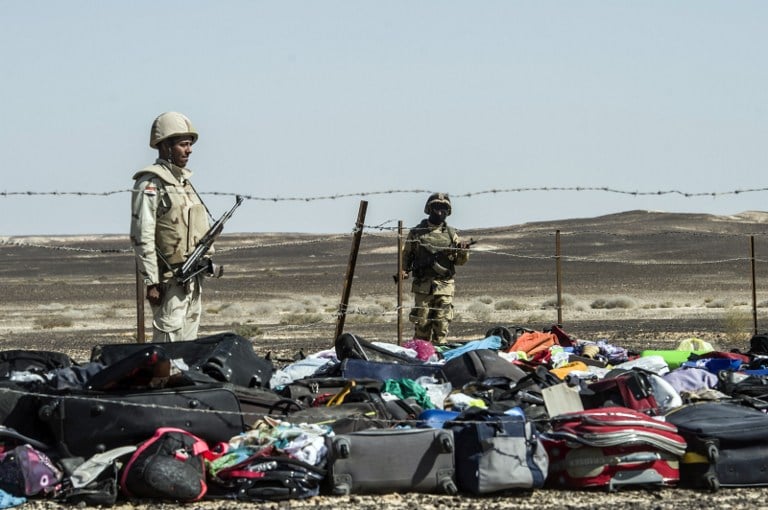
A British team is working to tighten security at the Sharm el-Sheikh airport with an eye toward resuming flights. Cameron said, “We want to start as soon as possible” to bring some 20,000 British tourists home, and empty planes will be flying out from Britain to do that, but it would take some time.
British Transport Secretary Patrick McLoughlin said Egypt would have to put in place tighter long-term security measures before British flights would resume. He told the House of Commons on Thursday that British security teams sent to Sharm el-Sheikh “will be working intensively with the Egyptian authorities to allow normal scheduled operations to recommence.”
McLoughlin said short-term measures, including different luggage-handing arrangements, would allow the estimated 20,000 British citizens in the Sharm el-Sheikh area, many of them tourists, to fly home.
Egypt’s minister of civil aviation, Hossam Kamal, insisted Thursday that the country’s airports do comply with international security standards and said “the investigation team does not have yet any evidence or data confirming this hypothesis” of a bomb bringing down the plane.
A spokesman for Putin, Dmitry Peskov, insisted that aviation investigators were working on all possible theories as to why the Airbus A321-200 crashed Saturday in Egypt’s Sinai Peninsula 23 minutes after taking off. He said naming just one possibility was mere speculation.
“One cannot rule out a single theory, but at this point there are no reasons to voice just one theory as reliable — only investigators can do that,” Peskov told reporters in Moscow.
Egyptian officials have condemned Britain’s travel ban as an overreaction. Egyptian President Abdel-Fattah el-Sissi, who was in London on a visit Thursday, has called the IS claim “propaganda.”