Can Erdogan create a rock so heavy he cannot lift it?
After a coup attempt failed to oust him from power, Israeli papers see the Turkish leader as 'omnipotent,' and take a hard look at what the Nice terror attack means for Jews and Muslims
It should come as little surprise that a failed coup in Israel’s new best friend Turkey over the weekend dominates the print media landscape in Hebrew Sunday morning, but what’s less obvious is that all three would essentially come away with the same story: The coup was doomed to fail and President Recep Tayyip Erdogan is an unstoppable force, for better or worse.
Together with the terror attack in Nice, the total enormity of which only became clear as weekend editions were rolling off the printing press early Friday morning making Sunday the first opportunity for papers to cover it, the two stories are pretty much the only thing given real estate in the Israeli print press, taking up 58 pages of a 72-page news hole across all three major dailies.
Yet the ways in which papers balance the two stories, and the way they play each one, are a study in how they serve their own internal agenda and the perceived tastes of their core readership.
Populist Yedioth Ahronoth, for instance, knows that what sells is gore and glory and that big news requires changing the rules of the game somewhat. Thus the tabloid calls its back page into service as a front page, creating a double truck (twice as wide) landscape A1, split between bodies strewn on the Promenade des Anglaise in Nice, France, and what looks like a future propaganda poster of people riding a tank and waving Turkish flags in Istanbul as the Coup-That-Wasn’t was turned back.
The color red – you don’t need to have a degree in color theory to understand the significance of the shade — plays heavily in both main headlines “The victory of Erdogan” and “The tears of France.” But in case you didn’t get it though, the paper spells it out in black and white.
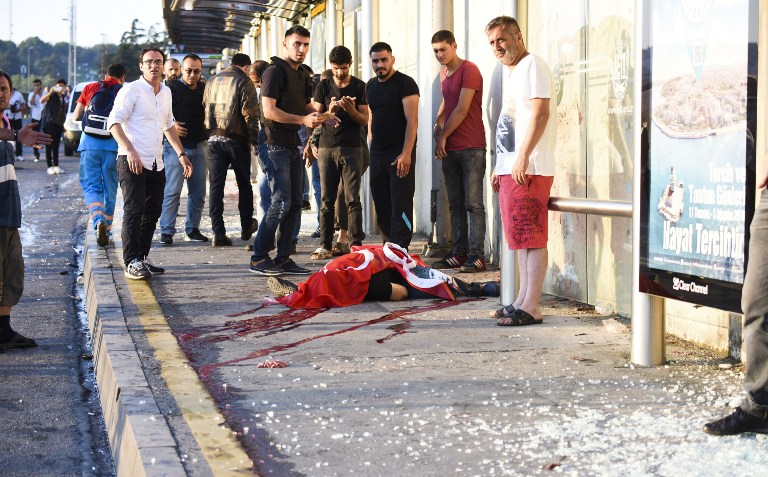
“Turkey’s red weekend: After a dramatic coup attempt Friday night, Istanbul’s streets were colored in red: The blood of the plotters who were beaten to death, alongside the red flag of Turkey, which Erdogan’s supporters were quick to wave at every corner. The civilians stopped the tanks, the rebellion failed, long live Sultan Erdogan,” the paper writes to lead off its main news story, accompanied by a picture of soldiers being beaten, and a graphic photo of a dead body with rivers of blood, twisted impossibly, and covered with a Turkish flag and picture of Kemal Ataturk.
While Yedioth’s front page shows touches of broadsheet sensibility (at least in its size) Haaretz leans into tabloid territory by going with big pictures and few words on its front page, though it dispenses with the gauche touches of colors employed by its competitors. Instead the broadsheet – which likes to bill itself as the thinking man’s paper, goes heavy on the analysis, including a couple of columns that see strongman Erdogan as stronger than ever and try to break down why the coup failed.
“Lacking a popular opposition leader or competing candidate within the ruling party, which is run like a military unit, Erdogan’s political rivals believe that for the foreseeable future he cannot be replaced by democratic means. This might have been the basis for the attempted coup. However, it clashed with public sentiment, which was stronger. People might hate Erdogan but they hate a coup more. In that kind of atmosphere the army cannot be thought of as the savior of the state, especially not after 14 years of successful civilian rule,” analyst Zvi Bar’el writes in a column in which he describes Erdogan as “omnipotent.”
Israel Hayom does what it does best, which is couch the news in its worldview – which just so happens to be the official worldview of the Israeli government. The paper, which a month ago likely would have joined in the coup against Erdogan, now seems to see him in a more favorable light, apparently the fruit of a recently signed détente deal with Turkey.
The paper’s correspondent in Istanbul comes away with a similar take to Bar’el and the others, also writing that with the coup turned back, the president can push through a number of reforms, consolidating power and “becoming more than ever an omnipotent leader.”
The paper’s columnist Eyal Zisser uses the same word – omnipotent – to describe what Turkey’s army is no longer: “The army has turned from bulldog into cute pet, and is no longer able to do whatever it wants in the country.”
The clear picture on Sunday morning of a powerful Erdogan and cowed opposition was less clear in the chaos of Friday night, as the coup got underway and uncertainty swept the streets of Istanbul. In Yedioth, local journalist Tulin Dialoglu describes the fear and uncertainty she felt in the first shaky – literally, from the sounds of explosions – hours of the unrest.
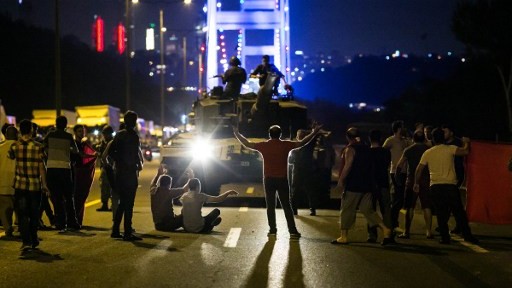
“The night turned more surreal as tanks took up positions at the entrance to the airport, blocked traffic and caused a huge jam. Similar things took place on both sides of the Bosphorous,” she writes. “I hurried home with my eyes wide open the whole time. A little after midnight, there was another fighter jet flying low, this time over my building. As someone who has covered the wars in Afghanistan and Iran, I never thought I would see sights like this over my home.”
While coverage of Turkey is wide as the Bosphorous, the papers have little in the way of any localization with an Israel connection. Yedioth, clearly seeking to shoehorn some blue and white among the red, reports that many of the tanks seen in the streets of Istanbul had Israeli equipment.
Going for a bit more substance, Haaretz’s Barak Ravid notes that Israel’s response to the coup was both late in coming and “laconic,” but not without reason.
“In light of the great sensitivity in Israeli-Turkish relations and the fact that the reconciliation accord was still in its infancy, the Foreign Ministry decided not to rush to comment but wait until things cleared up, watching how the international community was responding to events,” he writes. “Senior officials in Jerusalem said that it was important for Israel to emphasize that, on the one hand, what happened in Turkey didn’t diminish Jerusalem’s wish to normalize its relations with Ankara; and on the other, to send a polite warning that no one in Turkey should think of using the attempted coup as an excuse to violate the freshly minted agreement.”
Leave France, and leave Muslims alone
If Israel was on unsure footing with what to do with Turkey, it had no doubts when it came to responding to the Nice terror attack, and that certitude is reflected in the heavy play given the story by Israel Hayom, which devotes considerably more space to the Nice truck-ramming attack than the goings-on in Istanbul.
As Prime Minister Benjamin Netanyahu did after the Hyper Cacher attack last year, Israel Hayom’s Aviad Friedman, spending Shabbat in Nice, uses the opportunity of terror to call the Jews of France home to Israel.
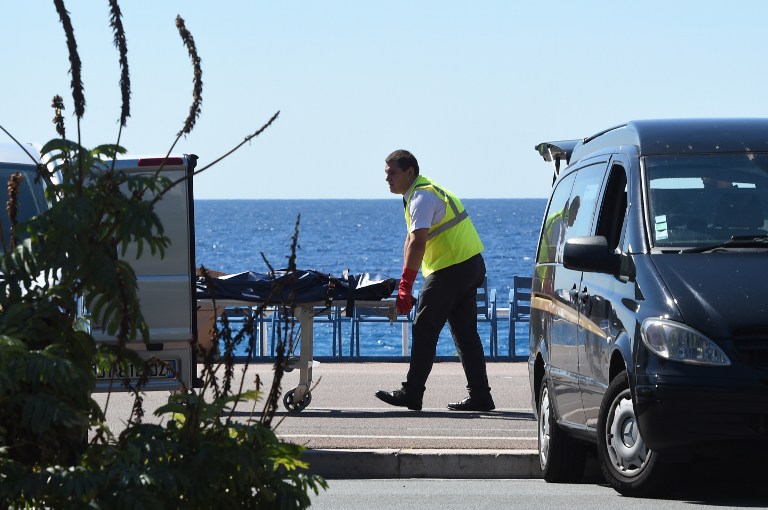
“This Shabbat many local Jews, including those who don’t normally attend, came to synagogue. A large number of them were there during the attack, went to see the fireworks like every year and were caught in a catastrophe. Those who weren’t there know someone who was, and everyone has a lot to tell,” he writes. “As someone used to dealing with building communities in Israel, I know how much strength community has in times like this. And indeed the synagogue in Nice was packed but what about those that didn’t come. Nice has a warm Jewish community and they are all close to Israel. Many of them own properties there, especially in Netanya, Tel Aviv and Jerusalem. Properties they bought for a rainy day. Has that day come? In conversations with locals, many Jews said the elections next year would be a turning point. If they far right rises, it will be a sign to flee. And if not, they can continue to put a hat over their skullcap, bolster security and stay in Nice.”
While Friedman is worried for the region’s Jews in the wake of the truck attack, Haaretz’s Amira Hass has concerns over what it could mean for Muslims, writing that what she sees as a rush by France and the Western world to blame the Islamic State plays right into the jihadi group’s hands.
“Both ISIS, for its own reasons, as well as its enemies and victims want to give the horrific slaughter ‘significance’: It is easier to place it in the context of the big, eternal picture of a dichotomist war between good and evil (the West versus jihadist Islam, or vice versa), than to explain it as the actions of a disturbed, violent, frustrated, unbalanced loner, a petty male criminal,” she writes. “With that as the interpretation for the mass attack, France is preparing a security-related solution — extending the state of emergency, upgrading surveillance methods and administrative detention of the ‘population with tendency’ (that is, the Muslims) — and intensifying war (through more assaults and increased military involvement in Syria and Iraq). These are precisely the solutions that frighten and worry leftists and writers of Muslim origin living in the West. They believe that these solutions create just the division that ISIS wants – between Muslims living in the West and the rest of the population.”