Century-old mistake fixed as Stars of David put on headstones of US Jewish WWI troops
Operation Benjamin replaces crosses on graves of the three American servicemen; ceremony also honors non-Jewish POW who protected Jewish comrades in WW2
More than a century after three Jewish American soldiers died fighting in World War I, their graves at Arlington National Cemetery were fixed this week to reflect the faith under which they should have been buried.
The headstones of US Army Pvt. David Latken, Cpl. Jacob Leifer and Pfc. Benjamin P. Yarish were replaced during a ceremony on November 17, removing the Latin crosses that had marked their graves and replacing them with Stars of David.
The three soldiers all died while serving in France during World War I before their remains were eventually returned to the United States and buried at Arlington. Operation Benjamin, a group dedicated to finding Jewish American servicemen whose military graves incorrectly identify their religion, researched their cases and worked to amend the error.
According to the organization’s account of the three soldiers, Latken died from wounds sustained during the Meuse-Argonne offensive in 1918; Leifer died after being severely wounded by poison gas during the same campaign; and Yarish was killed while fighting with the famed “Lost Battalion,” which was surrounded by German forces in the Argonne Forest for five days.
Asked by CNN how Jewish soldiers could have ended up beneath Christian markers, Operation Benjamin co-founder and chief historian Shalom Lamm pointed to the enormous administrative difficulties of identifying and reburying the war dead more than a century ago.
“The complexity, the number of soldiers they were dealing with in an age before computers, the clerical error crept in because they were buried initially on the battlefield in a shallow grave by their comrades,” Lamm told CNN.
For over a century, Jewish World War I soldiers rested beneath the wrong headstones at Arlington National Cemetery. Now they’re receiving new headstones commemorating their Jewish faith. pic.twitter.com/Gr0pLfPNKh
— The Lead CNN (@TheLeadCNN) November 19, 2026
He explained to the network that the remains were then moved repeatedly; first to collection points and larger regional cemeteries and ultimately to permanent military cemeteries, meaning that a soldier might have been reburied “four or five” times before reaching his final resting place.
For some descendants, the organization’s research has also uncovered relatives whose stories had disappeared from family memory. Leifer’s 85-year-old great-nephew, William Taubman, told CNN he did not even known his great-uncle existed until recently.
“He is remembered and his service is remembered and the sacrifice of him and others is remembered, and that is wonderful,” Taubman said.
“We get to introduce loved ones to their families who they never knew,” Lamm added.
Operation Benjamin has now corrected more than 70 grave markers of Jewish American soldiers who served in World War I and World War II, according to CNN.
The nonprofit is named after Pvt. Benjamin Garadetsky, a Jewish American soldier whose grave at the Normandy American Cemetery was marked by a Latin cross until the group’s work led to its replacement with a Star of David in 2018, according to the organization’s page.
Operation Benjamin has previously been involved in other efforts to restore the identities and Jewish burials of fallen American servicemen. In 2024, the remains of Jewish US Army 1st Lt. Nathan Baskind, who was killed shortly after D-Day and had spent 80 years in a German mass grave, were identified through DNA testing and reburied under a Star of David at the Normandy American Cemetery.
The Arlington ceremony this week also honored a fourth American serviceman, Pfc. Johann “Hans” Kasten, though his story was different from those of the three Jewish soldiers. Kasten, who was not Jewish, was captured during World War II’s Battle of the Bulge and became the elected leader of American prisoners of war held at Stalag IX-B in Bad Orb, Germany.
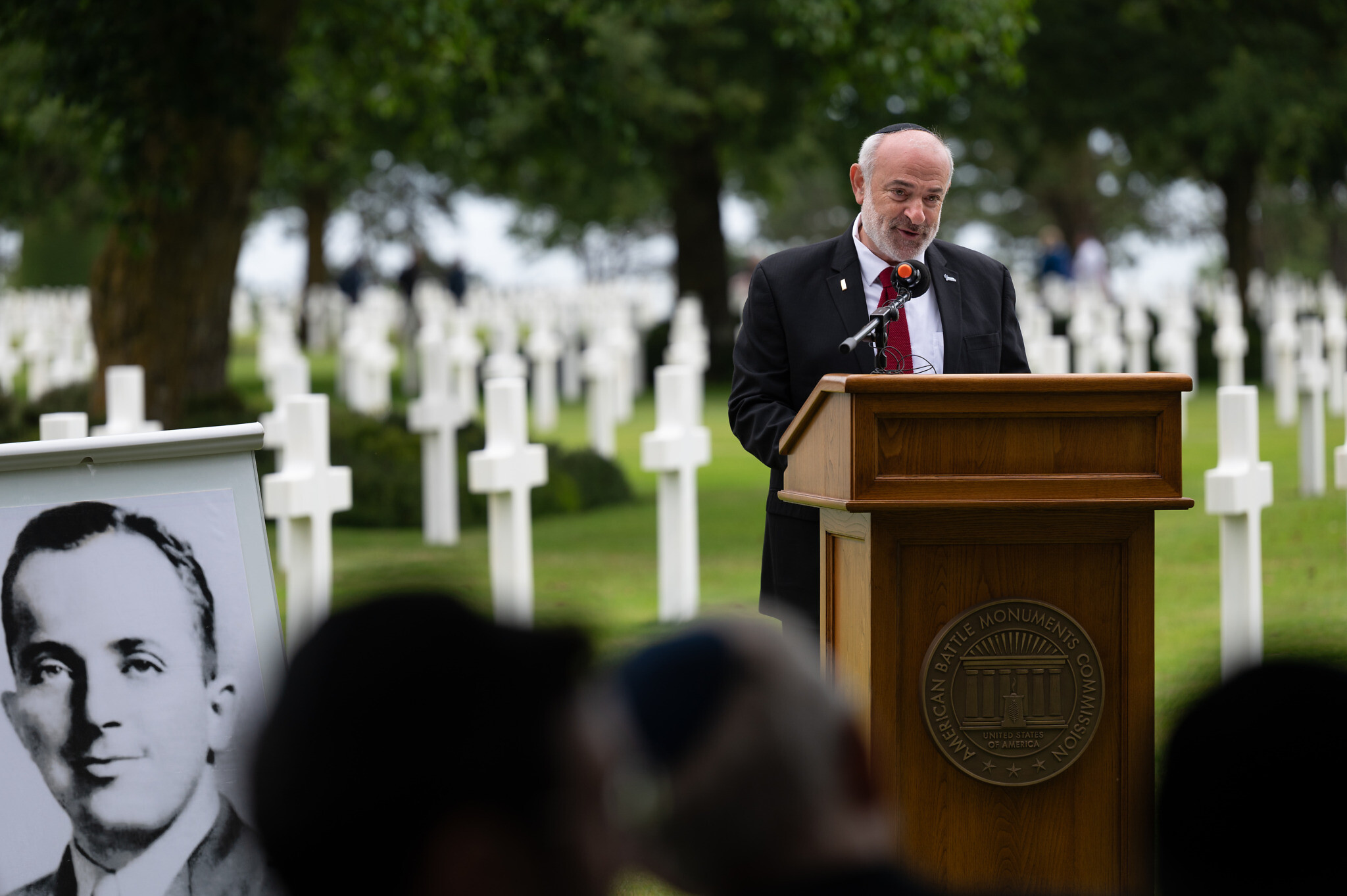
When the German commandant ordered Jewish American POWs to identify themselves so they could be separated and transferred to the Berga labor camp, which was associated with the Buchenwald concentration camp system, Kasten refused to provide their names.
He told his captors, while being tortured, that the US Army did not distinguish among its soldiers by religion and instructed other POW leaders that no prisoner should admit to being Jewish, according to Operation Benjamin.
Kasten’s grandsons placed memorial stones on his grave during the Arlington ceremony, CNN reported, honoring a soldier who risked his own life rather than turn over his Jewish comrades.