
|
|

|
Dear Times of Israel Community, The 2011 deal to free abducted soldier Gilad Shalit from five years of Hamas captivity in Gaza was impossible to justify at the time — because releasing 1,027 Palestinian security prisoners, many of them serving multiple life terms for murdering Israelis, was always certain to lead to the loss of many innocent lives. The fact that Yahya Sinwar, architect of the barbaric October 7 massacres in southern Israel, was among those set free underlines, to the most horrific extent, the scale of that catastrophic strategic miscalculation. Today, however, Israel’s government, under the same prime minister, faces a far more complex dilemma. As we knew it would, Hamas is using the remaining 132 hostages it has held since October 7 as leverage to try to survive Israel’s campaign to destroy its military capabilities, to maintain its hold on Gaza, and to secure the release of all Palestinian security prisoners today in Israeli jails — some 8,600 in all, including about 1,000 who either participated in the October 7 slaughter or have been captured in the course of the ongoing war since. The weeklong truce at the end of November saw the release of 104 hostages, Israelis and others, at the relatively minor cost of 240 Palestinian prisoners freed. The Hamas demands this time are of a whole different order, and acceding to them in full would have immense strategic implications. And so would rejecting them.  The state and its defense establishment failed the people of Israel on October 7. The failure remains unconscionable and unfathomable. The nation has yet to fully come to terms with the lives lost that day. But the lives of the hostages — or at least some 100 of them — can still be saved. (Twenty-nine have been officially declared dead.) Most of those who have to date suffered an unthinkable 117 days in the hands of Gaza’s savage terrorist government were civilians kidnapped from their homes and communities and the Supernova music festival, as others were being burned alive and executed and raped all around them. Israel has rightly made their release one of the two prime requirements of the war, along with dismantling Hamas. It simply cannot and must not fail them again — for their sakes, for the sakes of their loved ones, and for the sake of an Israel that needs to know that its defense establishment has regained its capacity to safeguard its people.  But conceding in full or large part to Hamas’s demands would have the opposite effect. It would relegate the vital national interest in destroying Hamas — the cause for which the IDF has been fighting these past 117 days, with soldiers risking their lives and, in 223 cases thus far, losing their lives. It could enable Hamas to survive, rearm, and repeat October 7. It could further embolden Israel’s other, more powerful enemies. It could leave the tens of thousands of Israelis forced from their homes in the Western Negev, and tens of thousands more near the northern border, unable to return. It could render Israelis everywhere in the country perpetually fearful for their basic security. It would discredit and marginalize non-extreme Muslim individuals, groups and governments. The IDF’s war against Hamas has been going “better than expected,” Prime Minister Benjamin Netanyahu said earlier this week. Indeed, the IDF has overall control in northern Gaza, has withdrawn most of its forces from the heart of that area, and is now engaged in the anticipated lower-intensity mop-up operations and targeted raids against what are assessed to be some 2,000 Hamas gunmen out of an original 14,000 there — the rest being dead, injured, fled or captured. A similar process is underway in central Gaza. And in the south, Khan Younis — where the IDF has largely destroyed two of the four Hamas battalions, and is now tackling the other two — is not far behind. 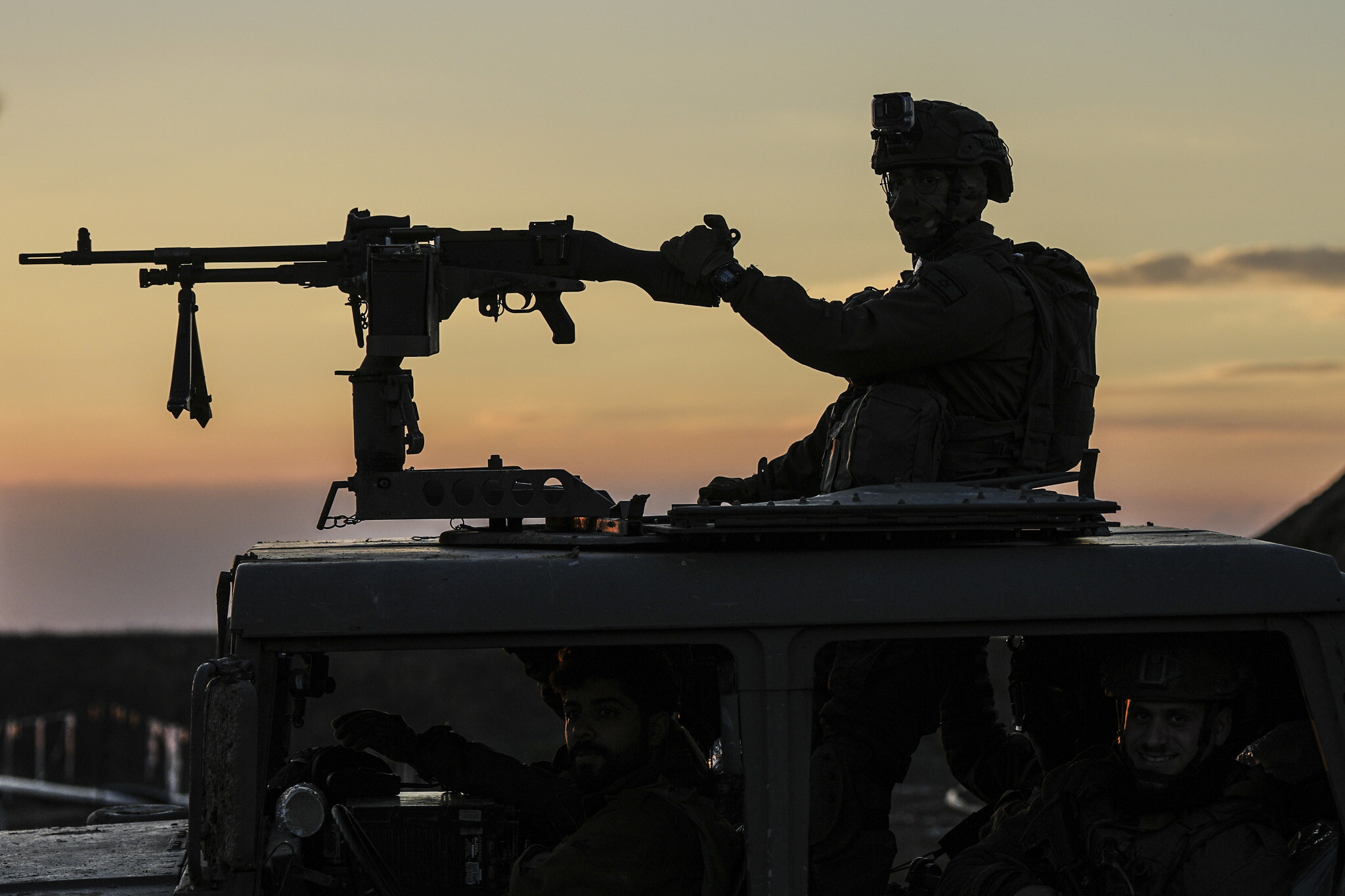 But Hamas has not been confronted in Rafah — where it may well be that Sinwar and his fellow chiefs are hiding out, with hostages for protection — in part because operating in that town on the Gaza-Egypt border requires coordination with Egypt, which the political echelon has thus far been unwilling or unable to attain. If Hamas is allowed to remain potent in Rafah, then it would certainly exploit any pause in the fighting as part of a hostage deal to reorganize and rearm its forces elsewhere in the Strip. For now, as the former IDF operations chief Yisrael Ziv summarized in an Army Radio interview on Wednesday morning, Hamas has switched to guerrilla warfare in those parts of Gaza where its battalions are no longer functional. It has commandeered the trucks of humanitarian aid flowing into the Strip — and is profiting financially from the distribution, as well as underlining its continuing governance capabilities. Because of the Israeli government’s refusal to substantively debate, much less begin to organize, alternative internal civil governance in Gaza, Hamas — assisted by UNRWA — unthinkably remains the only governance game in town. It’s in this context that Sinwar, though certainly aware that his battalions have proved no match for the IDF, rather than broadcasting desperation is making demands that Israel dare not meet for the hostages that Israel must not abandon. Riven at the topThirteen years after Netanyahu made the wrong decision with the Shalit deal, the dilemma facing the prime minister and his colleagues this time is acute and unenviable. It also appears to be politically almost impossible. War cabinet minister Benny Gantz and war cabinet observer Gadi Eisenkot argue that the hostages must take priority right now, and that Israel, in Gantz’s words, may be fighting Hamas for “an entire generation.” On the far-right of the coalition, however, Bezalel Smotrich and Itamar Ben Gvir are dead set against the release of Palestinian security prisoners, and Ben Gvir on Tuesday threatened to bring down the government if a “reckless” deal were struck. Netanyahu, choosing his words carefully, vowed, in response, that Israel will not release “thousands of terrorists” or withdraw the IDF from Gaza as part of a deal, and that the war will not end without “total victory.” 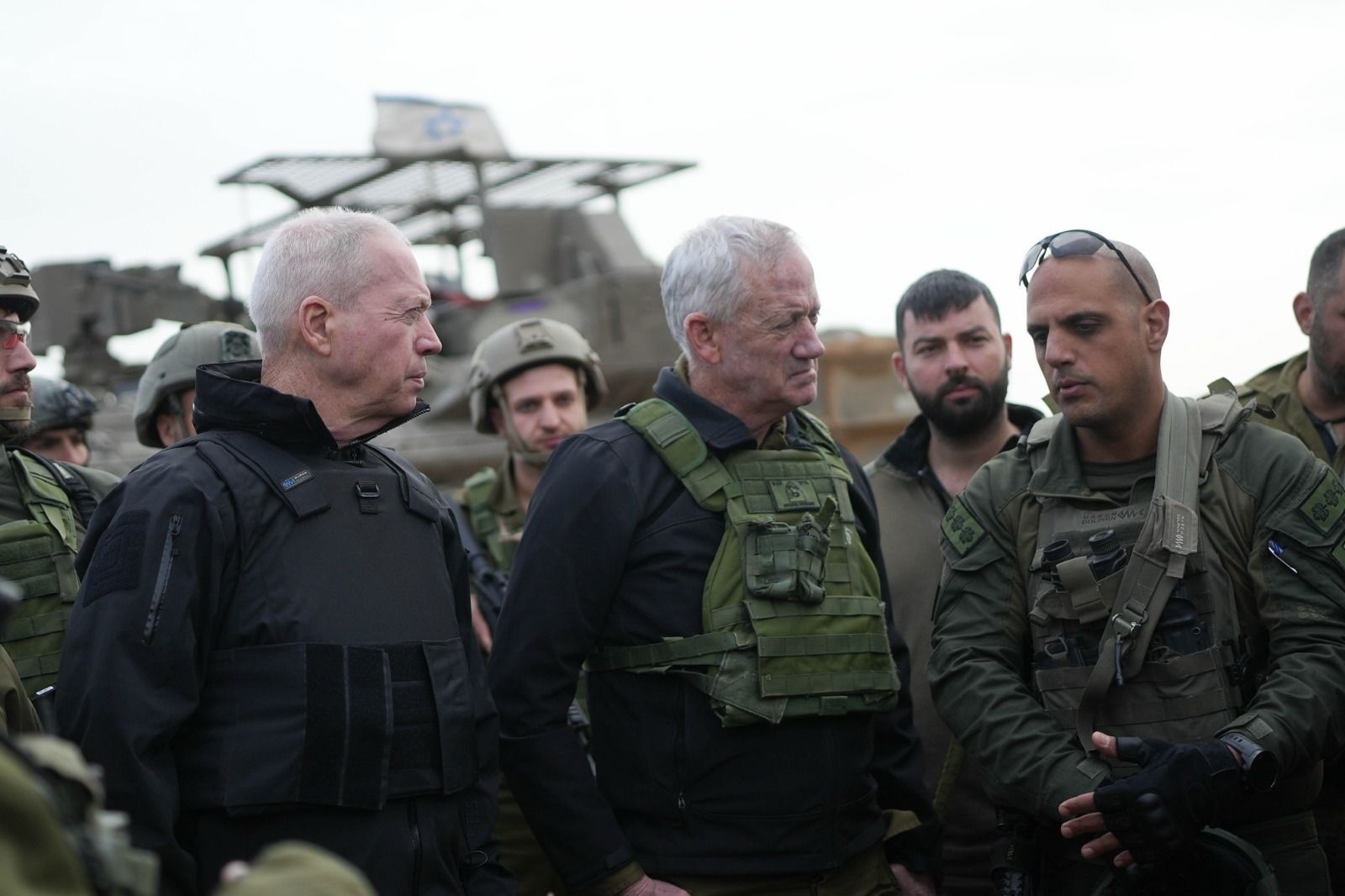 Is there a middle ground through all of this that can enable Israel to achieve those two essential goals — dismantling Hamas and returning the hostages? It is hard to imagine Hamas significantly moderating its demands unless or until Sinwar feels the terror group’s survivability prospects are far dimmer than he thinks they are today. He may have believed Israel would find it hard to resume the war when he was negotiating the November truce on relatively mild terms, and will not easily make that mistake again. And yet, with the US election campaign heating up, mounting impatience, anger and opposition to Israel in the international community — bolstered by a ruling of the International Court of Justice that stained Israel with a genocide allegation, even as its practical orders made plain that it does not believe the claim — perhaps the key question at this fateful moment is whether Israel would indeed be able to restart its campaign in Gaza after the six- to eight-week pause that is reportedly at the heart of the current hostage deal framework. The IDF, military sources indicate, feels that it would indeed be capable of resuming the war even after a protracted halt to enable the freeing of the hostages. It assumes Hamas would have partially regrouped, that there would be heavier fighting in areas where it had previously established primacy, that it would not be picking up where it left off — but that it would again be able to reassert control. But what of the international community, and especially the United States, without whose diplomatic and, especially, practical support Israel simply cannot fight for long?
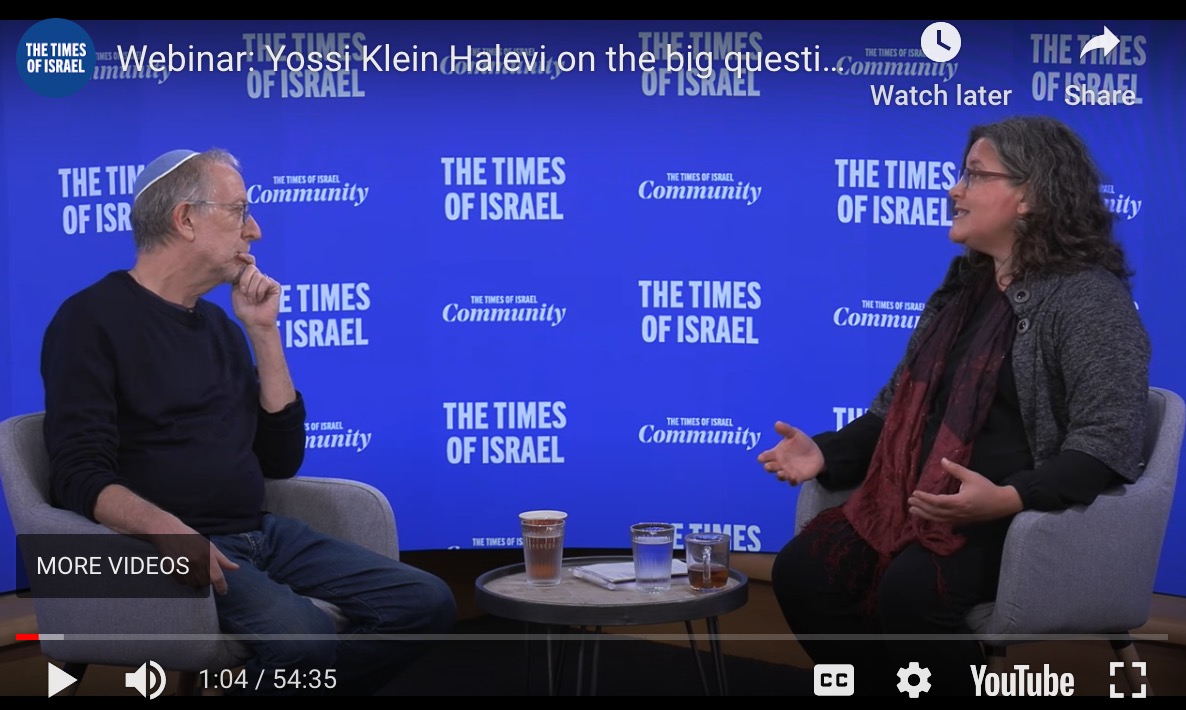
Webinar replay: Yossi Klein HaleviWe had a very special webinar last week with noted author Yossi Klein Halevi, exclusive for the ToI Community, addressing some of the big questions that this war raises for the state of Israel and for the Jewish people. If you didn’t watch the webinar yet, we encourage you to do now at your convenience. Simply login to your ToI Community account on our site and you can view the recording here:
Any difficulties signing in and viewing the webinar? Write to us and we’ll help you out.
Israel Story: Wartime Diaries with Maya German and Benjamin FainsodOur podcast partners at Israel Story continue to bring you remarkable voices and testimonies that paint a picture of these devastating times in Israel. Click below to hear the newest episode of the special Israel Story series ‘Wartime Diaries,’ which takes us to a place that is, under normal circumstances, one of the most visited sites in the entire country – Jerusalem’s Biblical Zoo, or as it’s officially known, The Tisch Family Zoological Gardens:
** Israel Story is produced in partnership with The Times of Israel.
🙋 Have something to share?We’d love to hear it! Join the discussion on our active ToI Community Facebook group. Keep tabs on new content and events on our Community Page. And please don’t hesitate to write to us with any suggestions, issues or questions. Thank you for your continued support of our independent journalism. ~ The Times of Israel Team |

|
You are receiving this email because you are a member of The Times of Israel Community. If you would like to stop receiving community updates, please click below to unsubscribe.
|