Hundreds of Haredi protesters clash with cops at army draft demos; 33 arrested
Police use water cannons, mounted officers to clear demonstrators who halt traffic on main highways at rush hour
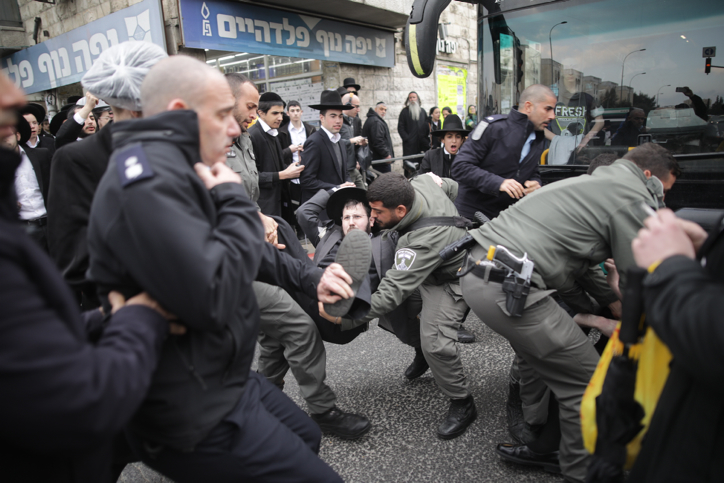
Police used water cannons and mounted officers on Thursday as they attempted to prevent hundreds of ultra-Orthodox protesters from blocking main roads during rush hour in a series of demonstrations over a draft dodger. At least 33 protesters were arrested.
A small section of the ultra-Orthodox community has been holding nightly protests this week against the police detention of a Haredi man arrested for failing to appear at a draft office.
The protests were stepped up Thursday after police extended the arrest of the 24-year-old draft dodger for an additional 10 days.
The demonstrators blocked major thoroughfares across the country, bringing traffic to a halt during peak rush-hour at the start of the weekend. They brought traffic to a near standstill on Route 1 — the main highway between Jerusalem and Tel Aviv — after running on to the road and blocking vehicles at the Latrun Junction, a major intersection.
Police later reopened the road.
In Jerusalem, mounted police charged protesters and others were hit with water cannons as they staged a sit down at the Bar Ilan Junction, a main thoroughfare leading out of the capital.
Police said prior to the protests that while it respects the “freedom to protest,” it “will not enable disturbers of the peace to violate the law and endanger the lives” of Israeli citizens.
Ten protesters at the Bar Ilan Junction were reportedly arrested by police. The ultra-orthodox men yelled slurs at police officers removing them from the road, including calling female police officers “shiksa,” a pejorative Yiddish term used for non-Jewish women, according to Hebrew media reports.
Many in the ultra-Orthodox community shun the mandatory military service that applies to most Israelis, and the community has historically enjoyed blanket exemptions in favor of religious seminary studies. But some in the religious community refuse to even appear at the recruiting office to request such exemptions in protest against the state.
Without getting an exemption, those Haredi men are legally considered draft dodgers and open to military detention, as was the case with the 24-year-old yeshiva student earlier this week.
In addition to the arrests in Jerusalem, two others were taken in by police in Beit Shemesh, which has a large ultra-Orthodox population. There were also protests reported in the cities of Bnei Brak, Ashdod, El’ad, Beitar Illit and at the Shilat Junction, near the city of Modiin.
On Wednesday, Defense Minister Avigdor Lieberman said he would take action against ultra-Orthodox yeshivas whose students participated in the protests.
“Minister Liberman will never, under any circumstances, ignore these riots and the severe incitement that occurred during them against IDF soldiers,” his office said in a statement.
In response to the protests, Liberman asked Israel Beytenu MK Oded Forer to “work with relevant government ministries to stop the funding” of the Ma’alot HaTorah yeshiva in Jerusalem and the Grudna yeshiva in Ashdod, which are both led by Rabbi Shmuel Auerbach, a staunch anti-draft advocate.
“This is in response to the riots and inciting protests that were held by Rabbi Auerbach’s students over the arrest of an IDF draft-dodging yeshiva student,” Liberman said.
The defense minister also ordered his ministry to reconsider the automatic draft deferral granted to students of those two yeshivas, his office said.
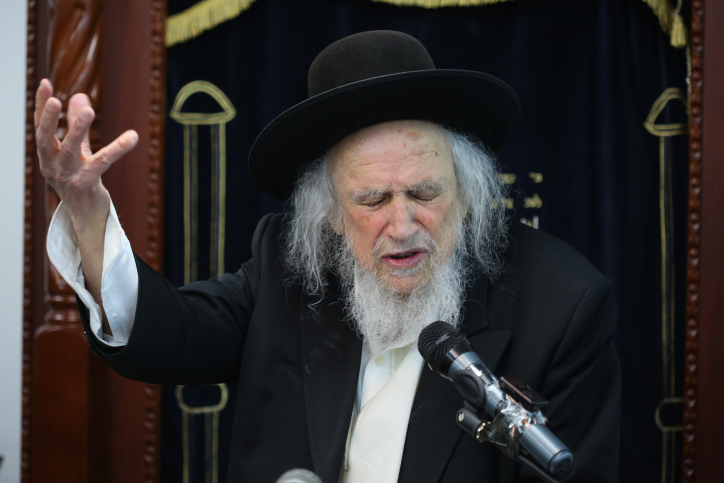
While some ultra-Orthodox rabbis have begun encouraging their communities to join the military, others — including Auerbach — have maintained staunch opposition to the practice on ideological grounds
Reforms passed in the Knesset in 2014 that sought to do away with the exemptions and gradually increase ultra-Orthodox recruitment met fierce opposition from many in the religious community, who perceive the army as a threat to their way of life.
In late November, the Knesset approved an amendment to the Equal Service Law, dramatically rolling back 2014 reforms and scrapping collective penalties to be imposed if annual quotas for ultra-Orthodox draftees were not met.
Stuart Winer and Judah Ari Gross contributed to this report.