Coverage of primaries a day late and a point short
Papers finally get their chance to weigh in on Trump's big win but bring little new to the table, and Haaretz shows its united colors of Bennett dislike
Never mind the fact that by the time Israel’s print newspapers hit the street on a soggy Monday morning, much of the US had already moved past the weekend’s American presidential primaries.
Never mind the fact that an overwhelming majority of Israelis can’t participate in the American democratic process.
Never mind the fact that it’s still so early in the race that nobody in Israel should really care that much about the gear-like machinations of both main parties as they pick a candidate.
Monday morning represented the first shot for Israeli print journalists to weigh in on the race and catch up with the rest of the world in looking ahead to Super Tuesday, and they will be damned if they aren’t going to get their two cents in.
Thus Donald Trump’s South Carolina victory, Hillary Clinton’s razor-thin win in Nevada and Jeb Bush finally bowing out make the front pages of two of Israel’s three main dailies Monday morning, after a day which saw little in the way of a major agenda-dominating story in Israel.
Under the headline “Next stop Super Tuesday,” (transliterated and assuming Israeli knowledge of something many Americans don’t even know/care about), Israel Hayom reports that Trump is cruising toward victory with 67 delegates in his pocket “but the race is far from over.”
Analyst Boaz Bismuth comes to the same conclusion many others reluctantly were forced to make peace with after South Carolina, that Trump isn’t a flash in the pan but may actually be the Republican presidential candidate.
Despite that, though, Bismuth notes that the loud-mouthed New Yorker may have to be less himself if he really wants to wrap this thing up.
“Trump is in a slightly troubling situation,” he writes. “He needs to expand his circle of supporters, and for that he may need to even endear himself to the base. On the other hand, his strategy of going after others, which has got him this far, would seem to advise that he continue going after everyone. What to do? Trump will need to gamble.”
Despite the adage that all politics is local, the paper makes no effort to localize the story for Israeli interests, leaving the coverage as little more than Jonny-come-lately reportage useful only to Internet-averse Hebrew-speakers.
Haaretz, assuming its readers have logged on, does away with any pretense of straight news coverage and jumps right into a news-feature-commentary hybrid by US correspondent Chemi Shalev, which seems to lack any coherent thesis beyond being a roundup of everything going on in the US races, including a mini guide on which GOP candidate Israelis would vote for if they could.
“From the point of view of ‘who’s good for the Jews,’ the question is which Jews we’re talking about. Cruz could probably find a home in the radical wing of Naftali Bennett’s Jewish Home party, though his neo-isolationist views could pose a problem. Rubio the conservative neoconservative would feel right at home with Benjamin Netanyahu in today’s Likud, though Sheldon Adelson hasn’t given his official blessing yet,” he writes. “Trump should probably be the preferred candidate of Israeli lefties and American two-staters, if only because he is inconsistent and irreverent and always ready to slay a sacred cow or two and on condition that one is able to quench the stench of his chauvinist and racist statements.”
Yedioth doesn’t seem to care much about the primaries and in its stead makes the strange decision to lead its paper off with coverage of a different race altogether: competition between two new smartphones entering the market.
While the decision to put phones over politicians may seem odd, truth be told, out of the two stories, the phone one is more likely to affect Israelis directly, at least in the short term.
The paper covers the releases of the fabulously named Samsung Galaxy S7 and LG G5 like a political race with headlines like ‘head to head,’ and ‘war of the Androids,’ and gives the basic consumer reports rundowns of what is in each model, plus when they will be available in Israel (March and April respectively).
As if that weren’t enough, the paper also rounds off its coverage with an analysis of the smartphone releases, which is about as interesting and insightful as you would expect it to be.
Bend it (to your will) like Bennett
The paper’s smartphone fixation may be weird, but it’s nothing compared to Haaretz’s apparent obsession with Education Minister Naftali Bennett.
If Israel Hayom is the Bibiton (a portmanteau of Netanyahu’s nickname and iton, the Hebrew word for newspaper) then Haaretz can be dubbed the Bennetton, though unlike Israel Hayom, the lefty broadsheet’s colors are united around criticism of the hawkish minister and his policies, not praise.
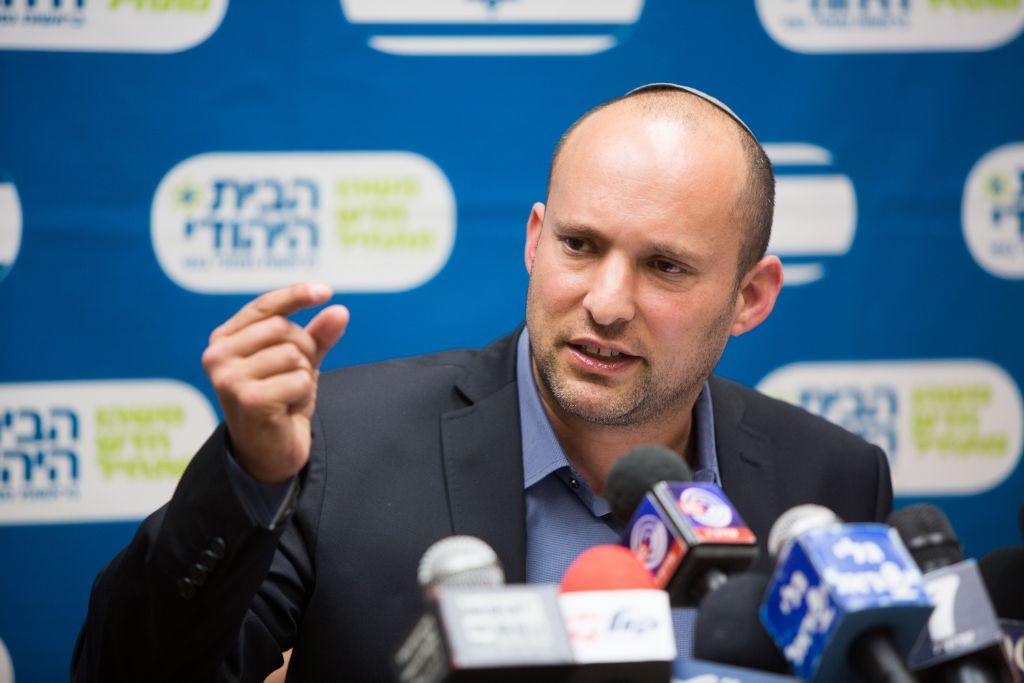
The paper, which has given Bennett noticeably outsized coverage for weeks, leads off with a report that six members of the Council for Higher Education, which oversees university education in Israel, have quit in protest of his decision to replace the head of the panel, which members say constitutes political meddling in the body.
“We don’t want to be part of a council that damages its independence and the future of higher education in Israel,” Moshe Maor, one of the members who resigned, is quoted saying. “There is a misunderstanding here of the essence of the council, the role of the council and the spirit of the panel.”
It’s not just education matters that have the paper watching Bennett like a hawk, but also security matters. The paper runs another story quoting him accusing Palestinian parents of allowing their children to carry out attacks against Israel, hoping for a payout from the Palestinian Authority when they get arrested or killed.
“Several ministers said that Israel should work to block transfers of funds from the PA to terrorists’ families. The ministers were told that every month Israel deducts what it estimates the PA pays to terrorists’ families before it pays over the taxes it collects on the PA’s behalf,” the paper reports, citing a source familiar with the Sunday cabinet meeting where the exchange took place. “At that point Bennett said that this deduction is not enough, and that an effort must be made to keep the families from getting money. He said the fact that families know they’ll get funds from the PA reduces their motivation to prevent their children from carrying out attacks. Bennett refused to comment for this report, saying the debate had been classified as top secret.”
The debate was sparked by comments by IDF chief Gadi Eisenkot days earlier in which he seemed to criticize police use of firepower against some Palestinian attacker.
In Yedioth, Yossi Yehoshua noted the upshot of Eisenkot’s trigger-shy policy, as seen during two of three attacks Sunday that ended in arrests and not funerals.
“In both cases the soldiers acted as anyone, assuming they are not an Israeli politician, would have been expected to act. The result: A terrorist arrested and not killed, thus there’s no stormy funeral, no bereaved family that enters the circle of the terror and promises to avenge the blood of their son, and no mourners tent in which Hamas can preach murder,” he writes. “What there is is soldiers who did their duty as demanded of them.”