Dating app takes aim at Mideast conflict
Tinder-like Verona seeks to connect Israelis and Palestinians for love, not war
There have always been Israelis and Palestinians ready and willing to talk. Now, they can also swipe — thanks to a new smartphone dating app that connects members of the two national groups for friendship, romance and whatever else they seek.
The Verona app (its name references the Italian city where Shakespeare’s star-crossed lovers Romeo and Juliet lived…and died in the end) was introduced in a beta version in mid-March. According to founder Matthew Nolan, it is already a “runaway hit,” with approximately 2,000 users to date and many more joining daily.
The idea for the free Tinder-like dating app was prompted by a conversation Nolan and some friends had after a Valentine’s Day party in New York this past February. They were discussing art projects aimed at promoting world peace, and a Palestinian in the group mentioned that something like that would be nice for him and his Israeli girlfriend.
Nolan, who is neither Palestinian nor Israeli and has never been to Israel or the Palestinian territories (but whose girlfriend is Jewish and went on a Birthright Israel trip), decided to apply his conceptual art school training and professional app development skills to the challenge.
“I saw an opportunity to do something positive,” said Nolan, 31.
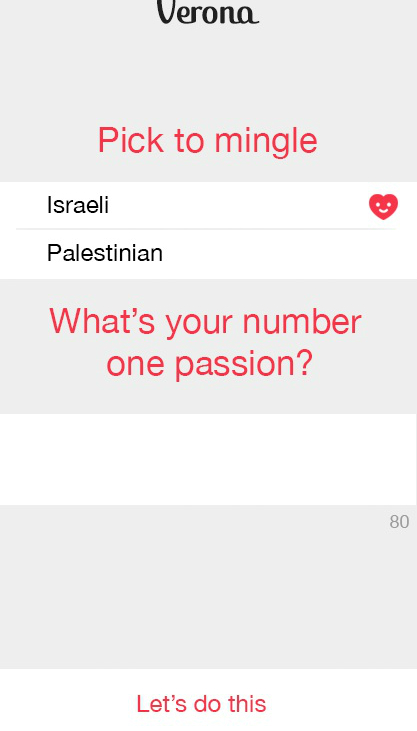
Verona’s user interface is straightforward. Once someone signs up to use the app, there are only two identities to choose from: Israeli or Palestinian. If a user is Israeli, the app only offers them potential Palestinian matches (and vice versa).
The app, however, does not have any way of knowing whether a user is actually an Israeli or a Palestinian.
“People self-identify, so ‘Israeli’ and ‘Palestinian’ can be interpreted as loosely as possible,” said Nolan.
“For instance, if your mom’s best friend is from the West Bank you could conceivably identify as ‘Palestinian,’ and if you are a quarter-Jewish, you could indicate that you are ‘Israeli.’”
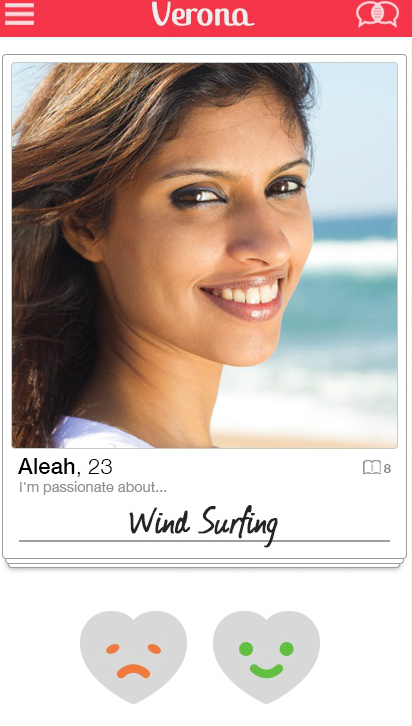
Users can filter for several criteria, including preferred gender and geographic range. The app pulls photos and other information from Facebook, and users are asked to post a short bio and list their greatest passion. Users are not asked to provide any information on how they identify religiously.
Nolan reported that initially most of the app’s users were college-age New Yorkers. But starting in early April, the number of users increased significantly, and at this point they appear to mainly be individuals in their twenties actually living in the Middle East.
“We have about 80% from the region, with the numbers skewing more heavily toward Israelis,” Nolan said.
Consequently, Nolan removed the app’s feature that indicated one user’s proximity to another. This could likely have been in response to security concerns voiced in the Jewish media that Verona could lead to a repeat of a 2001 tragedy. In January of that year, Israeli high school student Ofir Rahum was murdered by Palestinian terrorist near Ramallah after they lured him there by posing online as a potential love interest named “Sali.”
Although Nolan has read books and taken college courses on the Middle East and tries to keep up with news from Israel and the Palestinian Authority, he told The Times of Israel that he does not presume to fully understand the Israeli-Palestinian conflict.
“I don’t really understand it, and I don’t think I ever could,” he said.
Nolan said he is fully cognizant that Verona will not appeal to all Israelis and Palestinians.
“It’s really for people who are already of a certain mindset, an open mindset…probably people who are living in Europe or America,” he said.
“If you are offended by the app, then it’s not for you.”
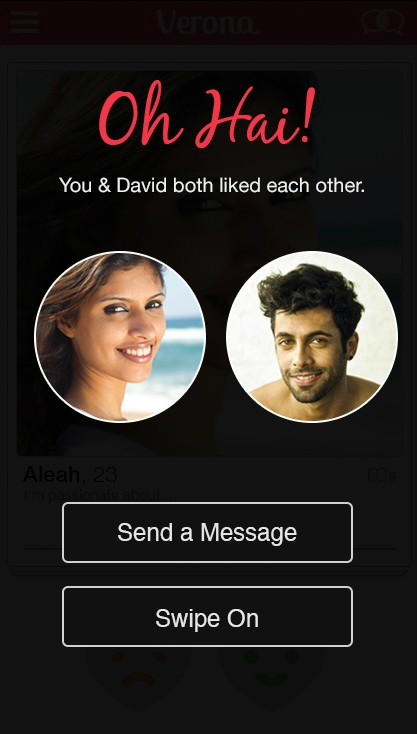
According to Nolan, he developed the dating app as a way to help people get around the elephant in the room, so to speak. Despite the ongoing conflict, he is trying to help individuals from the two sides connect with one another.
The growth of Verona, currently available only for Android, caught Nolan by surprise, pressing him to develop an iOS version more quickly than he had expected. He hopes Apple product owners will have access to Verona by mid-June. He is also planning several launch events for this summer in New York, and possibly also Tel Aviv.
Considering Israel’s war with Hamas in Gaza last summer and a recent spate of car ramming and other terror attacks by Palestinians against Israelis in Jerusalem, it would be nice to think that ultimately love can conquer all.
Some would call Nolan naïve, or a well-intentioned but misguided outsider. Some would frown upon or doubt the potential for a dating app for Israelis and Palestinians.
Writing in TNW News, technology journalist Mic Wright suggested Verona was “a wish fulfillment exercise by Western do-gooders unconnected to the realities of Israel and the West Bank” and that “its naivety is obviously going to upset people who have to deal with the daily challenges of what appears to be an intractable conflict.”
Wright also wrote that Nolan told him that although he will never charge users or sell their personal data, he has no intention of Verona’s being a non-profit for peace, and that a major goal is to beat all the other apps at the dating game.
“This is a for profit business…I have ways of monetizing this. Online dating is not going away any time soon. Everyone agrees that all the dating apps out there suck,” Wright quoted Nolan as saying.
Nolan told The Times of Israel that regardless of the naysayers, he is committed to using his coding powers to encourage people to make love, not war, in a region that has seen far too much of the latter.