Days of death and destruction
In death, as in life, the light of Elie Wiesel is forced to compete with violence and tragedy, as his passing is overshadowed by an upsurge in terror and Israel's response
Perhaps nobody understood the power of words, their muscle and their ability to respond to violence better than Holocaust survivor, writer and human rights activist Elie Wiesel. If Thomas Adorno showed the brutality of words in a post-Holocaust world, Wiesel taught us how important they could be.
“In the beginning there was silence – no words. The word itself is a breaking out. The word itself is an act of violence; it breaks the silence,” he wrote in 1985.
So it’s perhaps fitting that as his death is marked Sunday morning by Israeli newspapers, including one he once wrote for as a fledgling journalist, he and his words are forced — as they were his whole life — to compete with violence, as a deadly surge in terror again dominates the Israeli media landscape.
“The man who was there,” reads a headline on Yedioth Ahronoth’s front page, but right next to it, taking up double the space, is a story about a man who is no longer there, Otniel Yeshiva head Miki Mark, killed in a West Bank shooting attack Friday afternoon.
The scene is repeated on the front pages of Israel’s other major dailies as well, though, at least when it comes to the terror attack, front-page coverage closely follows the papers’ tried and true patterns, with populist Yedioth playing up the sorrow of the family, lefty Haaretz focusing on the political and security implications and righty/government mouthpiece Israel Hayom describing the hammer of fury that shall come down upon perpetrators and those in the Palestinian leadership supposedly egging them on.
Inside the pages, though, most of the focus is on one subject: terror, its devastating affect, and the reaction it will engender, with the attack coming on the heels of Thursday’s brutal murder of a 13-year-old girl sleeping in her bed in Kiryat Arba.
Dispatched to Otniel, which has been no stranger to terror (see: Meir, Dafna), Yedioth’s Oded Shalom telegraphs a sense of frustration in the community.
“This has been blow after blow, and people here are simply broken. I went around the settlement over Shabbat and it has permeated everything. People here have strength, but how much can one take. We are living here without any security, ” he quotes a local politician saying, immediately after describing Otniel as a town with a panoramic view of the desert and olive groves surrounded by “picturesque villages,” in a bout of cognitive dissonance.
Those villages will get a bit less picturesque, according to Haaretz’s Amos Harel, who calls Israel’s response a “return to collective punishment,” after ousted defense minister Moshe Ya’alon largely avoided the policy, and warns that it may make things worse.
“The current operation is a gamble because of the greater impact on the population. Will it be a deterrent or will it push others into terrorism, as the army has warned over the past few months,” he asks. “And with Avigdor Liberman now defense minister instead of Ya’alon come new punishments: a freeze (for now minor) on the transfer of PA tax money, a directive not to return the bodies of terrorists, and a renewed discussion on the deportation of their families. The IDF and Shin Bet security service say the first measure impairs security coordination with the Palestinians and the second doesn’t deter terrorism.”
But according to Israel Hayom, which has a 12-page package on the West Bank attacks and a rocket in the south, these moves are just what the doctor ordered, with a number of articles and commentaries viewing the decisions in a positive light if not downright stumping for them.
Among these is a column by Yoav Limor, who says those crying “collective punishment” are plain wrong, though he also bemoans the fact that Israel doesn’t really have a way to break out of its “Sisyphean” struggle against terror.
“A quick fix solution is not in Israel’s arsenal. What Israel can do is more of the same: carrots and sticks, preference for those who prevent terror and punishment for those who support and aid it, and in the absence of a peace process, continuing to fight Palestinian incitement. Different ideas proposed by ministers (deporting families, punishing prisoners and even blocking Facebook in Palestinian cities) are not practical or legal, and only raise expectations. It seems even widespread building in the territories is not on the table, in order to avoid harsh international criticism of Israel.”
Somewhat lost in all the focus on terror and Israel’s response is Mark himself, with the rabbi who was killed remembered with a scant few words from relatives and friends scattered through the papers (“Nobody was more special than Miki,” reads a headline in Israel Hayom, though the story doesn’t include much beyond that).
Standing on the side of humanity
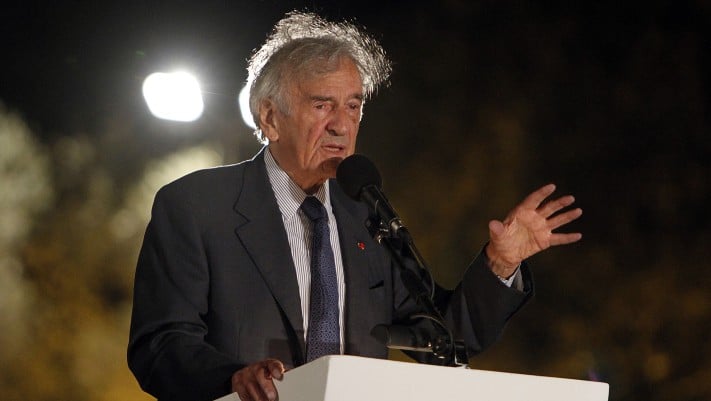
On the other side of that coin stands Wiesel, a man who turned his victimhood and loss in the Holocaust into an entry point for millions around the world to understand evil and work to thwart it, and who somehow was not drowned out by it. A living embodiment of never again, he’s remembered in the papers for his work in enshrining the memory of the Holocaust and in battling for human rights.
In Yedioth, which employed Wiesel as its New York correspondent in the 1950s, his obituary is topped by one word “The witness,” alongside a picture of him the last time he faced death, in the Buchenwald concentration camp.
Columnist Noah Kliger, calling Wiesel a friend, writes of his trouble finding a way to express his grief over the loss: “How do you write about the death of a giant, how do you write about the death of one of the greatest writers, philosophers and knowledgeable people of the 20th century,” he begins his short piece.
Lucky for him, others don’t have the same trouble, including Nahum Barnea in the same paper, who bases much of a long column on an interview he conducted with Wiesel on his life’s work two years ago.
“The death of Elie Wiesel, Nobel Peace Prize winner, is a great loss – a great loss for the Jewish people, for whom Wiesel fulfilled his historic role, and a great loss for humanity. In a world of power struggles and fighting managed mostly on considerations of cost-benefit, Wiesel was a moral compass of the values of humanism,” he writes.
In Israel Hayom, Yad Vashem head Avner Shalev remembers Wiesel as someone who took from the Holocaust not just loss, but a philosophical underpinning on how to prevent a future genocide.
“He had a magical ability to penetrate. He was an unparalleled envoy for the survivor generation, who unfortunately has left us,” he writes. “His most significant contribution was that he managed until his last days to show and to convince that the disaster that befell the Jewish people carried a great universal message – that the same moral world, which grew out of Jewish values, was the one that collapsed in World War II, and this collapse was the basis of the tragedy. He believed that we needed to be sensitive to the loss of our humanitarian values, and that a battle over this could have an effect. Elie fought for this belief until his last day.”