Dealing with it
While some commentators in the press turn their opprobrium dial up to 11, others eye the Iran nuclear agreement with wary optimism
The fallout from the nuclear deal between the US and Iran continues to lead the Hebrew news agenda Sunday morning, after a Passover weekend saw Israel harden its opposition to the agreement, even as Washington unsurprisingly showed no signs of letting the pact go.
All three major dailies lead off with the official Israeli response to the Thursday agreement, which is about as popular in Jerusalem as a steaming dollop of bitter herbs and which earns a rating of “existential threat” from the opposer-in-chief himself, Prime Minister Benjamin Netanyahu.
But while Netanyahu and his crew of elders are resolute in their opposition, a chunk of the commentaries on the deal that spread locust-like across the dailies shows that the breadth of Israeli opinions on the subject is plenty catholic, and not the Easter kind.
In Yedioth Ahronoth, for instance, Alon Pinkas — a frequent critic of Netanyahu — defends the treaty as good for both Israel and the US, calling the outcry against the deal “unneeded.”
“From a strategic perspective for Israel, this is a good agreement for its national security, and good for its regional standing. It doesn’t harm its deterrent capabilities and doesn’t expose it to any large threats. The opposite,” he writes. “Thus Israel needs to accept the deal positively. It can raise doubts as to its implementation and trust in Iran, but it needs to stand on the side of the US and the powers and say ‘let’s give this a chance, we’ll suspect, check and see, but give it time.’”
While many of Pinkas’s colleagues echo his stance of cautious optimism, many of Israel’s quill jockeys take a negative view of the deal.
Israel Hayom’s news coverage doesn’t even pretend to take a neutral stance (consider news story headlines like “A real threat to Israel,” “Chamberlain got a better deal out of Hitler” and “The president failed on goals he himself set”), but it’s the tabloid’s team of nattering nabobs, who have railed against the deal from day 1, who turn the indignation dial all the way up to 11.
“Just 72 hours have passed since Iran and the powers came to a framework agreement on the nuclear program and already the first creaks are heard,” Boaz Bismuth writes in the tabloid. “Many more creaks are expected. The nuclear deal with Iran turned into an obsession for President [Barack] Obama, but it seems that those who oppose the deal also know how to be obsessive. There are those in Israel who also praised the agreement, but these are the same people who saw the Oslo agreement of 1993 as the end of the conflict, the 2005 Gaza pullout as a praiseworthy step and Obama’s victory in 2008 as a huge step for peace and humanity. They were wrong then and they are wrong now.”
Burn.
Haaretz’s official editorial line is one of support for the deal, which the paper somehow connects to the West Bank settlement enterprise.
“Instead of entrenching itself in opposition to an agreement accepted by the international community, and continuing its policies of occupation, settlement and oppression, Israel should regard the agreement with Iran as an opportunity to reduce conflicts in the region, and ask how it can do its part,” the editorial reads.
The broadsheet’s Washington correspondent notes that while Netanyahu is harping on how the deal is a threat for Israel, he has lost sight of the fact that his vociferous but ineffectual opposition means that the real threat for Jerusalem now is being ignored by the US and international community.
“Even if we assume that Netanyahu is right in his criticism of the Lausanne understandings, he is being all thumbs when it comes to shooting them down. In the P5+1 forum that agreed to the Lausanne framework by consensus, there is only one country that genuinely cares for Israel’s security — but it is also the only one that Netanyahu has chosen to combat,” he writes. “Despite all the reports of outrage in Sunni Arab countries at Washington in the wake of the Iran deal, their leaders have reacted with polite restraint, leaving Netanyahu as a solitary prophet of doom railing against the world. This posture might serve the narrative of Netanyahu as a Churchill warning against the Nazi menace, with one important distinction: It was Churchill who coined the term ‘special relationship’ between the United Kingdom and America and nurtured them, and it was Churchill who made sure that there was never a sliver of doubt about his admiration and appreciation for the president.”
While Israelis aren’t sure what to think of the deal, it seems Iranians are jubilantly in favor, with all three papers featuring pictures of celebrating Iranians taking to the streets.
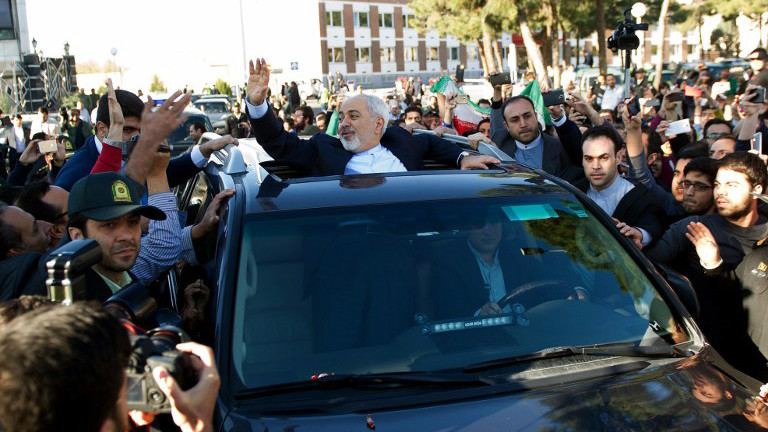
Haaretz sees cautious optimism in the Islamic Republic, though the two tabloids note unfettered joy in Tehran over the agreement. In Yedioth, a picture of Iranian Foreign Minister Mohammed Javad Zarif being feted by an adoring crowd is stamped with “laughing all the way to the bomb,” though their joy likely has more to do with the lifting of sanctions.
“We are so excited,” a celebrant named Musa is quoted saying by Israel Hayom. “We haven’t had significant economic progress in a decade already. We are happy that now we can move forward. This is a real victory for us.”
While Iranians are celebrating, though, Yedioth takes note of the timing of the US unveiling a new more advanced bunker-buster bomb that could potentially take out the Fordo nuclear facility, buried deep inside an Iranian mountain.
“The upgraded bomb can destroy Iran’s nuclear facilities if the talks fail and Obama is interested in a military option,” the paper quotes the Wall Street Journal reporting.
To Haaretz’s Gideon Levy, bombing is the only thing Israel is interested in doing, but he says the signing of the nuclear agreement takes that option off the table and buries it even further underground than Fordo, to Jerusalem’s dismay.
“With the world led by Obama trying to replace wars with agreements, bombings with peace arrangements, Israel sticks to its bad old language, the only one it knows, the language of war, bombing and shelling. With the world saying yes to diplomacy, Israel continues to say no. Eventually it will be condemned as a leper,” the always cheery Levy writes. “Now it’s over, hopefully — the danger of bombing and apparently the danger of the bomb. Netanyahu will have to find himself new scare tactics. The Israel that wanted bombing will have to remember the terrible damage inflicted by all its bombings and all its wars, and the benefits that stemmed from the few agreements it signed.”