Death toll in IS-claimed Baghdad bombing climbs above 200
More than doubling initial figure, officials say more than 200 also wounded after blast rips through crowded market in Iraqi capital
The death toll climbed to 213 in Sunday’s Baghdad suicide bombing claimed by the Islamic State group, officials said, making it one of the deadliest ever terrorist attacks in Iraq.
The suicide car bombing, which ripped through a crowded shopping area and sparked infernos in nearby buildings, also wounded more than 200 people, security and medical officials said on Monday.
Iraqi officials initially calculated that just over 100 people were killed in the blast on Sunday, but as the rescue effort continued, that number almost doubled.
The blast also wounded more than 140 people, the officials said.
Shortly afterward, an improvised explosive device went off in eastern Baghdad, killing at least five people and wounding at least 16.
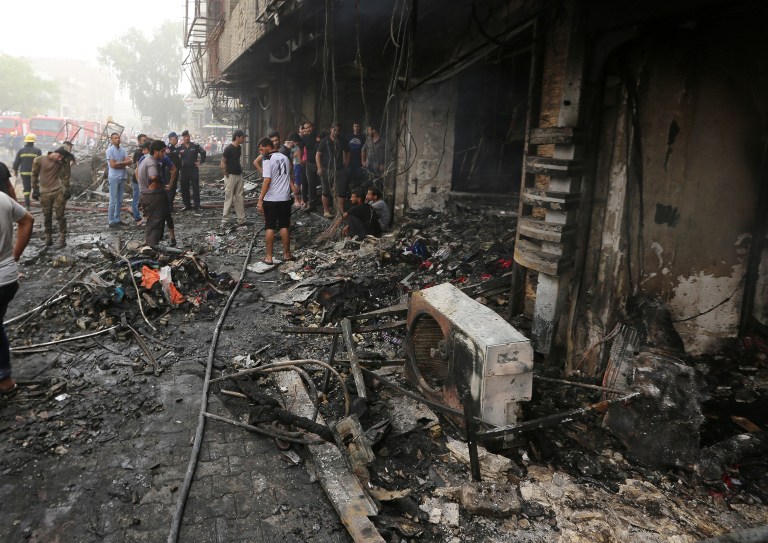
The bombings came near the end of the holy month of Ramadan when the streets were filled with young people and families out after sundown.
The Islamic State group claimed responsibility for the attack in the Karada district in a communique distributed on Telegram and Twitter, according to the SITE Intelligence Group which monitors jihadi online activity. The communique said a suicide car bomber targeted Shiites.
There was no immediate claim of responsibility for the second bombing.
Nearly an hour after the attack in central Baghdad, ambulances could still be heard rushing to the site. An eyewitness said the explosion set off fires at nearby clothing and cellphone shops.
The Baghdad attacks come just over a week after Iraqi forces declared the city of Fallujah “fully liberated” from IS. Over the last year, Iraq forces have racked up territorial gains against IS, retaking the city of Ramadi and the towns of Hit and Rutba, all in Iraq’s vast Anbar province west of Baghdad.
Despite the government’s battlefield victories, IS has repeatedly shown it remains capable of launching attacks far from the front-lines.
IS still controls Iraq’s second-largest city of Mosul as well as significant patches of territory in the country’s north and west.
At the height of the extremist group’s power in 2014, IS rendered nearly a third of the country out of government control. Now, IS is estimated to control only 14 percent of Iraqi territory, according to the office of Iraq’s prime minister.