Despite condemnation, legal fate of soldier in Hebron killing far from sealed
PM, army chief say incident in which wounded assailant was shot dead 'doesn't represent values of the IDF,' not that the soldier is guilty
The Israeli army’s policies on the treatment of Palestinian assailants are, on first glance, clear and direct.
In the event of an attack, IDF soldiers and police officers are obligated to use as much force as necessary to neutralize the threat.
But once an attacker no longer presents a clear danger, no additional force should be used and Israeli medics — both military and civilian — are required to treat the injured assailant as they would treat anyone else, based solely on the severity of their injuries.
This is not opinion or interpretation, but official IDF protocol.
The IDF Medical Corps’s oath, for instance, which every one of its soldiers swears to uphold, requires medical personnel to provide treatment for victims and attackers alike. “I swear on this day to give a helping hand to every injured and every sick… if it is a friend or an enemy, and to every person as a human being,” the oath reads.
But these supposedly straightforward policies are now again being called into question.
On Thursday morning, two Palestinian men attacked an IDF platoon commander and one of his soldiers in Hebron, stabbing the soldier in the shoulder and arm, moderately injuring him.
The platoon commander shot the attackers, seriously wounding one and killing another.
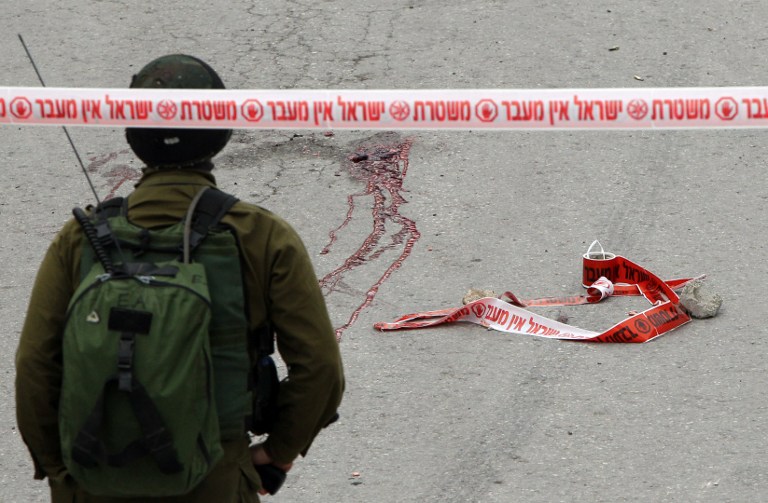
Then, approximately six minutes later, according to a military source, another soldier, whose name is under gag order, arrived on the scene. A few minutes later, as the injured soldier was being loaded onto the ambulance, the other soldier shot the wounded, supine assailant in the head, as can be seen in a video filmed at the scene.
The soldier who shot the Palestinian is now being investigated by the Military Police for murder. On Friday, he had his remand extended until Tuesday.
The soldier was not a part of the initial incident, but arrived to the scene several minutes later, according to the preliminary findings of Maj.-Gen. Roni Numa, head of the IDF’s Central Command.
(Video contains graphic images)
The soldier has claimed he feared the assailant had an explosive vest hidden under his shirt and could have used it to kill the people surrounding him.
“He operated under the rules of engagement orders he received,” the soldier’s attorney, Ilan Katz, said on Friday.
During the Second Intifada, Palestinian terrorists were known to use hidden explosives to carry out secondary attacks on medics, police and other first responders who arrived on the scene to assist the victims of an initial stabbing or shooting attack.
As a result, the IDF treats every Palestinian terrorist and assailant in every attack as though they have such an explosive device.
That, too, is standard operating procedure.
A second video, released on Friday, features someone warning medics to keep away from the assailant, precisely because he may have an explosive device on him.
Some have taken this shouted warning as corroboration of the soldier’s claim.
The actions of other soldiers and civilians on the scene, however, do not appear to decisively reflect the soldier’s defense.
Medics can be seen walking next to the Palestinian assailants as they load the soldier injured in the stabbing attack onto an ambulance.
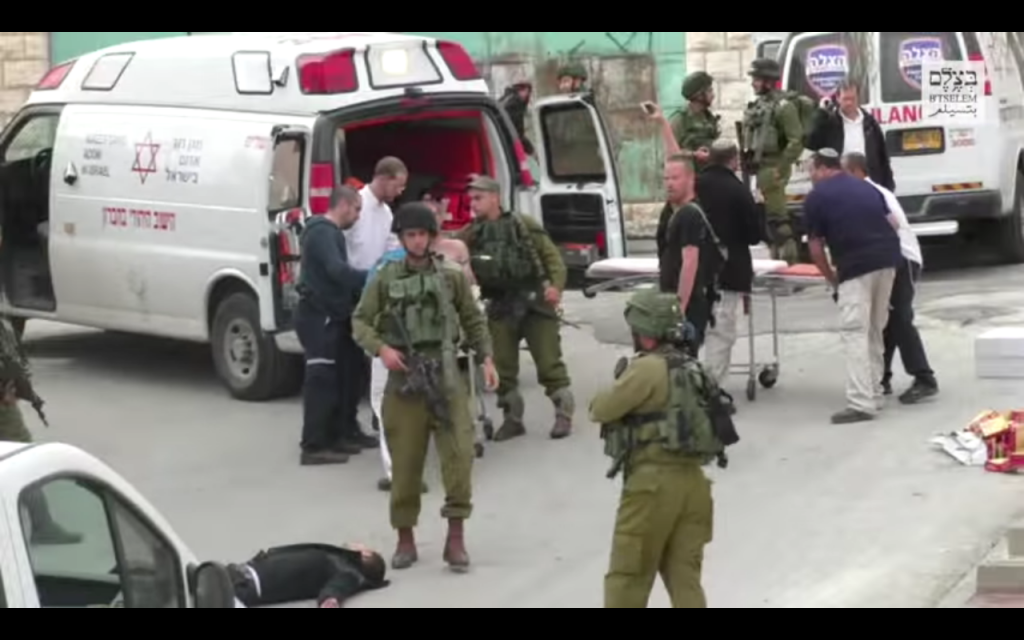
Moments before the soldier shoots the Palestinian in the head, an officer steps over the assailant and then proceeds to stand just a few feet away.
Then again, maybe these medics and the officer should have been more prudent.
It might be argued that the soldier’s own actions also appear to call his claim into question.
If he was concerned the Palestinian assailant intended to detonate an explosive vest, why would he not warn the officers standing mere feet away from him? If he feared an explosion, why did he himself walk closer to the Palestinian — and the bomb — before shooting? Again, though, this was the scene of a fresh attack, and not everybody acts as prudently and as logically as they might under normal circumstances.
All these and other questions and issues will surely be addressed in the investigation.
Precedent suggests that if the soldier’s attorneys can prove he had a reasonable fear that the assailant posed an ongoing threat, he will be cleared.
Indeed soldiers who have been found to have unnecessarily killed Palestinians in the course of a clash have also been cleared of charges, if they were able to prove that they had reasonable fear for their lives.
When the initial video of Thursday’s incident was first released, Prime Minister Benjamin Netanyahu, Defense Minister Moshe Ya’alon and the IDF top brass were quick to denounce the soldier in question and promised a speedy and thorough investigation.
Regarding the initial portion of Thursday’s incident, the attack and response, IDF soldiers displayed “professional behavior,” Chief of Staff Gadi Eisenkot said in a statement on Friday.
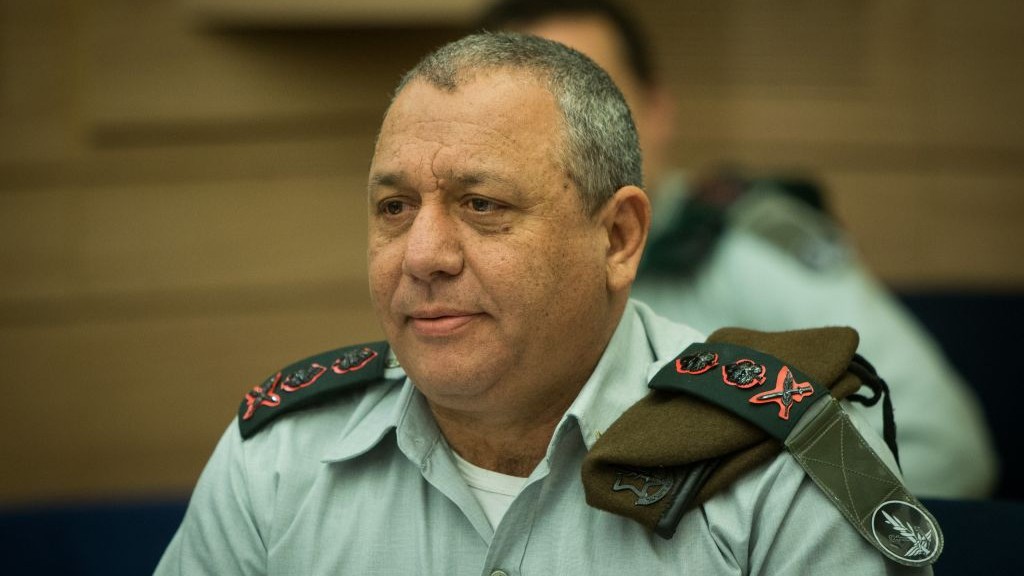
In the aftermath, however, the officers and soldiers did not, according Numa’s preliminary investigation.
The platoon commander involved in the initial incident, a second platoon commander who arrived to help just after the attack, and a company commander, have all been officially reprimanded — but not court-martialed — for failing to treat the Palestinians at the scene, according to a military source.
“What happened in Hebron doesn’t represent the values of the IDF,” Netanyahu said in a statement.
“This is not the IDF, these are not the values of the IDF and these are not the values of the Jewish people,” IDF Spokesperson Moti Almoz said at a press conference on Thursday afternoon.
“The IDF will give full support to commanders and soldiers who make mistakes, but not for behavior that is against its values,” Eisenkot said.
Ya’alon said the soldier’s apparent actions were “in utter breach of IDF values and of our code of ethics in combat.”
But for all the condemnation, it would be premature to conclude that this soldier who “doesn’t represent the values of the IDF” will be convicted of murder or of lesser charges.