Despite worst economy in years, anti-Netanyahu protests struggle to grip nation
Lacking a coherent strategy, the protest seeking the PM's ouster seems to have little interest in broadening its coalition, or restraining its radicals
Almost half the country — 45 percent of Israelis — identify with the ongoing protests calling for Prime Minister Benjamin Netanyahu’s resignation, according to polling released in early August by the non-partisan Israel Democracy Institute.
Two weeks ago saw the largest demonstrations yet against Netanyahu outside his Jerusalem residence on Balfour Street, with crowd estimates ranging from 15,000 to 32,000.
A colorful array of homemade signs have been filling the protests – some decrying unemployment as a virus, while others draw attention to Netanyahu’s alleged corruption. Some demonstrators call for an end to Israel’s occupation of the West Bank, while a few have held signs implicitly comparing the blockade of Gaza to the Holocaust. In the carnival-like atmosphere at Balfour, protesters responded to Netanyahu’s son Yair calling them “aliens” by showing up the following Saturday in full ET garb.
It is this “open source” nature that has driven the protests’ success so far, said political strategist Lior Horev, who has worked on campaigns for Ariel Sharon’s Kadima and Moshe Kahlon’s Kulanu parties.
But that success could be a poisoned chalice. With only their call against Netanyahu to hold them together, the protests may be missing their chance to reach frustrated right-wing voters and become a true mass movement.
Rather than focusing on economic issues that appeal to a broad swath of the electorate, demonstrators have rallied behind a cacophony of slogans — some popular, some radical — but without offering a clear alternative to the status quo.
It’s not about the money
Earlier this summer, before the crowds amassed on Balfour Street, there was the Ani Shulman movement, based around a Hebrew slogan meaning “I’m Shulman.”
While the protests against Netanyahu united around the call for his resignation, the Ani Shulman protests demanded that the government protect the so-called “shulmans” — freelance workers whose livelihoods had been put at risk by the coronavirus pandemic.
The two protest movements predated the pandemic era’s long, hard summer. Both gained steam as frustration with the government rose — but they wound up taking very different paths.
Abir Kara, who led the Ani Shulman protests, said his movement advanced tangible policies that helped freelance workers weather the crisis.
“It’s important in these struggles to pursue clear policies and not to get distracted by background noise. Anyone, at any moment, could drag you off toward a different place. There might even be laws that take you back, like the law that circumvented the Knesset, but they’re not part of your focus,” Kara said.
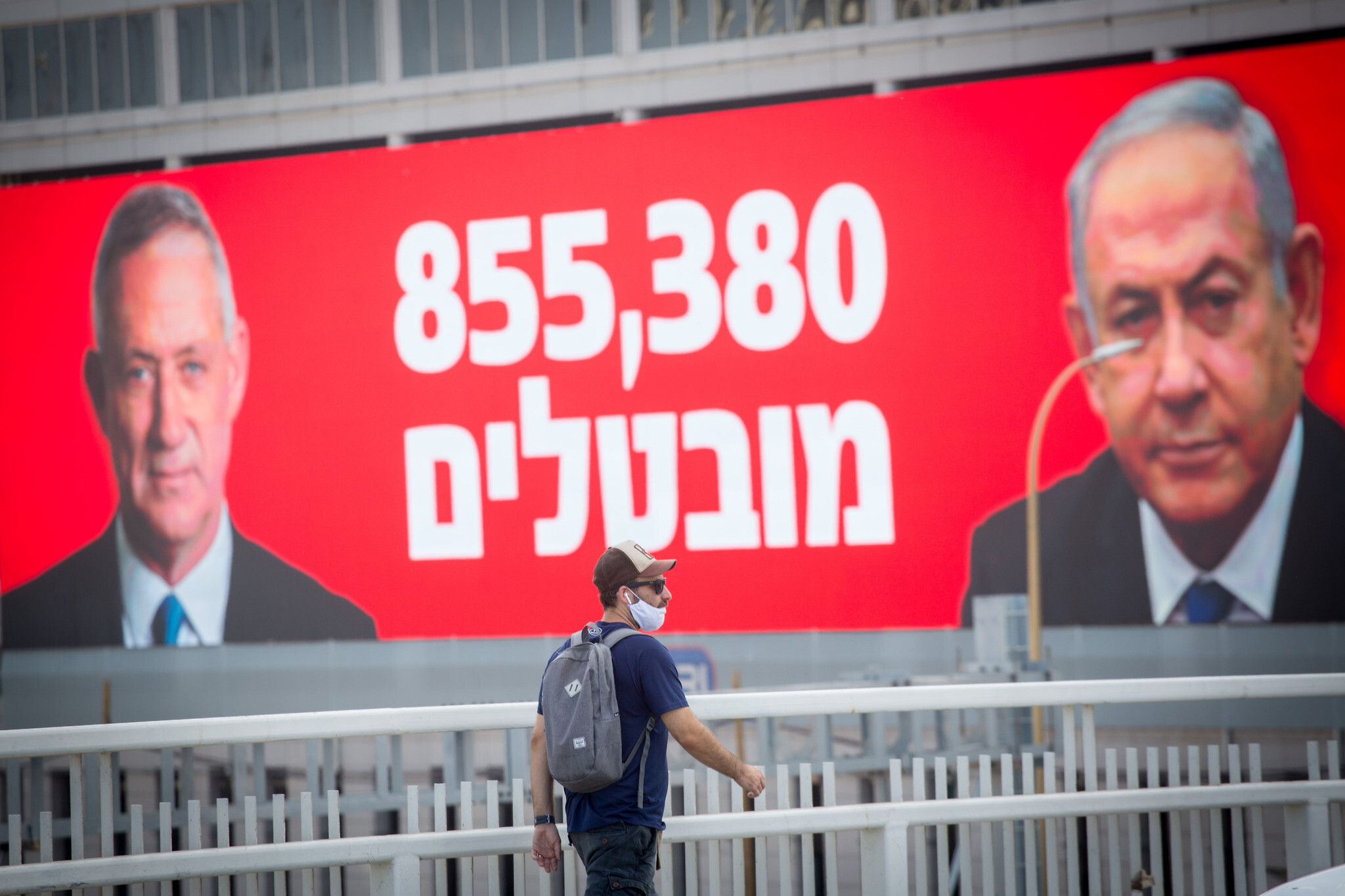
With around 500,000 unemployed and a troubled government response, it is perhaps no surprise that around 58% of Israelis — including 53% of right-wing voters — identify with protests against the government’s economic policies.
Some outlets estimated that as many as 70,000 attended the Ani Shulman protests in Tel Aviv against the government’s coronavirus response, larger by far than any single protest calling for Netanyahu’s resignation — even by the most optimistic estimates. Moreover, as The Times of Israel reported at the time, the crowd had many self-proclaimed right-wing voters.
Kara’s movement suffered after he was caught on air in July during an Israeli talk show texting with Finance Minister Israel Katz. He had never disclosed his regular communication with the government, which delegitimized his movement in the eyes of many.
Horev, the political strategist, believes that protesters can effect enormous change by avoiding “national” issues and doubling down on the economic crisis.
“It is the socioeconomic agenda that has the potential for a regime change. Netanyahu is always trying to transform the discourse into one about security, so he mentions the Arab-majority Joint List, and Iran and Hezbollah, in the face of a million unemployed,” Horev said.
The Balfour protests, by contrast, have brought in a whole cluster of wildly diverse ideologies and causes under a single banner — ousting Netanyahu — similar to the unhappy coalitions which united center and left political parties through three straight elections.
But they have struggled to reach the economically disaffected right wing.
“In Israel, we have people who are extremely upset because of the economic situation. But they are also the current government’s base. This is a problem, because the Balfour protests are in large part about Netanyahu and his government,” said Tamar Hermann, a senior fellow at the Israel Democracy Institute.
But you also won’t find Kara, who identifies with the right but is hardly a staunch Netanyahu supporter, anywhere near Balfour on a given Saturday night. Perhaps like many Israelis, Kara is torn over the protests. The rage and betrayal felt by many demonstrators at Balfour was something he said he understood well.
“This is a bloated government, to be sure, an out-of-touch government, full of ministers and deputy ministers. It costs us so much money. There was no attempt to communicate or speak to the public, and it destroyed public trust,” Kara said.
But Kara hesitates to join the Balfour protests due to the prominent, well-organized left-wing bloc at the demonstrations, among other reasons. The left-wing presence at the protests has been hailed by some as a watershed moment for anti-occupation activists and condemned by others as the attempted centering of a group of fringe radicals with extreme views.
Many Israelis consider some of their actions — calling for justice and democracy “from the [Jordan] river to the [Mediterranean] sea” or waving Palestinian flags — to be beyond the pale. It leaves even those as sympathetic as Kara conflicted about the demonstrations. While at least one right-wing MK has attended the Balfour protests so far — Yisrael Beiteinu’s Eli Avidar — most of the right-wing opposition has shied away.
“When you’re talking about demonstrations where people cry ‘Free Palestine,’ that’s deeply hard for me. But at the same time, those people at Balfour are hurting, and they’re my brothers — I can’t help but identify with them. I’m very conflicted on the issue of the Balfour protests,” Kara said, adding that such protests could send the country to a fourth round of elections in 18 months, a move he strongly opposed.
A failure to reach out?
Balfour organizer Omer Granot, who leads a faction in the Histadrut federation of labor unions, said it was “a shame” that some anti-Netanyahu protest groups focused heavily on the prime minister’s indictments to the exclusion of economic concerns.
“A protest that is anti-Bibi is less inviting to the population that voted for Bibi, once, twice or three times in the last year or to his coalition partners… The economic protest, naturally, connects them in a broader way,” said Granot.
Amir Haskel, a retired career military officer and senior activist in Ein Matzav, a major anti-Netanyahu group, said that his group was trying to focus more on economic issues, bringing speakers to address small crowds on monopolies and regulation.
But Haskel also insisted that he had no interest in telling anyone how to protest — especially not at the biggest demonstrations on Saturday nights.
“When there’s a protest, people come with different ideas, everyone with his own sign… Our goal is to put pressure on the right wing from outside their camp in the hope that the rational right will stand up and do the right thing,” Haskel said.
It is important, the IDI’s Hermann told The Times of Israel, to mobilize one’s base when engaging in a popular struggle. But after three rounds of elections in a bitterly polarized society, it seems hard to believe that the left and center can win without bringing substantial participation by the political right.
“We speak [with right-wing groups] sometimes to try and come to a common understanding. But are we doing anything actively to reach out to them? Not really,” leading anti-Netanyahu activist Gonen Ben Yitzhak conceded.
“What should matter, on a moral level, is that we have a prime minister with three indictments against him,” Ben Yitzhak said.
To create a coalition with Israel’s many frustrated right-wing voters, the protest’s organizers might have to start drawing red lines and say what the demonstrations are really about. And that, so far, has been the one thing they won’t — or can’t — do.
Grand strategy
There’s one model of how a successful protest movement can win — it organizes, and a central leadership emerges to broadcast a unified, clear message. Some organizations — such as the Peace Now settlement watchdog — even used to regulate the signs that could be held at their demonstrations, Hermann said.
Eventually, the new group seeks to mobilize its base, build coalitions and enter institutional politics.
“At a certain point, you need a leadership that can direct people… You don’t have to agree on each and every detail, but without some attempt to institutionalize the struggle, it will simply dissipate,” Hermann said.
For better or for worse, many Balfour organizers who spoke with The Times of Israel said they had no interest in creating such a central leadership or in telling people how to protest.
Organizers often based their arguments on what they called the failure of the 2011 cost of living protests, which brought a new generation of leadership — such as Welfare Minister Itzik Shmuli and former MK Stav Shaffir — into the Knesset.
“The failure of 2011 was due to their inexperience. They attempted to create a single leadership, which promptly embarked on egotistical internal struggles,” 65-year-old Avi Ofer, a longtime activist involved in the anti-Netanyahu protests told The Times of Israel in July.
Without a leadership and strategy, perhaps all that remains is a cry of frustration with politics. That might not be enough to oust Israel’s longest-ruling prime minister.
Yonatan Levi, a leading activist in the 2011 social protests, said that an opposition needs to advocate for a coherent political alternative to the status quo.
“The demonstrations are always the most exciting part of it and the most tempting. But that’s not where the long-term, deeper change happens. I feel that sometimes what we did in 2011 was to serve as quite a magnificent production company for huge demonstrations,” said Levi, who is now a doctoral candidate at the London School of Economics studying social movements.
Moreover, it’s not clear what demonstrators hope will happen if Netanyahu does, in fact, resign. Anti-Netanyahu activist Ben Yitzhak said he supports a fourth round of elections — an enormously unpopular idea across nearly every segment of Israeli society.
At the same time, Ben Yitzhak told The Times of Israel he holds little hope for the success of the left even if Netanyahu resigned and elections are held — leaving troubling question marks over why, exactly, the country should go through them again. With the demonstrators so divided — and so unwilling to unite — who could they even vote for?
For some demonstrators, it’s not about strategy, or how to win the next elections — nor is it only about economics, corruption, coronavirus, or the occupation. It is about all of it, maybe, and more. It is about the basic sense that Netanyahu must go — that anything, anyone, would be better than the present situation.
It’s about hope, maybe. But also about a despair so deep that the daily grind of everyday politics can’t contain it.
“I’m left-wing, but at this point I don’t even care. It could even be [Yamina party leader Naftali] Bennett — we need someone, anyone, who will try to lead the country,” said demonstrator Maya Glasser, 28, a Meretz voter.
Anat Peled contributed reporting.