Dudu Tassa and Jonny Greenwood let their stirring Arabic music speak louder than politics
The collaborating rockers bring 'Jarak Qaribak,' their album of revived Arabic love songs, to a packed Jerusalem Oud Festival opening -- bridging divisions simply by playing a regional songbook
Applause for musical collaborators Dudu Tassa and Jonny Greenwood thundered through the auditorium as the 17 members of their band filed onstage Thursday night, with an electric sense of expectation in the crowd.
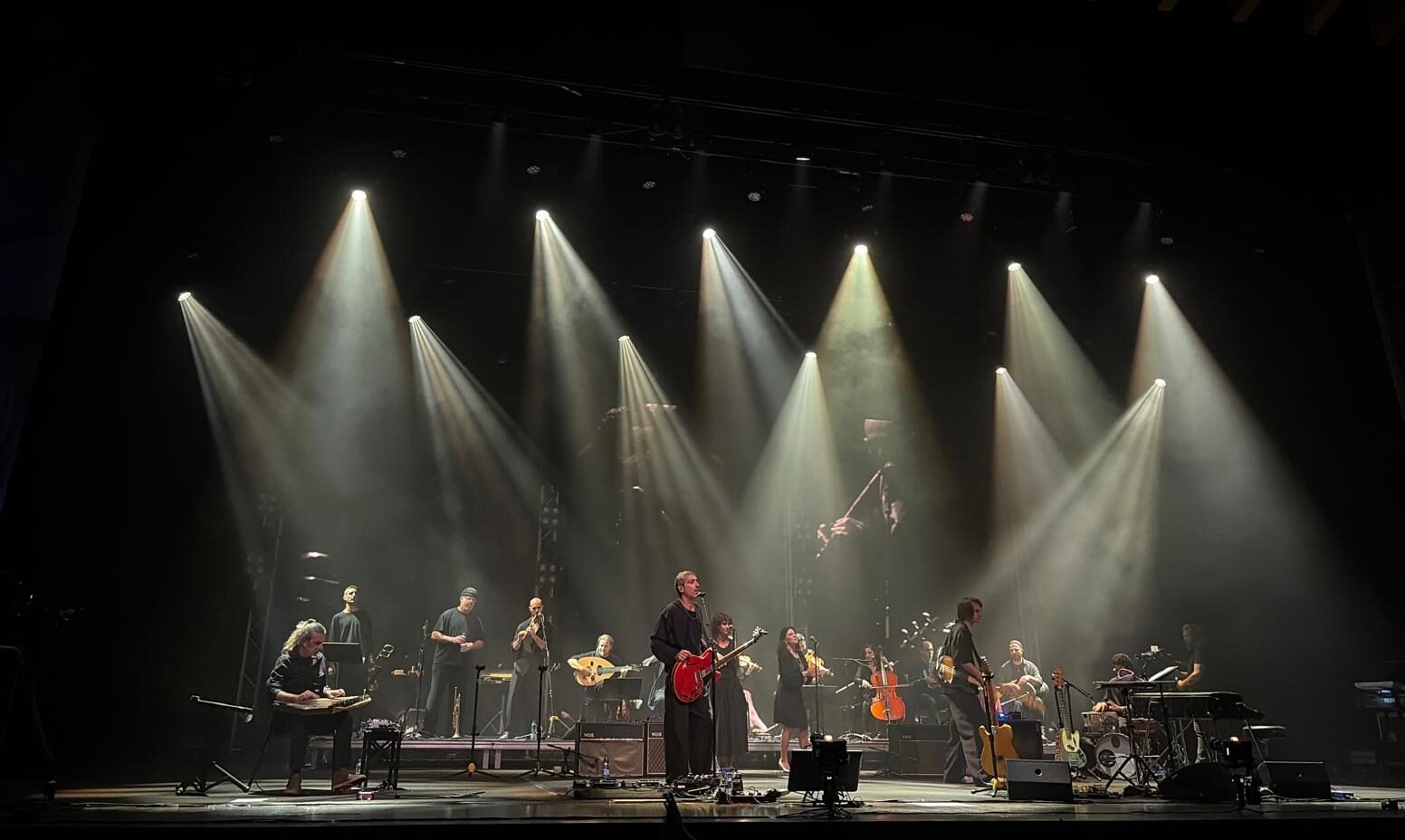
The ensemble, led by rocker Tassa and Radiohead’s Greenwood, opened the Jerusalem International Oud Festival, performing songs from “Jarak Qaribak,” their 2023 album that renewed classical Arabic love songs with jazzy rock overtones.
Throughout the tight 90-minute set, Tassa and Greenwood, both playing lead and bass guitars, led a band of excellent local Arabic- and Hebrew-speaking musicians and singers that included Greenwood’s Israeli wife, Sharona Katan, on keyboard, and their daughter, Omri Katan, as one of two backup singers.
The oud, the pear-shaped, fretless, stringed instrument, was played, along with a qanun, a traditional Middle Eastern flat-stringed soundboard, and the rebab, a spike lute, alongside cello, saxophone, viola, violins, drums, percussion, flute and trombone. It created a rich, multilayered sound.
Tassa launched into the first song in the 18-strong playlist, crooning Arabic into the microphone for “El Hajar,” and the crowd was mesmerized, clapping along, heads bobbing, shoulders rocking — an audience at one with the remarkable musicians onstage.
Tassa and Greenwood have collaborated musically for 20 years. They launched “Jarak Qaribak” in September 2023, a month before the October 7 Hamas-led terror onslaught.
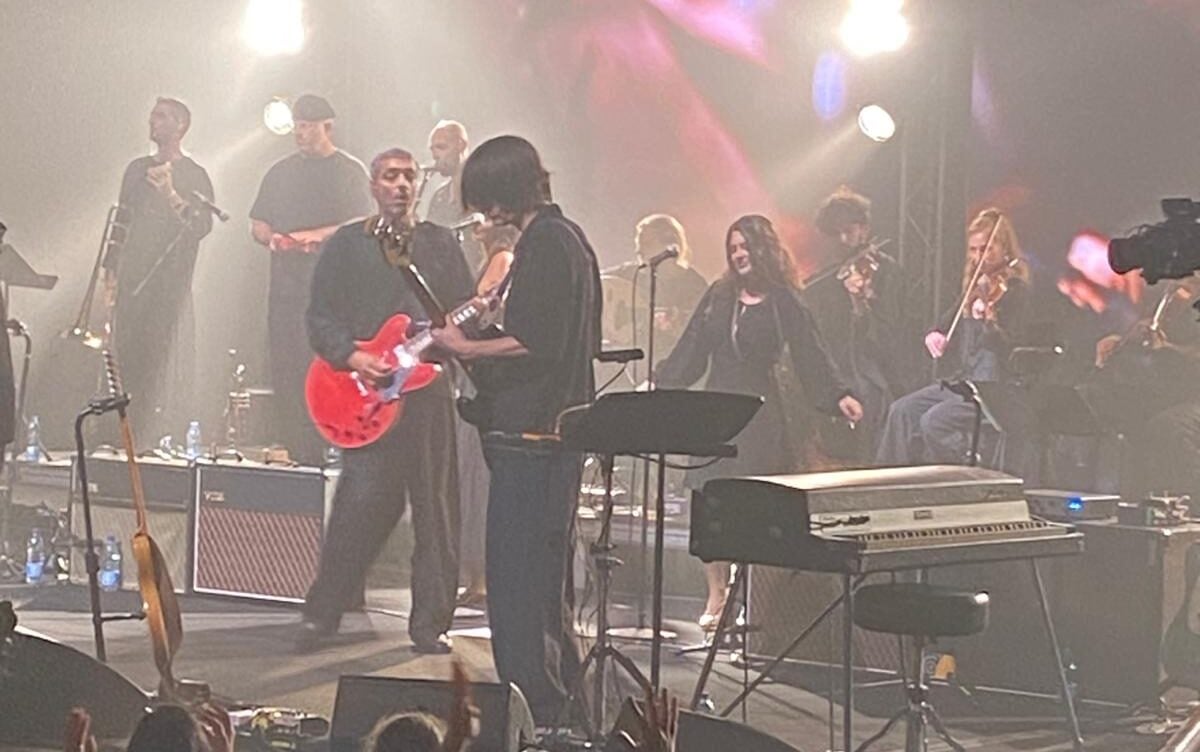
The two have performed together since then, and “Jarak Qaribak” has continued to bring together vocalists and musicians from across the Middle East, creating collaborations for the title that, loosely translated, means “your neighbor is your friend,” with its covers of Arabic songs from throughout the region.
Greenwood’s collaboration with Tassa has also generated fierce opposition from anti-Israel groups. A European tour was canceled in 2023 amid the war in Gaza, and two UK concerts were called off in 2025 amid what were deemed credible threats to the venues and staff.
The album was meant to avoid political subtexts, Tassa and Greenwood stressed upon its release. It was that same concept that resonated on Thursday night, as the two guest singers, Karrar Alsaadi from Baghdad and Jianna Nadaf from Nazareth, performed many of the numbers, always at one with the crowd in their smiles, their dance moves, their joy onstage.
“We are so, so, so happy to be here,” said Tassa, who spoke only after several songs. With all that is going on in the world outside, he said, “We didn’t know if it would actually take place.”
He said he had thought hard about what exactly he should say onstage, and ended up improvising. This past month has seen “so much politics, people talking and talking, and most of it is full of anger, hatred, nothing that is about closeness,” said Tassa, “but here I have a British friend.” He pointed toward Greenwood, to the roar of the crowd.
“A friend from Baghdad, a friend from Nazareth,” Tassa continued. “Music is the thing that we all love. You don’t have to agree about everything and everyone can have their opinion, but accept the opinions of others; it’s okay.”
Those brief remarks apart, overt politics was indeed largely absent at this performance of Arabic songs, including six sung by Tassa, who regularly performs Iraqi and Kuwaiti songs with his band, The Kuwaitis. The songs originate from music he learned from his grandfather and uncle, a pair of musical giants in Iraq. Any political message was found in the music, the musicians, the venue and the audience — a celebration that bridged divisions without explicitly citing them.
It was also an evening of appreciating music with lyrics that many in the audience probably couldn’t understand, but didn’t need to, although at one point an audience member called out in Hebrew, asking Tassa to “connect me to Hebrew.”
He paused, a little dumbfounded, then told her that his band, The Kuwaitis, would be onstage at the Barby Tel Aviv venue next week.
There was a moment of political protest before the musicians took the stage, when Effie Benaya, artistic director of the Oud Festival, introduced the event and welcomed Culture Minister Miki Zohar, who was booed by a vocal portion of the audience. Zohar, a Likud party ally of Prime Minister Benjamin Netanyahu, has threatened to pull state funding in the past from Israeli cultural enterprises.
He is generally unpopular in the local arts and culture scene, and was notably so among the crowd assembled Thursday night. He stayed through the show, leaving before the encores.
Each song was opened by a different musician from a band that comprised Dan Mayo on drums, percussionists Nour Bar Goren and Louay Khoury, Ariel Qassis playing the qanun, flutist Yitzhak Ventura, Sefi Zisling on trumpet, trombonist Maayan Milo, cellist Eden Djamchid, violinist and rebab player Johanna Rittmüller, Tomer Moked on violin, viola player Siraj Abdelmoati, Yaniv Teichman playing the oud, Sharona Katan on keyboard, and backup vocalists Omri Katan and Tamar Shawki.
Greenwood was silent vocally, his heavy fringe of hair often hiding his eyes, but he was ever-present, using a soundboard at his side to bring in more standard rock and electric sounds.
Greenwood hadn’t performed in Israel since 2024, when he and Tassa played in Tel Aviv, prompting a call from the Boycott, Divestment and Sanctions (BDS) movement to boycott Radiohead’s then-upcoming tour. It went ahead as planned.
Sharona Katan’s nephew, Reef Harush, was killed in 2024 in battle against Hamas in Gaza.
In a Sunday Times interview last year, both Radiohead frontman Thom Yorke and Greenwood took umbrage at fans’ calls for Radiohead to take a vocal position on the war in Gaza, and to pledge not to play in Israel.
Greenwood, in The Times interview, called the entire situation “nuts.”
“The only thing that I’m ashamed of is that I’ve dragged Thom and the others into this mess — but I’m not ashamed of working with Arab and Jewish musicians. I can’t apologize for that,” he said.
The unavoidable political context underlined how difficult it must have been to put together Thursday’s concert (and a second sold-out show set for Friday) at this time, and with this mix of performers, who chose to let their music guide them.
Clearly, Greenwood and Tassa have chosen to use their clout to create and perform this music — logistically complicated, musically rewarding, and unstatedly politically harmonizing.
For the audience, it was a night of mutual appreciation, where the concertgoers saw, heard and felt how much the performers wanted them to be there, and the performers showed what magic music can achieve.