Edelstein stands ground on draft-dodger sanctions as Shas set to depart coalition
'Public will not forgive those who fail to rise to the occasion,' powerful Likud MK warns Haredi parties, whose exit will not topple Netanyahu government for the time being
Knesset Foreign Affairs and Defense Committee Chairman Yuli Edelstein stood firm Tuesday on the necessity of imposing personal and institutional sanctions on draft dodgers, laying out his red lines for a conscription bill even as he called on the coalition’s ultra-Orthodox members not to bring down the government over its terms.
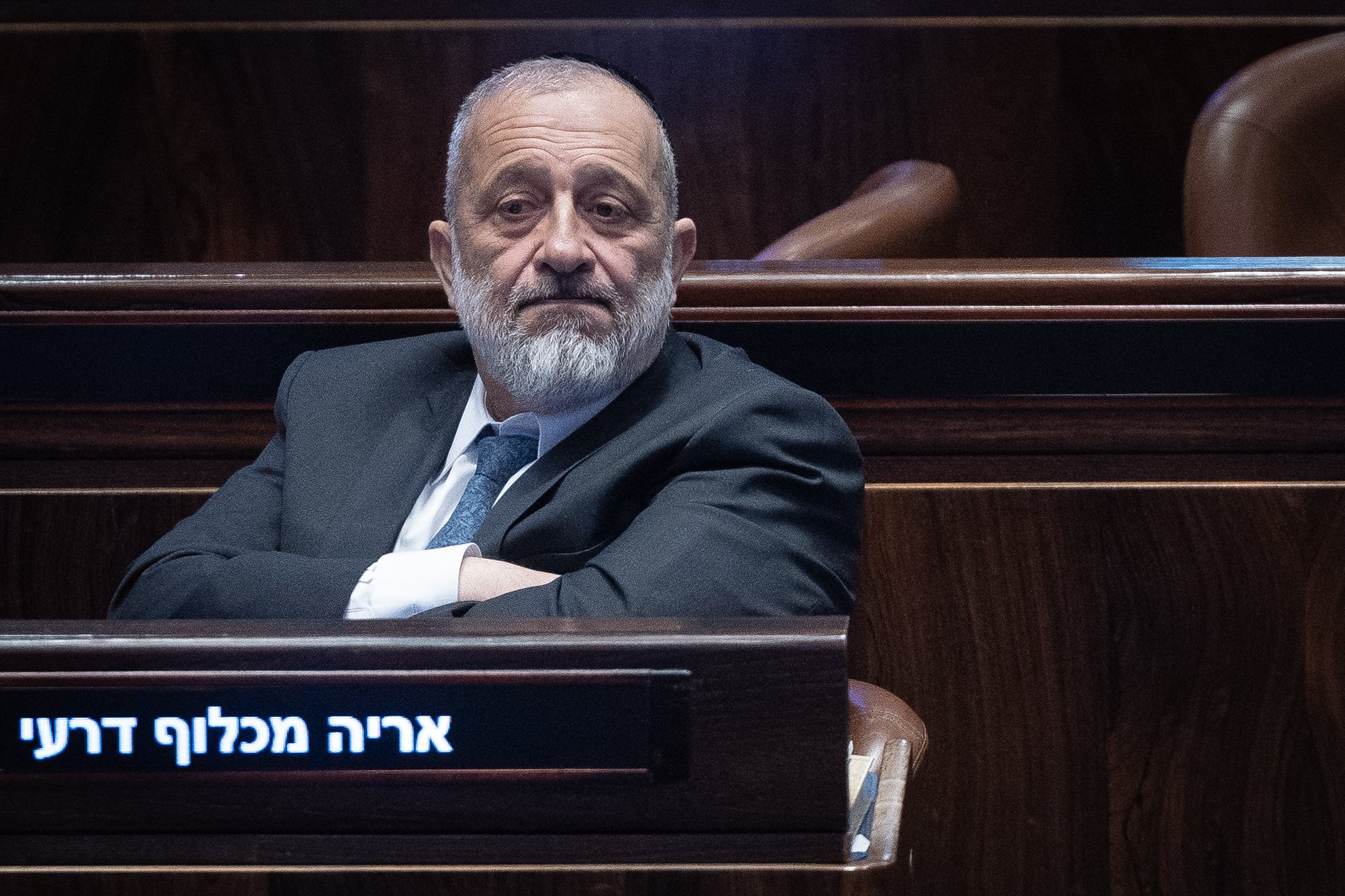
Addressing reporters hours after Aryeh Deri’s Shas announced that it was seriously considering following the Knesset’s second Haredi party, United Torah Judaism, out of the coalition, Edelstein blamed the ultra-Orthodox for the crisis, stating that “the representatives of the Haredi factions in the Knesset are rejecting the outline of the law that I have formulated.”
UTJ quit Prime Minister Benjamin Netanyahu’s coalition Monday night after being presented with a copy of a proposed enlistment bill prepared by Edelstein, which it argued violated the terms of a compromise that was reached by the two sides last month when an effort was being made to prevent the Haredi parties from toppling the government ahead of the war with Iran.
According to UTJ, Edelstein’s bill fails to deliver on several key demands, including offering full amnesty to yeshiva students who have already received and ignored enlistment orders. It also reportedly contains a clause requiring yeshiva students who receive exemptions to check in and out of their yeshivas using a fingerprint scanner.
Instead, the Haredi parties are looking to pass legislation that would enshrine sweeping exemptions from mandatory military service for ultra-Orthodox men. The issue gained greater urgency following a court ruling last year that the longstanding practice of granting exemptions had no basis in law.
Some 80,000 ultra-Orthodox men aged between 18 and 24 are currently believed to be eligible for IDF service but have not enlisted. The IDF has said it urgently needs 12,000 recruits, amid the strain on standing and reservist forces amid the ongoing war against Hamas in Gaza and other military challenges. Currently, only around 1,800 Haredim enlist annually. About 2,700 enlisted over the past year, far short of the IDF’s goal of 4,800.

Edelstein’s proposed legislation would reportedly provide for conscripting more than 4,800 Haredim over the next annual recruitment cycle, although it is unclear how rapidly that would increase year-over-year.
An ultra-Orthodox media report from June claimed that Edelstein had agreed to increase recruitment targets much more slowly than he had previously demanded, rising to half of the annual potential draft cohort from the community by 2030. Edelstein has declined to provide specific numbers and has only said his bill would “significantly” ease the burden on those already serving.
“We knew the whole time that it wasn’t happening,” Motti Babchik, a senior adviser to UTJ chairman Yitzhak Goldknopf, told The Times of Israel on Tuesday morning regarding the kind of law that the Haredim have been demanding. “We’ve known for almost three-quarters of a year that there’s no chance of passing a law. They’re not planning to pass a law. They’d rather go to elections without a law.”
Shas on the way out
In the wake of UTJ’s withdrawal from the coalition, Shas announced that “following the serious and unacceptable harm to the status of Torah scholars” brought about by the current government, its ruling Council of Torah Sages would meet on Wednesday for “a crucial discussion regarding [the party’s] continued path in the government.”
Shas party newspaper HaDerech blamed the crisis on what it called “Likud and Edelstein’s blatant violation of agreements on the law regulating the status of yeshiva students.”
According to media reports, the party is expected to follow United Torah Judaism’s lead and exit the coalition on Thursday.
Together, Shas and UTJ’s departure from Netanyahu’s coalition would leave it with 50 seats in the Knesset, far short of a 61-seat majority. But the parties have not indicated that they intend to topple the government and trigger elections.
Instead, the Knesset is likely to head into its three-month summer recess on July 27 with a minority coalition, giving Netanyahu time to try to reach an agreement on the enlistment issue.
Only if that proves unsuccessful, and the legislation remains stalled, will Shas and UTJ advance the government’s dissolution, the Kan public broadcaster reported on Sunday. The move would require a workaround after an opposition-backed bill to disperse the Knesset and call early elections failed to advance last month, forcing lawmakers to wait six months before trying again.
‘A bluffing law’
Addressing Haredi criticisms, Edelstein told reporters on Tuesday that the conditions he had presented to include in the legislation were “based on the principles that we have discussed throughout the legislative process and include a number of essential sections on which compromise is not possible.”
These include “effective personal sanctions, institutional sanctions if targets are not met, applying high recruitment targets, which will increase rapidly,” and “effective oversight and enforcement mechanisms,” he said, asserting that “without these, it would not be a conscription law, but a bluffing law.”
Declining to share a copy of the updated bill, which has yet to be seen even by members of his own committee, Edelstein declared that he had insisted since the beginning of the legislative process that he would “only pass a good law that would meet the needs of the IDF and significantly ease the burden on reservists and the serving public.”
Arguing that he had repeatedly acted to thwart threats to the coalition over the conscription issue, Edelstein said that ahead of Israel’s war with Iran, he worked with Netanyahu “to prevent the dissolution of the Knesset.”

“That evening, some of the clauses were agreed on, but it was clear to everyone that the drafting work was not finished then,” he said, arguing that it was the Haredi parties and not he who violated their agreement when they began boycotting coalition legislation and threatening to bring down the government following the war.
“Last night, I had a long meeting with the prime minister and representatives of the Haredi parties, and I presented to them the draft of the conscription law that I believe in, prepared and ready for submission,” he continued.
Calling the bill one that “meets the needs of the IDF” and ensures “that anyone who enters the army as a Haredi will be able to leave it as a Haredi,” Edelstein warned them that “the public will not forgive those who fail to rise to the occasion and unite for one common goal – the security and future of the State of Israel.”
“I am always ready for dialogue. I have never acted out of hatred of the Haredim. I think that with a little more flexibility on the part of the Haredim representatives, we can reach a bill that can be enacted,” Edelstein insisted.
‘Playing a political game’
Responding to Edelstein’s remarks, Shas and UTJ released a joint statement blaming him for the crisis over the conscription law, and accusing him of sabotaging talks and deceiving the public.

“For a year and a half now, he has been misleading the negotiating teams, the rabbis, the reserve personnel, the military and security officials, and everyone who has acted honestly to bring about a balanced and respectful settlement on the issue,” the statement charged.
“He continues to mislead about the ‘compromise outline’ he formulated, but in practice, he has repeatedly sabotaged every possible outline,” it continued, accusing Edelstein of going back on agreements.
“It is no coincidence that he refuses to reveal the text of the law he supposedly agreed to – because he knows that this will expose his series of violations and deceptions,” the statement added.
Members of Edelstein’s Likud party should “denounce” him, Shas and UTJ insisted.
In response, Edelstein’s spokesman Maayan Samun tweeted that the Haredi parties “violated agreements, made threats, and withdrew from the coalition.”
Those who are breaking up the government are the ones harming the reservists and their families, Samun argued. “No more schemes, no more bluffing — either a real conscription law or nothing.”