Egypt turns to Russia to combat terrorism
Sissi visits Moscow for second time in 3 months, says 'the Egyptian people' are hoping for broader ties with Kremlin
MOSCOW — Russian President Vladimir Putin and Egyptian President Abdel-Fattah el-Sissi on Wednesday called for a coalition to combat terrorism in the Middle East.
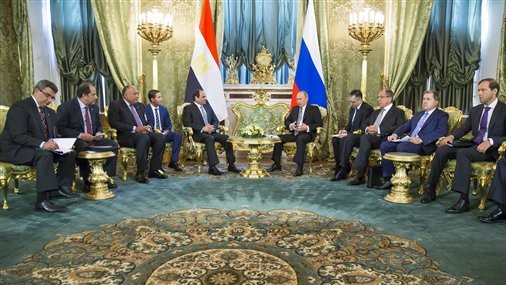
Opening a meeting with Putin in Moscow, Sissi said “the Egyptian people” are hoping for broader ties with Russia in all areas, particularly in fighting terrorism in the Middle East.
Sissi’s Russian visit, his second in the past three months, highlights Moscow’s attempts to expand its influence in Egypt at a time when Egyptian-US relations have soured in the aftermath of the ouster of Islamist President Mohammed Morsi.
Putin told reporters after the talks that regional powers should join their efforts to combat the Islamic State group.
“(We) have underscored the vital importance of setting a counter-terrorism front to include key international players of the region including Syria,” he said.
Putin and Sissi were also expected to hammer out the details of a joint project to build Egypt’s first nuclear power station but Putin told reporters on Wednesday that experts from both countries are still working on it.
Egypt has suffered a wave of attacks against its military in the Sinai Peninsula over the past months, by an Islamist group calling itself Walayat Sinai (the Sinai Front). Another group, Ansar Bayt al-Maqdis, is also fighting the Egyptian military in the Sinai.
The largest of these came in early July, when a coordinated attack on Egyptian army checkpoints in the northern part of the peninsula, including multiple suicide car bombings. At least 50 Egyptian soldiers were killed in the attack.
Ansar Bayt al-Maqdis terror group claimed responsibility for the July attack, saying its fighters targeted a total of 15 army and police positions and staged three suicide bombings.
— Times of Israel staff contributed to this report.