Erekat, Livni optimistic about Trump’s push for peace
At regional conference, former Israeli negotiator says wider Arab support for an Israeli-Palestinian deal is crucial and a 'game-changer'
DEAD SEA, Jordan — Two veteran Israeli and Palestinian negotiators, who logged many hours together in failed efforts to strike a deal, said Saturday they are optimistic about President Donald Trump’s Mideast bid.
Senior Palestinian official Saeb Erekat and former Israeli foreign minister Tzipi Livni spoke at a regional World Economic Forum meeting at the Dead Sea in Jordan. Erekat remains the chief Palestinian negotiator while Livni is a senior member of the opposition Zionist Union party.
Livni told the forum that the chances for peace remain. “I believe there is a huge opportunity to work together,” said Livni. “Two states for two peoples is reasonable. I am not ready to give up yet.” for cultural peace. This is a good place to start,” she said indicating that as the two peoples become more comfortable with the idea of peace, the better the chances it will have of flourishing.
Livni, who also met with Palestinian Authority President Mahmoud Abbas on the sidelines of the conference, pointed out that it is important to keep out the “background noise” during negotiations. Abbas was quoted in Hebrew media reports telling Livni he is prepared to meet with Prime Minister Benjamin Netanyahu, and saying it was time to revive peace talks.
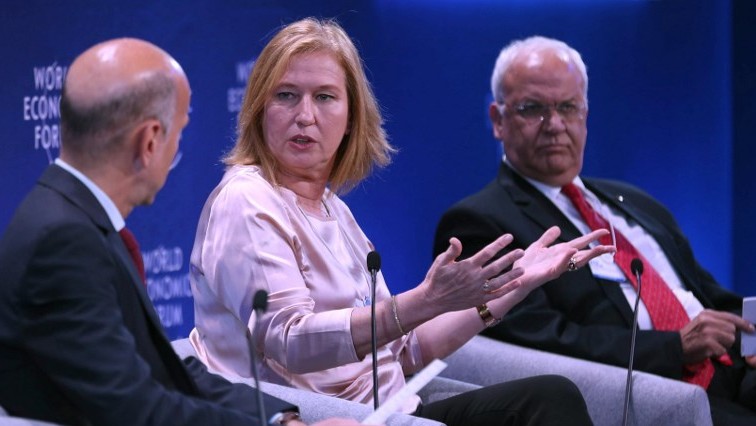
“In the past, we had an understanding about what is needed for cultural peace. This is a good place to start,” she said indicating that as the two peoples become more comfortable with the idea of peace, the better the chances it will have of flourishing.
Livni said strong Arab support for a future Israeli-Palestinian deal is a “game changer” that could help sway a skeptical Israeli public.
“There is a big opportunity now in the region,” Livni told The Associated Press. “The role of the Arabs is very important since basically they can back any decision-making by the Palestinians, but also send a message to the Israelis that peace is not just between Israelis and Palestinians, but can change the entire region.”
Arab countries offered Israel normal ties in exchange for a withdrawal from the lands Israel captured in the 1967 Six Day War as far back as 2002, but Israeli governments did not embrace the so-called Arab Peace Initiative, instead expressing a series of reservations.
Livni said the Arab Peace Initiative sends an important message but suggested each side could take interim measures instead of waiting for a final peace deal. She said the Arab world could take steps toward Israel in exchange for Israeli gestures toward the Palestinians.
Livni said Netanyahu would have a parliamentary majority for any peace moves, despite his current right-wing coalition.
“There is a majority in the Israeli parliament and in the Israeli public that support not only the vague idea of two states for two peoples, but really decision-making,” she said.
Trump was in Saudi Arabia on Saturday, the first stop of the president’s first international trip, at a time when his young administration is engulfed in controversy. On Monday and Tuesday, Trump is to visit Israel and the West Bank, for meetings with the Israeli and Palestinian leaders.
In Saudi Arabia, Trump is meeting with Arab leaders to forge stronger alliances to combat terrorism.
Erekat told The Associated Press that he is encouraged by Trump’s determination, describing the president as “very serious” about reaching a deal.
The Palestinian negotiator dismissed reports that Israeli and Palestinian delegations would meet later in the week, following Trump’s visit to the Holy Land. The last round of US-led negotiations broke down in 2014, and no serious talks on the leadership level have taken place since 2008.
“I don’t think there is anything set yet, not in Cairo, not in Ramallah, not anywhere,” Erekat said. He met two days ago with Trump’s regional envoy, Jason Greenblatt, and said they were trying to decide on the next steps.
Livni has also met several times with Greenblatt in recent weeks.
Erekat said there are two conditions for peace in the region. First, the leadership of the state of Israel must recognize the state of Palestine. Second, it is important to recognize that 55% of the Arab population is under the age of 25; they have expectations and needs that must to be fulfilled, particularly the opportunity for employment, according to a statement from the conference.
“As Arabs, we need to revisit education, good governance and the rule of law. We cannot continue business as usual,” he said.
Erekat told the conference that the Palestinians would like to see an Israeli settlement freeze.
“We expressed our readiness to engage seriously, but it is not about sitting down to talk or about negotiations. It is about decisions. We need a prime minister in Israel who is willing to put a map on the table to define borders, security and water,” Erekat said.
“We need to reach an agreement that is fair. No one can dictate an agreement to us. That will not satisfy the Palestinians,” he said, calling for a “culture of peace”.