Several killed as explosions rock downtown Jakarta
Two civilians, policeman and four assailants dead as bombers and gunmen attack Starbucks and shopping center near foreign embassies in Indonesian capital
Gunfire and explosions in the Indonesian capital Jakarta killed several people Thursday, with police flooding the streets amid fears gun-toting militants were still on the run.
Police said four of the attackers and three others were killed in the brazen attacks, which came after several warnings in recent weeks by the police that Islamic militants were planning something big. It was unclear if other perpetrators remained at large.
Witnesses said at least one gunman had attacked a Starbucks cafe in the city center — near a cluster of embassies — shooting at bystanders, as a series of explosions rocked the area.
No one has claimed responsibility for Thursday’s attacks, which took place in front of the Sarinah shopping mall on Thamrin Street that prompted a security lockdown in central Jakarta and enhanced checks all over the crowded city of 10 million.
Badly mangled bodies were seen lying on the streets as security forces moved in, with regular reports of gunfire and warnings of snipers in the area.
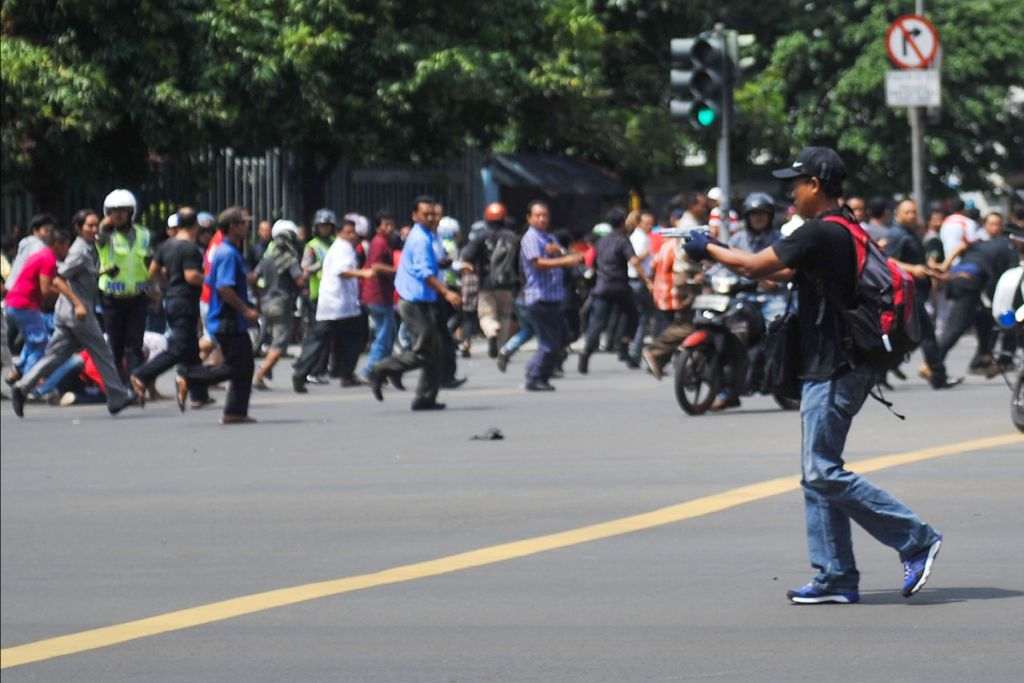
National police spokesman Anton Charliyan told AFP one officer was among the dead.
“For now the gunfire has stopped but they are still on the run, we are afraid there will be more gunshots,” he said.
Jakarta police spokesman Col. Muhammad Iqbal said seven people, including four attackers, were killed in the brazen attacks in the downtown capital.
He said police have recovered the bodies of the attackers, but it is not clear if more remain at large.
Two civilians are also confirmed as having died, Deputy National Police Chief Budi Gunawan told reporters.
Two attackers were killed in a shootout with police, while two others were suicide bombers, he said.
Of the two civilians, one was a foreigner, Gunawan said.
As well as the known deaths, a number of people were feared injured in Thursday’s assault, with an eyewitness telling AFP he had seen a “terrorist” open fire on a local journalist. Gunfire and explosions continued to be heard hours after the attack.
Iqbal said that five police personnel, one foreign civilian and four Indonesian civilians were injured.
Ruli Koestaman, 32, who had been in a meeting in a nearby building, said the attack started around 10:35a.m. Jakarta time (5:35 a.m. in Israel).
“Then I heard a loud bang, boom. It felt like an earthquake. We all went downstairs,” he said.
“We then saw that the Starbucks downstairs was destroyed too. I saw a foreigner, Westerner, a man, with a mangled hand but alive. A Starbucks waiter then ran out with blood coming out of his ear. And I asked anyone hurt inside, he said yes, one. Dead already. Then everybody gathered and a terrorist appeared. He had a gun and started shooting at us and then at Starbucks. Then the police post… exploded.”
Koestaman said the attacker shot at a reporter who was at the scene.
“Police then started to shoot at the guy, who kept reloading his gun. And then there was another explosion. Then shootings.”
The blasts — at least six, according to eyewitnesses — were close to a shopping center, the Sarinah. The area also has many luxury hotels, and offices and embassies, including the French. The other set of explosions were in neighborhoods where the embassies of Turkey and Pakistan are located.
Graphic photographs from the scene showed the bloodied bodies of what appeared to be two men in civilian clothes lying by the side of a road next to the wrecked police post.
Another body, also apparently male, dressed all in black was pictured lying on his back in the center of the street while another, almost naked, lay nearby.
The first explosion appeared to have triggered a gun-battle between the attackers and anti-terror police squads.
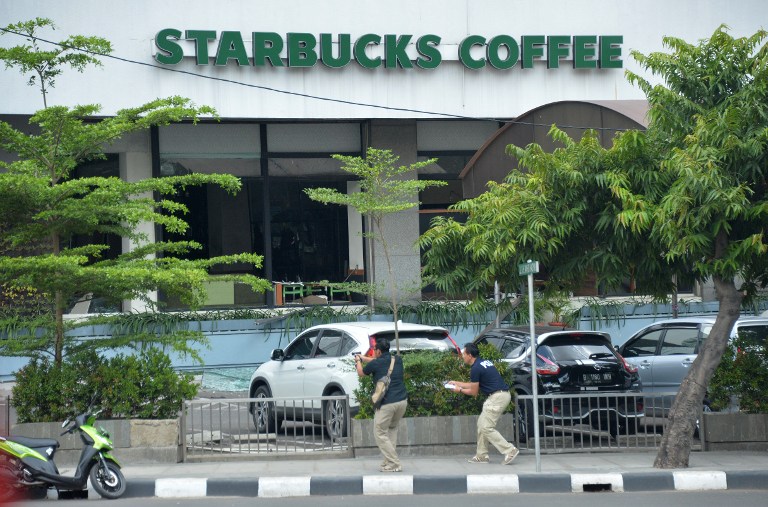
Tri Seranto, a bank security guard, told The Associated Press he saw at least five attackers, including three suicide bombers who exploded themselves in the Starbucks.
He said he was out on the street when he saw the three men entering Starbucks and saw them blowing themselves up one by one. He said the other two attackers, carrying handguns, entered a police post from where he heard gunfire. He said he later saw one policeman dead and three seriously wounded.
He said the two gunmen ran away with police chasing them.
Anton Charliyan, national police spokesman, told Metro TV, that the bombers did not blow themselves up., and that no arrests had been made.
“This is not a suicide bomb, based on witness account at the police post it was something that was thrown, whether it was a grenade or a bomb we still haven’t been able to confirm.
He said at least one attacker — maybe two — fled afterwards, using a motorbike.
Police had earlier said the explosions were caused by bombs.
Officers at the scene told AFP reporters to “get back” because there “is a sniper” on the roof of a building.
Plainclothes police officers were also seen aiming their handguns towards people outside the Starbucks.
Other armed officers were seen taking up positions behind a vehicle.
It was not immediately clear who was behind the attacks.
Indonesia, the world’s most populous Muslim-majority country, suffered several major bomb attacks by Islamic radicals between 2000 and 2009, including the 2002 bombings on the resort island of Bali that killed 202 people.
A security crackdown weakened the most dangerous extremist networks, leading to a long lull in large-scale strikes. However, the emergence of Islamic State has raised concern that Indonesians returning from Middle East battlefields could stage attacks on home soil.
Indonesian President Joko “Jokowi” Widodo said in a statement on national TV the situation is under control and is calling on people to remain calm.
“The state, nation and people should not be afraid of, and lose to, such terror acts,” Jokowi said.
The bombs come just weeks after Jakarta was placed on high alert after anti-terror police foiled what they said were plans for an New Year suicide attack in the Indonesian capital.
Late last month police said they had arrested two men, including a member of China’s Uighur minority, who they claimed were involved in the plot.
After a series of attacks on foreigners in the last decade, Indonesian extremists have in recent years directed their violence at domestic “enemies of Islam”, mostly police.
There have been no attacks against foreigners since the 2009 twin hotel bombings in Jakarta that killed seven people.