Falling planes and plummeting ties
German airliner takes tragic nosedive; US-Israel ties plunge to new, and strategically scary, depths
A week and a day after Israelis went to the polls, the election, subsequent politicking, and attendant tensions with the US over peace talks and Iran are moved off the top spot in the news agenda for the first time, as a horrific plane crash in the French Alps that left 150 people dead covers Israeli front pages Wednesday.
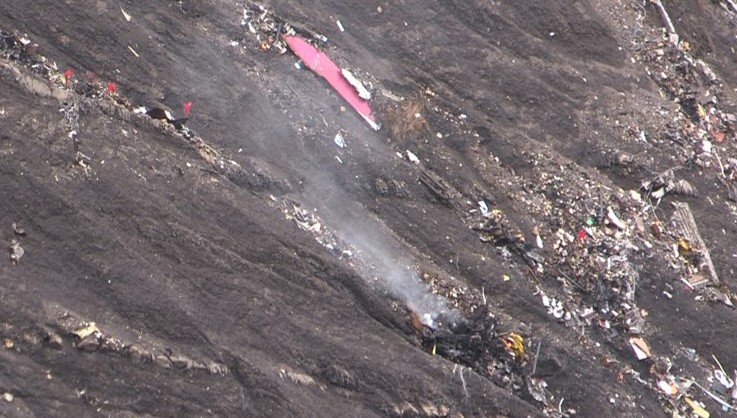
“Eight minutes of hell” reads Yedioth Ahronoth’s kitschy front page headline, accompanied by an overhead picture of wreckage strewn across a mountainous stretch, the shot garishly dressed up with a picture of a non-crashed Germanwings plane and a crying woman, like some nightmarish decoupage.
Beyond the boilerplate coverage of the crash, the paper zeroes in on Eyal Baum, the sole Israeli aboard the flight from Barcelona to Dusseldorf. The paper reports that Baum, 39, was born in Hod Hasharon, but moved several years ago to Spain with his wife and baby daughter. There, he worked for a tech company and would often fly back and forth to Germany.

“Eyal was a happy and simple guy, someone who was contented and loved to live. He was a modest guy whose smile never left his face,” acquaintance Sali Sklar, who knew him in Barcelona, tells the paper. “I remember he told me once that he always volunteered to travel for business trips. He loves that, loved to travel.”
Baum’s parents heartbreakingly tell the paper that they are hoping for good news, even though officials announced everyone on board was killed.
“We still don’t know exactly what happened, we are waiting for an update from the Foreign Ministry,” the parents are quoted saying. “All the details or what happened are still not clear and everything is still in initial stages, and we are hoping for good news.”
In Israel Hayom, commentator Aaron Lapidot wonders how a plane can just plummet from the sky in ideal flying conditions.
“It’s too early to know what happened. But there are a few scraps of information that can point in a direction,” he writes. “The plane started to fall a minute after reaching cruising altitude at about 35,000 feet, and it dropped within eight minutes to about 6,000 feet. That height is not possible for a flight over the Alps, and the mountain peaks would scrape the belly of the plane at that altitude. For those eight minutes, the pilots did not contact the control tower. It’s possible they were looking for an emergency landing and didn’t manage, or maybe not and maybe they just fell from the sky. Most accidents are the result of human error. Few occur from technical problems and even fewer from purposeful terror. The answer is buried in the black boxes of the plane, which have already been found.”
Haaretz is the only paper not to lead with the air disaster (though it gets major front page real estate), instead sticking with the tried and true horse-trading going on as Prime Minister Benjamin Netanyahu attempts to sew together a coalition.
The paper starts off with the news that Kulanu leader Moshe Kahlon will be appointed finance minister, to the surprise of exactly nobody. However, party sources tell Haaretz that Netanyahu will still have to sweeten the deal by offering Kulanu one-third of the ministerial slots and official posts Likud gets, since it has one-third of the seats of the winning party.
“Party sources suggested this would amount to three ministerial portfolios: the Finance Ministry would be granted – as agreed – to Kahlon, General (res.) Yoav Galant would be a candidate for either internal security or intelligence minister. Either of these jobs would include a position for Galant in the inner cabinet, strengthening Kahlon’s position in the coalition,” the paper reports.
The Wall Street Journal sets the agenda
Tensions with the US persist in the morning fish wraps, especially in Israel Hayom, which is so inspired by a two-day-old Wall Street Journal comparison of US President Barack Obama to George Orwell that it paraphrases Bret Stephens for its front page headline “The upside down world of Barack Obama.”
Inside, the paper’s Boaz Bismuth tries his own hand at Obama bashing, calling a separate Wall Street Journal report, which said that Israel was spying on the US’s talks with Iran, part of Obama’s “revenge campaign” against Netanyahu. After writing that Israel would never do such a thing (and indeed it was officially denied) and taking a backhanded swipe at the US for its own spying on allies recently uncovered by Edward Snowden, Bismuth counsels Obama to cool his jets.
“Obama needs to understand that in all of this, Israel is not alone: We also have France, the Arab states and the Republicans,” he writes, conjuring up flashbacks to George W. Bush’s defense of his flaccid Iraq war coalition of the willing. “Bibi is not alone. And after the last elections, Mr. President, I’m sorry to say, but Netanyahu is Israel.”
Less skeptical of the WSJ report is Yedioth Ahronoth’s Ronen Bergman, considered among the country’s most respected intelligence journalists. Bergman defends Israel’s supposed spying, writing that everyone does it and citing the US’s spying on German chancellor Angela Merkel and a quote from former CIA chief Michael Hayden justifying snooping on her predecessor Gerhard Schroeder, who had sour ties with the US.
‘This is more proof that the crisis between the White House and Prime Minister’s Residence has strategic implications well beyond the ties between the two leaders’
However, Bergman writes, Jerusalem made a damnable mistake in leaking the information to US lawmakers and meddling in American politics.
“The defiant manner in which Netanyahu has managed his policies vis-à-vis Washington has been a mistake. If Israeli officials, as part of those same aggressive policies to influence the US government via Congress, use intelligence information gathered from US sources, that’s no less ridiculous,” he writes. “And even more than that: There’s a serious danger that intel information was leaked. The most worrying of all is the leak to the American press. This is more proof that the crisis between the White House and Prime Minister’s Residence has strategic implications well beyond the ties between the two leaders.”
Chemi Shalev agrees that the catastrophe extends past the personal animosity between Netanyahu and Obama, writing that the White House is now letting loose with six years of pent-up righteous indignation against Jerusalem’s moves. And, he says, it’s likely only going to get worse.
“One way or another, don’t put too much stock in the assurances being given by both sides that the tensions are confined to the top while their subordinate echelons maintain business as usual: it doesn’t work that way,” he says. “Throughout the administration there will be many officials who identify with the White House’s fury at Netanyahu and others who will gauge where the wind is blowing so they can expediently start to follow it. The longer the feud continues, the greater the damage it causes, and the leak to the Wall Street Journal … was just a shot across the bow.”