Female power anchors video art at Ticho House, once home to doyenne of Israeli art
'Bliss' and 'Zahara' present artful, dystopian views of women in exhibit at historic Jerusalem artist's villa
When artists Meirav Heiman and Ayelet Carmi unveil their latest video installation, “Bliss,” at Jerusalem’s Anna Ticho House on July 9, they’ll bring female power, nature and a sense of Israel’s realities to the historic museum.
The two female artists, known for video installations that often place women and family in dystopian worlds, do so again with “Bliss,” their new, nearly 10-minute film.
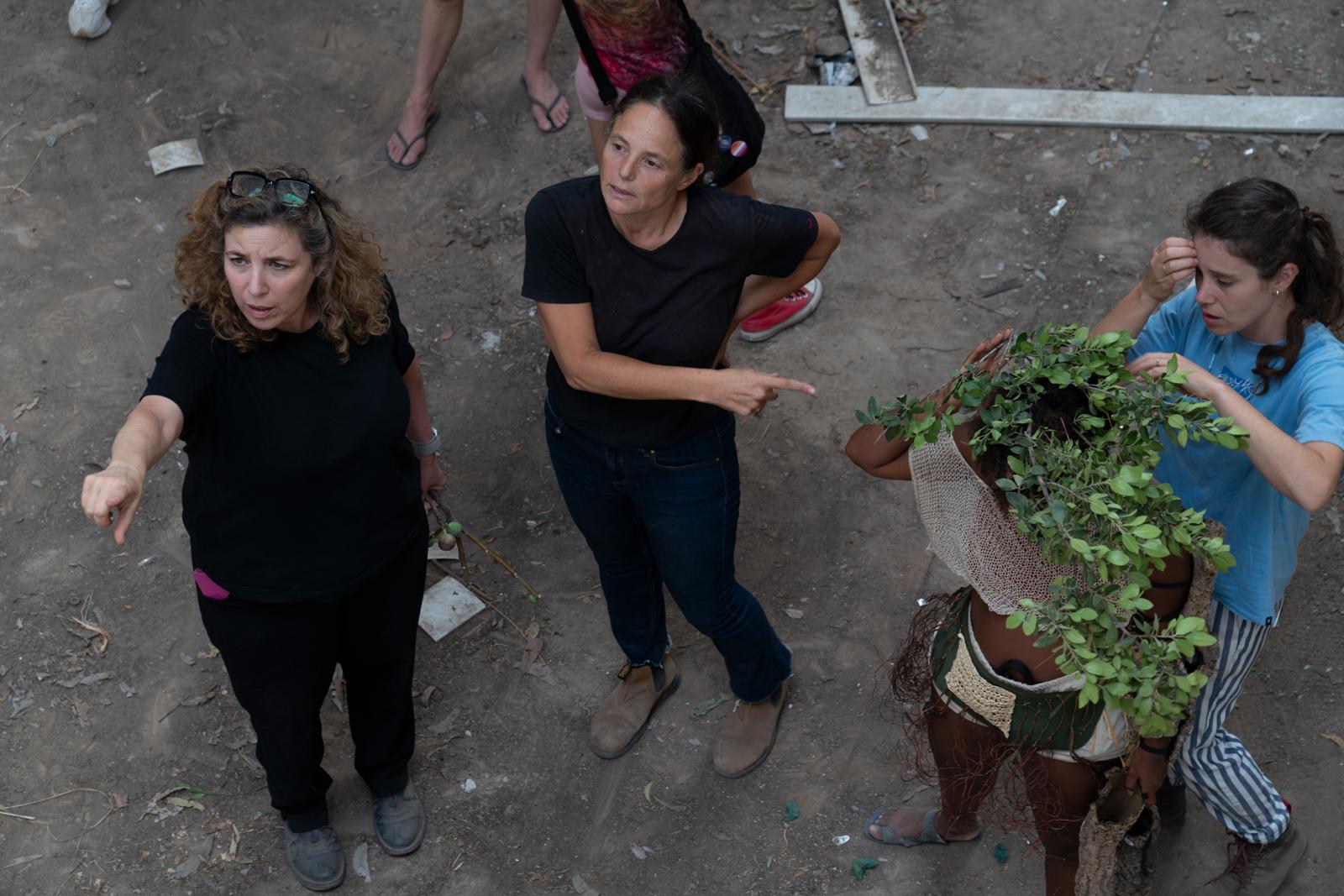
In “Bliss,” female figures run through a deserted field toward an abandoned building, where they silently create a biosystem for themselves and are transformed into a living column.
The women, who represent all ages from infant to elderly, each have a specific role in the deserted building, whether to provide food or drink, care or sustainability.
This 10-minute journey into another world feels both realistic and dystopian at the same time.
“It’s connected to thoughts about nature, ecology, time,” said Heiman. “There’s something very communal about it, but there are also the complications of how to build this column and live in it, how to create an alternative community.”
Heiman and Carmi told The Times of Israel that the process of creating the video work took about four years.
Their brainstorming began before the coronavirus pandemic, as they sat together and considered images, the ages of the actors, and the idea of an entire community that lives on a column.
The column refers to the Greek caryatid, a sculpted female figure serving as an architectural support that takes the place of a column or a pillar, such as those at the Acropolis in Athens.

“Bliss” was filmed in a dilapidated building in Beit Dagan in central Israel that felt like part of the natural atmosphere, said Heiman.
One of the building’s columns was prepared for the shoot with small shelving placed for the women to sit or perch on, and each actor was secured to the pole for safety.
“We always try to relate to the women working with us as partners in the process,” said Heiman. “Everyone has a job in ‘Bliss,’ whether it’s the one who provides water or food, the one who weaves a basket, there’s a design for each character, and everyone brings something of themselves.”
“It’s a conversation,” said Carmi.
The pair filmed the work several days before the Hamas terrorist attack of October 7, 2023.
“You’re filming it, and then three days later, the world is upside down,” said Carmi, adding that one of the actors, a young woman who is also her neighbor, was on reserve duty by late in the day on October 7.
“A week and a half later, and we’re preparing a package to bring her, full of baked goods and sweets. And you start looking at all the scenes differently, like the one of them running through a field in the beginning. It suddenly felt completely different,” said Carmi, referring to the scenes of people fleeing from Hamas terrorists at the massacre at the Nova rave, and in the kibbutzim that were invaded.
“It was years in the making, and it was just a matter of finding the right time to show it at Ticho House,” said Ticho House curator Timna Seligman, referring to the historic home of the late 20th-century artist Anna Ticho, which is now part of the Israel Museum group. “It had to be within the context of Anna Ticho and the house and its history.”

Heiman and Carmi have different visions, techniques and skills, said Seligman, and that’s an essential part of the video, about the communality that women bring to one another — “a hand up all the time instead of one-up-manship.”
The video will be screened next to a museum gallery hung with Ticho’s portraits of women.
“Bliss” will also be shown alongside another of the pair’s video installations, “Zahara” (2021), premiering at a museum for the first time.
“Zahara” is based on the tragic story of Zahara Levitov, one of Israel’s first military pilots. The film reimagines what happened after her plane crashed in 1948 in Jerusalem’s Valley of the Cross, as she and an older woman make their way through modern city streets to the old Shaare Zedek hospital, where Zahara succumbed to her injuries.
The older woman is based on the figure of Ruth Schwartz, the future wife of IDF chief of staff and defense minister Moshe Dayan, who, with her sister Reuma Schwartz (who later married Israel’s seventh president, Ezer Weizman), heard the crash from their nearby home in Rehavia and ran to help Zahara, taking her to the hospital.
Like “Bliss,” “Zahara” exemplifies the conceptual world of Carmi and Heiman, said Seligman, presenting an archetypal female landscape based on larger-than-life historical figures that’s people with ordinary women with whom anyone can identify.
“Bliss” and “Zahara” will be exhibited at Ticho House until January 2026.