Fighting fire with fire
As riots persist, the Hebrew papers focus on Netanyahu and Abbas's ardent addresses
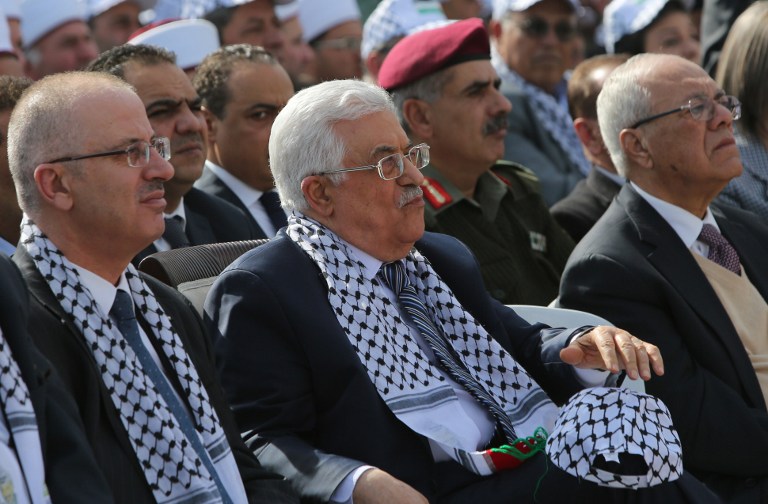
On the backdrop of ongoing clashes between Palestinians and Israeli forces, the Israeli press on Wednesday picks apart the fiery statements issued by Prime Minister Benjamin Netanyahu and PA President Mahmoud Abbas a day earlier.
All three national dailies spotlight Netanyahu’s comments on the security measures set to be introduced, which include house demolitions for terrorists and fines for the parents of rioters under the age of 18. The papers also highlight Abbas’s diatribe against Israeli activists who are “contaminating” the Temple Mount and may spark a global “religious war,” as well as remarks by Defense Minister Moshe Ya’alon, who warned of a further escalation.
Haaretz pits Netanyahu’s comments alongside Abbas’s, terming them both “belligerent statements.”
The left-wing daily proceeds to be uncharacteristically critical of Abbas, emphasizing that the PA has not issued a condemnation of the double terror attacks on Monday in which two Israelis were stabbed to death. The paper also accuses the PA leader of somewhat circuitously inciting violence against Israel in the Gaza Strip, by way of his criticism of Hamas in his Monday address, in which he accused them of violating the unity agreement in the bombings of Fatah leaders’ homes last week: “Abbas issued what seems to be a bill of divorce to Hamas – and in so doing, according to assessments, limits the prospects of reconstruction in the Gaza Strip, and indirectly contributes to increasing the tension against Israel there.”
Haaretz spares no criticism of Netanyahu, however, dedicating its editorial to the man who “forgot to be the prime minister,” and who, it argues, consistently undermines Arab Israeli identity.
The editorial lashes out at Netanyahu for “exposing his nationalist face to the public.”
The prime minister “systematically unravels sensitive seams in the fabric of Israeli life. He weakens Arab citizens’ feelings of Israeli identity and also demonizes Jewish citizens who want to solve the conflict by dividing the land (“for you, the only initiative is to jump off a cliff and capitulate”). The Netanyahu of the last few days is an even more violent, harmful version of the Netanyahu of 1996-99 (“the left has forgotten what it means to be Jewish”; “they are a-f-r-a-i-d”),” it writes.
With regard to the security situation, the paper cites a military source who said it remains unclear how long the instability will last.
Meanwhile, Yedioth Ahronoth takes a different tack in unpacking the prime minister’s initiatives to end the violence. The paper castigates the prime minister for making decisions without cabinet consideration, stating that during the cabinet meeting on Tuesday, the ministers were briefed on decisions that they were not party to.
The paper downplays Netanyahu’s plan to reduce the tensions. “At least in the meantime, the security forces have no plan to conduct a large-scale military campaign in the West Bank, but rather [intend to] contain the incidents until calm is restored through focused efforts, and avoid confrontation with the Palestinians.”
Amid the squabbling in the Israeli media about whether the current bout of violence can be aptly described as an intifada, Yedioth’s Ben Dror-Yemini takes it a step further, declaring the recent violence to be part of a “global intifada.” The columnist recounts the attacks by jihadists in New York, Canada, London, as well as the endless fighting in the Muslim world, and concludes: “Welcome to the global intifada.”
“It’s not the ‘occupation,’ or the foolish stubbornness of the activists on the far right who want to change the status quo on the Temple Mount, since this is a global conflagration… At some point the world will wake up. At some point it will be made clear that this is a global intifada. One can just hope that it happens before it’s too late.”
Meanwhile, Israel Hayom touts the prime minister’s comments as an effective way to combat the wave of violence, spotlighting Netanyahu’s reassurance, “We will win this fight, too,” in its headline.
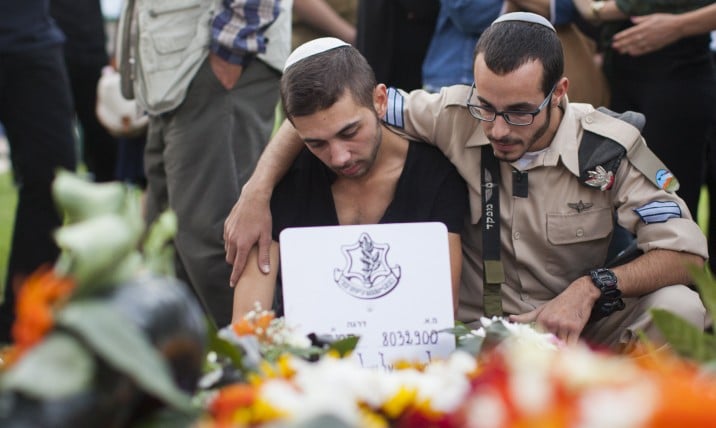
The three newspapers also highlight the funerals of terror victims Dalia Lempkus and IDF soldier Almog Shiloni, and the eulogies of Lemkus’s sister and Shiloni’s twin brother.
“I know you want me to say that everything is all right, and that you’re watching over us from above, “ Sahar Shiloni said Tuesday at the Mount Herzl military cemetery, where over a thousand people came to pay their last respects. “Everyone who really knew you would be proud of you. And I, as your twin brother, your other half, am the most proud of you. Even as I arrived at the hospital, I told Abba [father]: ‘There’s no way [that he won’t survive], he’ll pull through this.’”
“I had a whole heart, and now I have half a broken heart.”
Lemkus’s sister Shoshana recalled a 2006 stabbing attack in which Dalia Lemkus was lightly injured, Yedioth reports.
“He missed you then,” she said. “It’s unfortunate that they released that terrorist, and I hope this one will not be freed.”