Fires give way to fears of being left high and dry
Despite government pledges to cut red tape, blaze victims still dread squelching their way to recovery, while experts warn global warming and too many trees can keep this rash aflame
With rain and moister weather still a few days out, Israel is still under intense threat of new fires. But after Sunday came and went without any major new conflagrations, the focus shifts from squelching blazes to victims picking up the burnt pieces of their lives and starting the long and painful path to recovery.
And in a sign that the country is beginning to move on, papers are taken up with another kind of fire after a clash with Islamic State-linked fighters on the Syrian border.
While Israel Hayom’s headline “Starting over again” offers an upbeat assessment, with the paper playing up all the help the government is putting forward, Yedioth Ahronoth shows that the assurances of no red tape are about as comforting to some as a fire retardant-soaked blanket.
“No bureaucracy for getting compensation for damages from the fire. That was the central message to come out of government ministers’ mouths yesterday as they met for a special conference in Haifa,” ledes the paper’s top story. The tabloid also includes a Q&A to answer some of the victims’ most burning questions, like what kind of damages would be received by those whose home was burned in a fire found to be nationalistic arson versus those whose lives were destroyed thanks to good old negligence.
If that sounds complicated already, put yourselves in the shoes of those who will actually have to navigate the warren of supposedly stumbling block-free offices and paperwork to get compensated.
Yedioth’s headline reads “What scares us most is the bureaucracy,” below a picture of the forlorn-looking Agion family in their gutted Haifa home.
The story tells the tale of father Dan Agion as he tries to find out how he’ll be taken care of and when, along with the hundreds of other people in the same boat in the hard-hit Ahuza neighborhood.
“Hundreds of people converged on the service center set up by the municipality and the property tax office in a nearby shopping center. The line was long and the answers were frustrating. Dan left the registration stand but suddenly stopped in his tracks and remembered: his family has nowhere to live,” the paper reports, giving a taste of what has become the Agions’ life.
“Calling different hotlines, standing in line, bringing forms, it’s a real challenge,” his wife Michelle is also quoted telling the paper.
The paper also focuses on the emotional toll wrought by the flames, with its top story a roll call of young girls talking about how they are dealing with the fires that destroyed their homes, somewhat strange for its singular focus on that demographic. One girl, 13-year-old Noara Dilayon from Halamish, talks of losing her bedroom, which the paper describes as “her sanctuary.”
“My room was always a mess. I had a lot of pictures of fun times with friends, letters from [youth group] counselors, diaries, clothes I loved, jewelry that was very dear to me, my goldfish that I just got as a present two days,” she’s quoted telling the paper. “It’s hard to explain this situation where the house you grew up in, the only place you’ve ever known – and most importantly your room which was your whole world and your fortress, everything is gone and nothing remains.”
Even if Sunday managed to pass without any major new fires, Haaretz isn’t one to rest on its haunches, writing of persisting dangers, both from the fire and from a more familiar foe.
In one article, the paper’s Nir Hasson tries to explain what made the forests outside Jerusalem so flammable and why this might not be a one-off. The paper quotes Prof. Yehoshua Shkedi, the head scientist at the Parks Authority, saying that part of the problem is that Israel has too many trees, with him going as far as counseling that on the Jewish arbor holiday of Tu B’Shvat, people should go out and cut down trees instead of planting them.
Meanwhile, Hanoch Tzoref, a senior official at the JNF-KKL, which is responsible for planting many of those trees, says the problem is climate change.
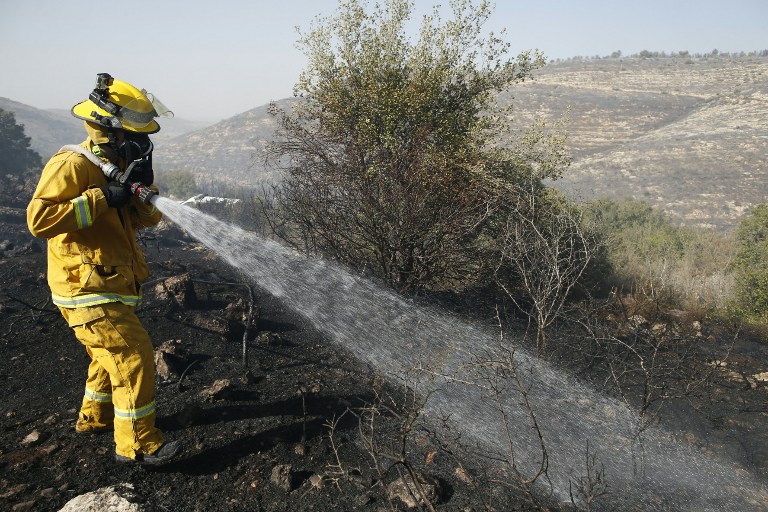
“Winter is beginning later, and the months of November and December have become very dry, with strong winds. Continuous dry, strong winds not only dry the laundry, but also the vegetation, and turns it into highly flammable material,” he’s quoted saying, while adding that he doesn’t remember a dry spell quite like this one ever before.
The paper’s lead story, though, deals with an assessment from the head of military intelligence warning of instability in the Palestinian Authority, which could lead to a fresh wave of terror. The paper quotes Herzl Halevy saying that the fires were actually part of the wave of violence, and that the Palestinians will continue coming up with new ways to terrorize Israelis.
“We will find a way to deal with the fires, but ultimately new inventions will turn up,” he’s quoted saying. “It will come in waves, and we need to be prepared.”
Islamic state of play
As if Israel worrying about new terrorist inventions isn’t enough, the IDF already gained a brand-new enemy on Sunday, after it had a direct confrontation with IS-affiliated fighters on the Syrian border for the first time.
In Yedioth, Yossi Yehoshua notes that the Israeli military was quick to term the clash a “local incident,” reflecting the fact that despite its unprecedented nature, the army doesn’t think this is the start of a wider engagement with the group.
While Israel Hayom buys the army’s line, burying the story in the back of the paper with all of four paragraphs and not at all playing up the fact that it was first time Israeli forces have engaged IS, others aren’t so quick to downplay the cross-border exchange.
Nahum Barnea in Yedioth links the fight to what’s happening to the Islamic State in the wider world, and warns that on the Sinai border as well, things may be heating up.
“There’s a clear connection between the awakening of Islamic State in the Golan arena against Israel and its activities in the Sinai against Egypt and Israel and what’s happening on the groups’ eastern fronts in Raqqa and Mosul,” he writes, referring to the group’s bastions in Syria and Iraq respectively. “The more IS is pushed against the wall in Iraq and Syria, the orders to its proxies around the world, including along the border with Israel, will be to ramp up efforts to create victories to offset the harsh blows the group is taking.”
In Haaretz, Amos Harel writes it’s not clear-cut whether the incident will or won’t lead to more, though he assesses that Israel can handle it.
“Israel ended with the upper hand, but a new ledger in blood has been opened. The Yarmouk Martyrs Brigade is thought to have about 600 fighters in the Syrian villages in the border triangle. That’s nothing compared to what the IDF can field, but it’s a force that can harass the IDF and Israeli communities near the border,” he writes. “In the near future it will become clear whether this was a lone incident or the first signs of a new front in the southern Golan.”