French lawmakers approve bill to revoke terrorists’ citizenship
After November Paris attacks, controversial reform would change constitution to give sweeping new powers to police, judiciary
PARIS (AP) — French lawmakers have approved a divisive bill aimed at making it possible to revoke the citizenship of people convicted on terrorism charges.
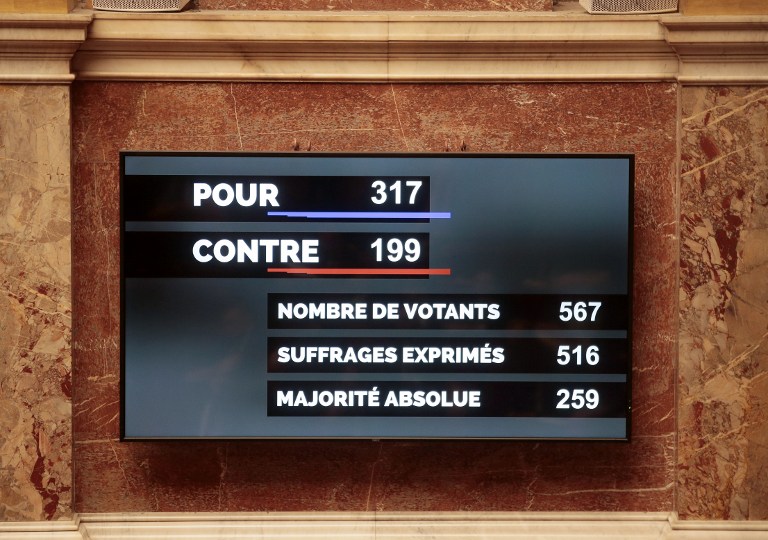
The bill, presented by Socialist Prime minister Manuel Valls in the wake of the Paris attacks last year, passed by 317-199 Wednesday in parliament’s lower house, the National Assembly.
The measure revealed deep division among the ruling Socialists. Many on the left expressed indignation at the move and refused to vote for it. Justice minister Christian Taubira resigned last month in protest. The measure also divides the opposition conservatives.
Valls justified the need for the bill by the terrorist threat. “Because we are at war, we must unite,” he told journalists after the vote. “This is a great day for the Republic, for unity, for France and for the fight against terrorism.”

The reform, which would alter the Constitution, is still far from being definitively adopted. It also needs to be voted on by the Senate and ultimately would require a three-fifths majority vote from lawmakers of both houses.
The government says the measure would concern a very small number of people but is of high symbolic value. The decision to revoke a person’s French citizenship would be made by a judge and would apply to terrorism-related crimes.
Human rights groups had warned that the bill risked discriminating against minorities of immigrant background as the initial text targeted dual nationals only.
In response to the criticism, the Socialist government removed the mention of dual nationals and extended the measure to all French citizens. That risks leaving a person stateless, which could be in conflict with France’s obligations under international law.
Another measure in the bill would introduce the principle of the state of emergency into the Constitution. It would apply in the event of a terrorist threat or a natural disaster for a 12-day period that could be extended by a vote of the Parliament, as under current law.
The package must now gain the support of the Senate, or upper house of parliament, and then three-fifths of the Congress, the body formed when both houses of France’s parliament come together to debate revisions to the constitution.
The stakes were high for President Francois Hollande, who announced in the emotional aftermath of the shootings and suicide bombings that killed 130 people in Paris in November that he wanted to revise the constitution to toughen the fight against terror.
If the measures had fallen at the first stage, it could have dealt a fatal blow to Hollande’s ambitions of re-election in 2017.
‘Pointless’
Writing on his Twitter account ahead of Wednesday’s vote, right-wing politician Alain Juppe, a former prime minister seen as the frontrunner in next year’s presidential election, dismissed the reforms as “pointless” and said they “divide all the parliamentary groups — to be avoided!”
Cecile Duflot, a member of the green EELV party and a former minister in Hollande’s government, urged her fellow MPs to “resist the blackmail” posed by the nationality measure.
Rights groups and left-wing lawmakers say they believe police are abusing the additional powers, rounding up suspects with little proof.
In addition, Hollande’s former prime minister Jean-Marc Ayrault has publicly condemned the proposal.
But the government insists the measures are necessary as France faces a continued high threat from jihadist attack.
The Islamic State group claimed responsibility for the carnage in Paris, saying it was in response to French air strikes against the group in Iraq and Syria.
It was the second time in a year that jihadists had struck at the French capital. In January 2015, gunmen attacked the offices of the satirical newspaper Charlie Hebdo and a Jewish supermarket.