Hallelujah! Lost Leonard Cohen documentary resurfaces after his death
Tony Palmer's film of Cohen on tour aged 37 returns to offer an intimate glimpse of the performer who 'took no notice' of the cameras
NEW YORK — Aside from Leonard Cohen’s song “Tower of Love,” there was little pre-show chatter breaking the silent anticipation as moviegoers filed into Theater 3 of New York’s Film Forum in groups of twos and threes.
They were here to see “Leonard Cohen: Bird on the Wire,” Tony Palmer’s documentary about the singer, songwriter, novelist and poet.
Among those in the audience was Ann Weiss. She traveled two hours from Philadelphia, arriving outside the cinema just moments before the box office opened. She wanted to see the very first showing of the documentary’s first theatrical release.
“I loved him. I lived him. I felt his songs,” Weiss said. “The line of his that speaks to me the most is ‘There is a crack, a crack in everything, that’s how the light gets in.’ It’s not that it’s my favorite, that would be like asking me which of my children is my favorite, but it summarizes so much about life and pain and growth.”
Following Cohen’s 1972 European tour, which took the singer from Dublin to Jerusalem, the film raises the curtain ever so slightly on a deeply private and reflective man.
“Leonard speaks for all of us. He speaks for our hopes, our fears, our anxiety,” director Palmer said in a telephone interview. “He didn’t sing sentimental little love songs about Suzanne or Marianne or whomever was his lady friend at the time. He was singing about the world in which he lived and the world in which we live today. That’s what people find endlessly fascinating.”
The film’s backstory also intrigues people — for, once made, it was lost for nearly 40 years. As Palmer describes it, the story of how the documentary finally made it to the Film Forum could serve as the plot for a B-movie, Palmer said.
Palmer, whose body of work includes more than a dozen documentaries on subjects ranging from The Beatles and Jimi Hendrix, to Maria Callas and Yehudi Menuhin, met Cohen in 1971. Marty Machat, Cohen’s long-time manager, wanted Palmer to make a film of what was then billed as Cohen’s last tour.
According to Palmer, Cohen was hesitant to do the film. While he hoped it might bring him a wider audience, he was leery of allowing Palmer to essentially be a fly on the wall for the duration of the tour. He also didn’t want a typical tour film that showed him traveling from point A to point B with stops in between.
Once Cohen agreed to the film, he granted Palmer complete access. And so the camera is there as fans jostle and crowd the singer and as reporters question him as he stands on a tarmac. Palmer attended all 20 concerts, though he only recorded music on four or five occasions.
In the film, Cohen argues with promoters, declines advances from groupies, jokes with band members and once hurriedly leaves the stage on the final night of his tour. The camera follows Cohen through nondescript airports, on buses and in the narrow corridors separating his dressing room from the stage. It is there when Cohen cries in a dressing room in Jerusalem, the final night of his tour.
“He took no notice of us. He never made an objection at all. He lost awareness of the camera very quickly. It was absolutely clear he trusted me and knew we weren’t making a rock and roll movie,” Palmer said.
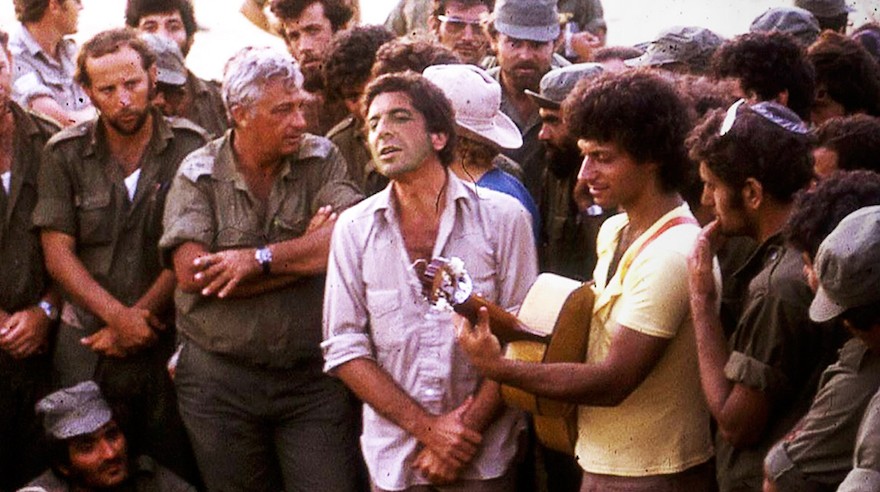
To Palmer that might be the most valuable part of the film, the way it gives “a real feel for the rough and tumble and difficulties of life on the road. I know of few other films where the backstage confusion comes so vividly to life, with Cohen apparently taking no notice whatsoever of the camera,” he said.
Yet, as the story goes, when Cohen saw the documentary’s final cut he was less than pleased. He thought he appeared “exhausted, even wasted” and too confrontational, Palmer said.
Although Palmer didn’t agree, his “regard for him as a poet, a performer and as a man had grown hugely during the film, so I wanted to give him the benefit of the doubt,” Palmer said. The director suggested a re-edit.
Nine months and hundreds of thousands of dollars later a second version was ready. Cohen was displeased with that cut as well, but it was shown once at the Rainbow Theatre in north London on July 5, 1974.
After that it disappeared without a trace until 2010 when 294 rolls of film were found in a Hollywood warehouse. Some of the cans were so rusted they had to be hammered open. Ultimately, Frank Zappa’s manager shipped the cans to Palmer.
At first the director didn’t think anything could be salvaged. None of the cans contained the negatives, some of the prints were in black and white, and much of it had been damaged beyond use.
‘When I finally opened one box and found most of the original sound dubbing tracks, I knew we had a hope’
“But when I finally opened one box and found most of the original sound dubbing tracks, I knew we had a hope of putting the jigsaw back together,” Palmer said.
For the next several months Palmer worked to restore the film. He put together almost 3,000 fragments until he had something very close to the original film.
“I’m happy and grateful there is a video document for any era of my father’s life. Palmer’s film is no exception, capturing quite compellingly (and unmistakably) the early 70s,” Adam Cohen, the late singer’s son, said in a Facebook message.
Indeed, newsreel type footage includes the Berlin Wall snaking through a bifurcated city and South Vietnamese Gen. Nguyen Ngoc Loan’s execution of Vietcong operative Nguyen Van Lem as well as smoke-filled hotel rooms and men with bountiful facial hair sporting mile-wide collars.
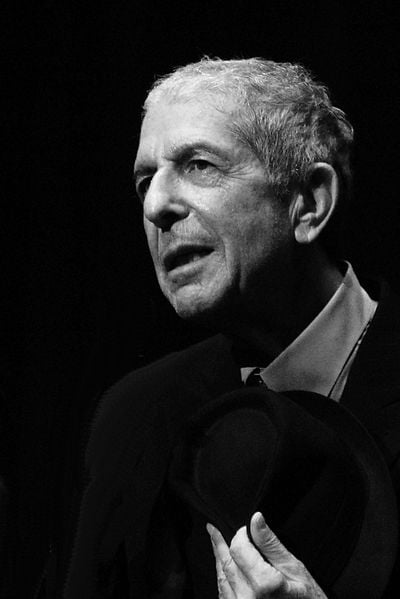
Aside from footage of Cohen performing many of his classics such as “Sisters of Mercy” and “Suzanne,” the film also captures the then-37-year-old backstage with his band, munching on side-of-the-road sandwiches, uncomfortably sitting for a radio interview, and once, in a shot evocative of André Kertész’ photo “Underwater Swimmer” the singer swims naked in an empty hotel pool.
Palmer once described Cohen as Bob Dylan’s blood brother. While both men wrote songs loaded with personal details, they transcended into something more universal, Palmer said.
Take the lyrics for “The Story of Isaac.” The song opens with references to a father appearing “when I was 9 years old.” On a personal level, Cohen’s father died when he was just 9,” Palmer said.
“But that’s not what the poem or the song is about. It is about those ‘who would sacrifice one generation on behalf of another,’ as Cohen says in the film,” Palmer said. “Leonard was completely preoccupied with the fuck up we make of our world. The Middle East preoccupied him. He felt he had a duty to reflect that in song. I don’t wish to over egg the pudding, but the songs do have a certain resonance today if you’re even half awake.”