Haredi MK to Netanyahu: ‘Keep ban on Temple Mount visits’
Moshe Gafni asks PM to prevent 'desecration of holy site' as police recommend lifting restrictions on lawmakers
A veteran ultra-Orthodox lawmaker on Wednesday urged Prime Minister Benjamin Netanyahu not to lift a ban on visits by political leaders to Jerusalem’s Temple Mount.
In a letter obtained by Army Radio, MK Moshe Gafni of United Torah Judaism said that ascending to the holy site “amounts to desecration at a place that is the most connected to the Jewish people and the holiest for them.”
According to a Channel 2 report Tuesday, the Israel Police has proposed that cabinet ministers and MKs be allowed to visit the site as long as they fulfill 14 conditions, including prior notification of a visit, limits on visiting hours, agreeing to enter without a security entourage or journalists, and a ban on delivering speeches at the site.
Netanyahu was expected to convene top security officials in the coming days to examine the police recommendations, the Prime Minister’s Office said Tuesday in response to the TV report.
The prime minister “will hear their positions and then make a decision,” a PMO statement read. “Until then, there is no change in the policy.”
Gafni on Wednesday came out against lifting the restrictions, which were imposed last October and renewed every few months since.
“Because of our sins, the Temple was destroyed and there is a punishable prohibition against going up to the Temple Mount,” the MK wrote to the prime minister.
The existing ban is important “both for political reasons and the way the world views it, and for security reasons and the incitement that follows these visits, mainly from the Muslim world, but not only,” he argued. “The main thing is that there is no need for it. It does not show sovereignty. On the contrary, it amounts to desecration of a place that is the most connected to the Jewish people and the holiest for them.”
Orthodox rabbis have traditionally prohibited their followers from going up to the site of the two biblical Jewish Temples over ritual purity concerns.
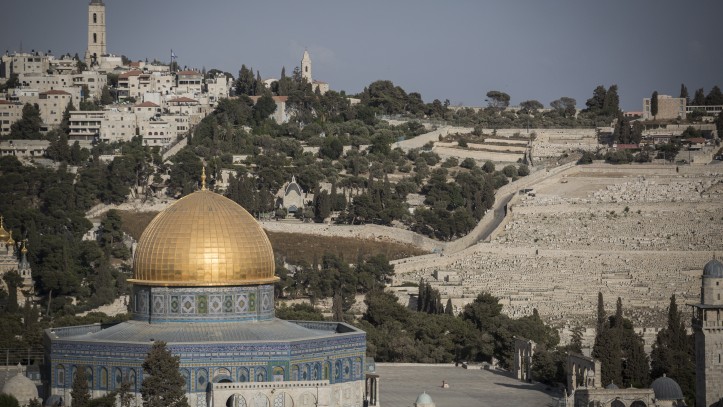
In recent years, rabbis more closely associated with the religious Zionist camp and the settler movement have advocated both going up onto the Mount and praying on it to establish a Jewish presence on the site, on which the third-most important holy site in Islam — the Al-Aqsa Mosque — rests. Under Israeli law, Jews are allowed to visit the Mount but not to pray there as part of a “status quo” agreement put in place by Israel after it captured the site from Jordan in 1967.
Netanyahu’s ban on visits by political leaders followed a visit last September by Agriculture Minister Uri Ariel (Jewish Home).
Arab (Joint) List MK Jamal Zahalka visited the site shortly after, and was filmed at one of the gates attempting to physically prevent Jews from entering and yelling “crazy criminals, you’re all Kahanists, fascists, racists, get out of here, you hurt Muslims!”
These visits, alongside accusations by Palestinian preachers that Israel was secretly plotting to “destroy” the Al-Aqsa Mosque, and campaigns by Jewish lawmakers to allow Jewish prayer there, were seen by many, including Israeli and Palestinian security officials, as contributing to tensions that helped stoke violent clashes in Jerusalem and the wave of Palestinian terror attacks launched in October 2015.
Likud MK and Temple Mount activist Yehudah Glick, one of the most active proponents of Jewish prayer on the Mount, called Tuesday on the prime minister and Knesset Speaker Yuli Edelstein to accept the police recommendations.