Hezbollah terror chief blown up. Israel not blamed!
The Shiite terror group, most unusually, is not accusing Israel of assassinating Mustafa Badreddine, killed in Damascus. So who did it?
Mustafa Badreddine, the heir to Imad Mughniyeh as Hezbollah’s terror chief, had no shortage of enemies.
He was wanted in the US and in Saudi Arabia for his part in the murder of former Lebanese prime minister Rafik Hariri in February 2005. He was the sworn enemy of opposition activists in Syria. Of Islamic State. Of Al Nusra Front. Of Israel. And that’s not the full list.
Badreddine was also involved in a great deal of the clandestine, illicit activities — drugs smuggling, weapons smuggling and more — by which the Shiite terror ground funds its various military actions.
Hard to know, then, who killed him.
In an official statement on Friday morning, Hezbollah didn’t claim to be certain. While pro-Hezbollah media had quickly pointed the finger of blame at Israel, the statement did not. It said only that “an initial investigation shows that Mustafa Badreddine was killed as a result of a large explosion at one of our bases near the Damascus International Airport. We are conducting an investigation to find out the circumstances of the explosion – whether it was caused by an aerial assault, artillery strike or a rocket. We will publish our findings soon.”
And the early reports on Al-Mayadeen, a website affiliated with Hezbollah, to the effect that Badreddine was killed in an Israeli airstrike, were subsequently taken down.
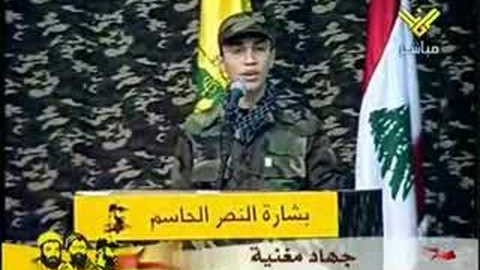
After similar incidents in the past, Hezbollah has often been quick to hold Israel responsible. That was the case with the assassination of Hassan al-Lakis in the center of Beirut in December 2013, and with Jihad Mughniyeh — son of Imad and a relative of Badreddine — in January 2015.
This time, it would seem, therefore, Hezbollah has good reason for thinking Israel was not responsible.
The location of the assassination — if, indeed, this was not a “work accident” — shows the degree to which Hezbollah has lost its shame regarding the extent of its involvement in the Syrian civil war.
“One of our bases near the Damascus International Airport,” the statement says, indicating that, as far as Hezbollah is concerned, Syria and Lebanon have become one front today — with Islamic State threatening the Shiite axis on the one hand, and several Lebanese parties continually harassing Hezbollah over intra-Lebanese issues on the other.
Lebanon and Syria have morphed into a single cause for the Shiite terror army. The best Hezbollah fighters and commanders are dispatched to Syria, including the likes of Badreddine. Hezbollah has lost more than 1,500 fighters in Syria, and now a respected commander too.

Badreddine never attained the notoriety of Imad Mughniyeh, the mass bomber, kidnapper and assassin responsible for innumerable attacks and regarded by the US as to blame for the killings of more American citizens than anybody else prior to 9/11.
Badreddine’s “successes” in terror attacks against Israel were limited, and his involvement with Rafik Hariri’s death earned him enemies across the Sunni Arab world. Social media on Friday was brimming with invective against Badreddine and others over Hariri.
Hezbollah expert Matthew Levitt, from the Washington Institute for Near East Policy, wrote that Badreddine was considered the organization’s No. 2 man but was also seen as a “loose cannon,” compared to Mughniyeh. According to Levitt, Badreddine was also known as a bit of a playboy and was not a very religious man.
Who killed him? If it were Islamic State or the Nusra Front, they would likely rush to boast of their success.
So perhaps the men behind the attack are from the intelligence corps of a country – not Israel – which wanted to settle a score with Badreddine. And which is now doing its best to cover its tracks.