How Steven Spielberg grew a social conscience
In her new biography on the iconic director, Molly Haskell traces the filmmaker's life in Hollywood as an 'old-fashioned humanist'
LONDON — Back in 1982, Hollywood director Steven Spielberg first read Thomas Keneally’s Booker Prize-winning historical fiction novel, “Schindler’s Ark.”
The book tells the story of Oskar Schindler, a German businessman and member of the Nazi party who saved the lives of more than a thousand Polish-Jewish refugees by hiring them to work in his factories.
It would take Spielberg over a decade to turn the story into the Hollywood blockbuster movie “Schindler’s List.”
“Steven Spielberg: A Life in Films,” recently published by Yale University Press’s Jewish Lives series, looks back at the career of a director who has been enchanting global cinema audiences for over four decades. In the book, film critic Molly Haskell recalls the controversy that surrounded the making of the first Hollywood blockbuster about the Holocaust back in 1993.
“’Schindler’s List’ was definitely a watershed movie, not just for Spielberg, but for Judaism and for the Holocaust,” says Haskell. “It’s a magisterial film, and Spielberg managed to find a way to tell what is a horrific story.”
Any movie depicting the Holocaust was to be subject to scrutiny, Haskell claims. Especially one made by a Jew.
“At the time, one of the main criticisms Spielberg faced with the film was accusations of amalgamating all of the Jews into one,” Haskell explains.
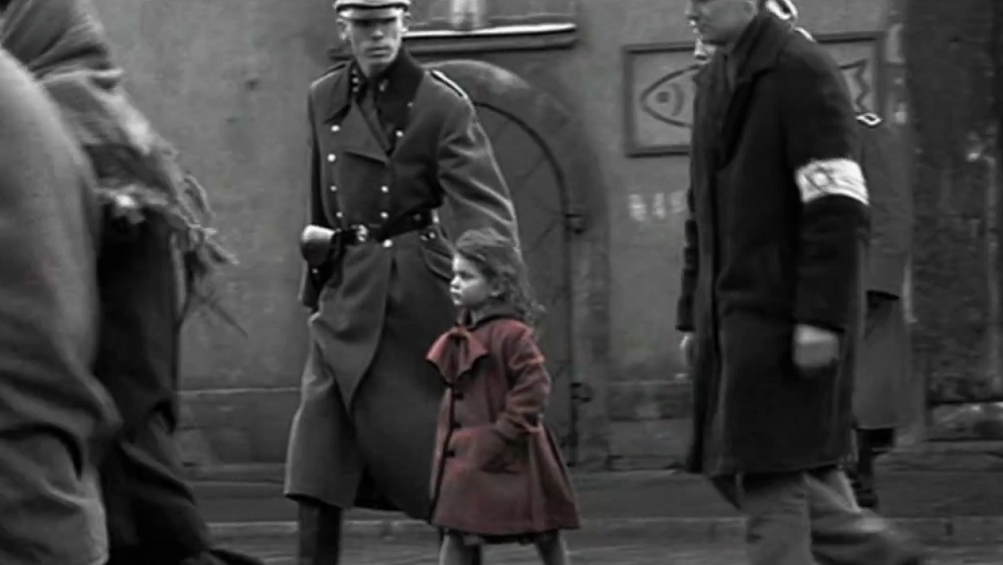
“But what Spielberg tends to do in a lot of his films is to take a crowd, and then individualize certain members of the crowd,” Haskell says.
Other naysayers at the time also emphasized their disdain and disappointment that a narrative about the Holocaust would focus on the few Jews that were saved, rather than the six million that perished.
There was also criticism that the film didn’t portray the Jews as characters in their own right.
‘Levi once said that the very essence of the subjugation of the Jews was how they lost their physical humanity’
Haskell refers to the late Italian Jewish writer and Holocaust survivor Primo Levi and his book of essays, “The Drowned and the Saved,” which claimed that people lose their individuality as soon as they become oppressed and defined as a group.
“Levi once said that the very essence of the subjugation of the Jews [in the Holocaust] was how they lost their physical humanity,” the film critic recalls.
In her latest book, Haskell argues that in “Schindler’s List” Spielberg finds “a judicial balance between individualizing the Jews, as well as as realistically and symbolically folding them into the blur of a nearly inhuman mass.”
Still, Haskell believes some of the criticisms of “Schindler’s List” are perfectly valid and justifiable.The film critic draws particular attention to scenes in the movie where naked bodies are being herded into the gas chambers.
Such images can create what Haskell refers to as “Holocaust pornography.”
Hailed by some critics as a masterpiece, and called “Spielberg’s bar mitzvah” by others, “Schindler’s List” was nominated in 1994 for 12 Oscars, and won seven, including Best Picture and Best Director.
But apart from the commercial success of the film, it also put Spielberg deeply in touch with his own Jewish roots and heritage.
Putting down roots
Born on December 18, 1946, in Avondale’s Nonsectarian Jewish Hospital in Cincinnati, Ohio, Spielberg grew up in a household that was acutely aware of the family’s Jewish culture and tradition. His mother’s family, the Posners, hailed from Odessa, while his father’s family came from Kamenetz-Podolsk in Ukraine. But Spielberg’s parents, Leah and Arnold, were progressive, ambitious, upwardly mobile, and wanted to assimilate into the homogeneous conformity of 1950s America’s largely conservative society.
A push by the Spielbergs towards total assimilation left young Steven deeply confused about what exactly his Jewishness meant, Haskell explains. And this crisis of identity was something Spielberg avoided until middle age.
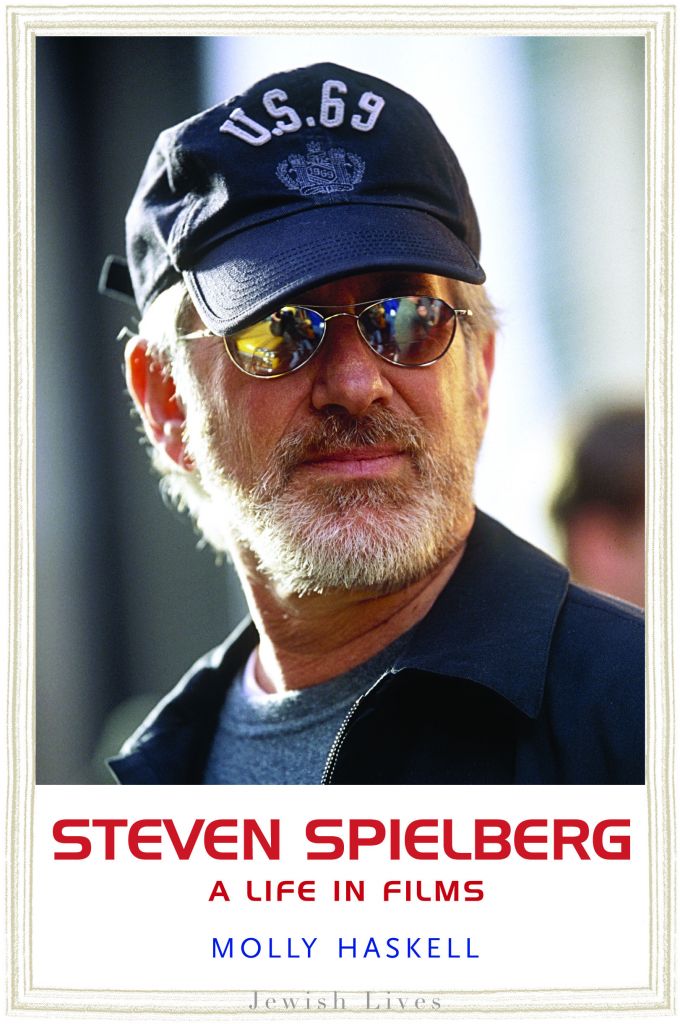
“I think after he made ‘Schindler’s List’ Spielberg really reclaimed his Jewishness. He really didn’t think or talk about it a great deal before that. Certainly not in public,” says Haskell.
Spielberg was also strongly encouraged in the early 1990s, by other film makers of Jewish decent — such as Roman Polanski, Stanley Kubrick, and Billy Wilder — to make “Schindler’s List.”
The late Wilder and Kubrick felt a particular affinity with the Holocaust.
“Both film makers would have liked to have made films about the Holocaust, but didn’t know how to go about it. And so they just kept encouraging him to make the film. Spielberg felt it was a mission to make a film that was both cathartic, and also entertaining, too. And that’s not an easy thing to do when you make a film about the Holocaust,” Haskell says.
Spielberg chose to purposely end “Schindler’s List” by blurring the lines between fact and fiction. In the film’s final scene, the picture quickly shifts from black and white — and from the fictional past — into color and the present day real world, where a parade of Holocaust survivors suddenly comes into view.
‘During the shooting of “Schindler’s List” a Holocaust survivor came up to Spielberg and said, ”Are you taking down our stories?”’
This transition away from art and into the ethical realm, says Haskell, was a conscious decision the film maker made. And it also spurred Spielberg on to embrace a new mission: setting up the Survivors of the Shoah Visual History Foundation, which eventually became known as the Shoah Foundation Institute for Visual History and Education.
Haskell recalls that the Shoah Foundation was started “during the shooting of ‘Schindler’s List’ when a woman, who was a Holocaust survivor herself, came up to Spielberg and said, ‘Are you taking down our stories?’ And so that gave Spielberg the idea of doing a video archive of talking to these people.”
Spielberg has claimed in one interview that setting up the foundation is the “most important job I’ve ever done.”
‘As we get further away from the Holocaust, it brings the immediacy of it back’
The director took a three-year break from filmmaking to set up the foundation, which entailed an international team of interviewers traveling to more than 50 countries to begin collecting the stories of over 53,000 Holocaust survivors in more than 30 languages.
The Shoah Foundation was seeded with $6 million dollars from “Schindler’s List” earnings, and budgeted at $60 million for the first three years.
“It started as a small project but then it became so big that they moved it to the University of Southern California and widened the scope of it for other genocidal victims too,” Haskell explains.
“But it’s also just a great educational and historical tool that people can go to.
And a great source of enlightenment. Especially as we get further away from the Holocaust, it brings the immediacy of it back,” she adds.
Radical moderation
From this point on in his moviemaking career, Spielberg viewed his role as director rather differently, Haskell claims. Crucially, he became more attuned to the idea of making movies that had a social conscience.
This was an important sea change in Spielberg’s career, Haskell argues.
During the late1970s and throughout the 1980s for instance — with films like “Jaws” (1975), “Raiders of the Lost Ark” (1981) and “E.T.” (1982) — the director focused on making mainstream blockbuster films where the primary goal was to entertain his audience and create huge box office receipts for Hollywood studios.

“Spielberg didn’t fit in with the counter culture in the late 1970s,” says Haskell.
“He wasn’t a radical like so many of his peers. All these other filmmakers were taking acid, going to the beach, taking coke, drinking, smoking and getting laid. Spielberg, meanwhile, was hanging out with the studio executives and going to work with a brief case.”
On the surface, then, Spielberg appears to be a safe-bet mainstream conservative film maker.
However, Haskell says, one should read between the lines of Spielberg’s work to fully understand what his artistic vision consists of.
“I think what Spielberg does a lot of the time is he takes traditional film and then makes it into something new,” she says. “For instance, a film like ‘Minority Report’ is eerily prescient about surveillance. Spielberg is not being overtly political in an ideological way here. But he’s acutely aware of the dangers of overreacting to [terrorism] after 9/11.”
Moreover, because almost all of Spielberg’s films lack any firm ideological commitment, the filmmaker is always being attacked from both sides — by critics and audiences — no matter what subject he is portraying, says Haskell.
Another Spielberg film that sparked much controversy in Israel, upon its release in 2005, was “Munich,” which recalls the massacre of 11 Israeli athletes and coaches at the 1972 Munich Olympics by Palestinian terrorists.
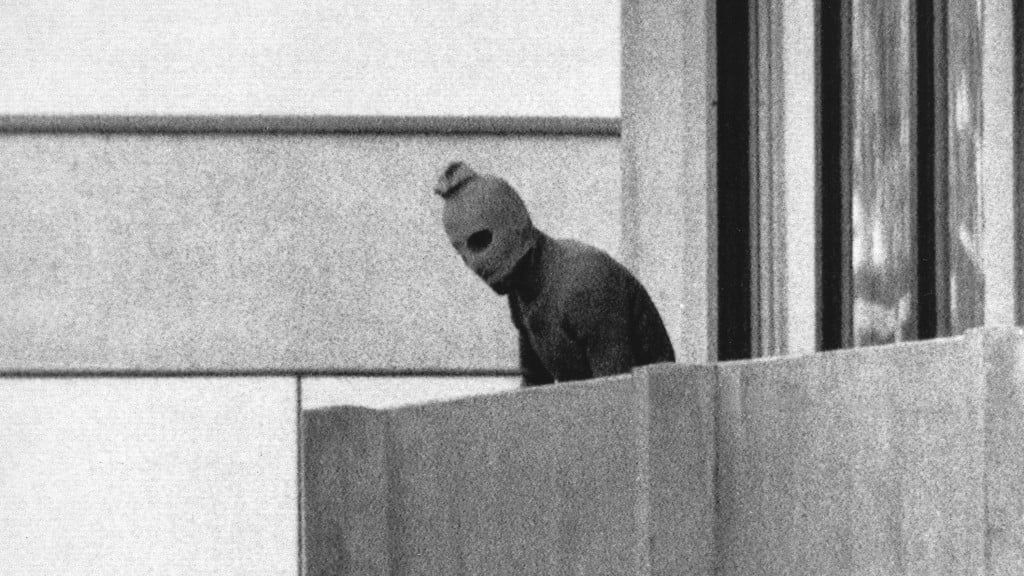
The film then looks at the subsequent mission by various individuals, handpicked by the Mossad, to track down and kill members of the Black September terrorist group who were responsible for the attack.
Since the Israeli government has still never disclosed information on this covert operation, many questions still remain widely unanswered. To wit, did the Mossad’s emissaries kill the wrong people, and not actually the Black September leaders responsible for the attack, as some have asserted?
“There were accusations that Spielberg made an error concerning the movies facts and that the Mossad did not actually get the people who had perpetrated the atrocity,” says Haskel.
“The Zionists would feel that Spielberg is too sympathetic to the Palestinians in ‘Munich.’ Others would say he is too sympathetic towards the Mossad,” she adds.
But Spielberg always wants to see things from both sides, Haskell claims.
Spielberg even purposely inserts a scene in “Munich” where a Palestinian briefly talks about what it means to have no homeland.
“That was always going to antagonize certain people in the audience,” says Haskell.
“But in ‘Munich’ Spielberg was trying to figure out, what does it take for people to kill? And also what effect does it have on those people who are carrying out the killing too? That might not be something that Israeli fighters stop and think about,” she says.
“But where Spielberg is coming from as a moviemaker is to examine the souls and the conscience of these characters, and to try figure out the divide that there must be in forming this operation.”
‘There is something refreshingly old fashioned in Spielberg’s films’
As a director whose decades-long influence on both American cinema — and indeed global popular culture — is unprecedented, Spielberg is, in many ways, just an old-fashioned humanist, says Haskell.
“There is something refreshingly old fashioned in Spielberg’s films. He doesn’t break any boundaries or do anything too artistic. But there is a tremendous generosity of spirit there,” she says.
“He is not someone who wears his political heart on his sleeve. But he has an acute understanding of politics, which I think comes into his films. You can’t just pinpoint Spielberg, either artistically or politically. There are just so many impulses in him as a filmmaker that nobody else has. He has a great rhythm for storytelling. And a lot of the facets that he has as a filmmaker are just indescribable.”