In debate over Hebron shooter, Netanyahu is straddler in chief
Most Israelis both 'justify' the killing by soldier Elor Azaria of a disarmed assailant and trust the IDF, which is prosecuting him. The prime minister is trying to reflect that complex majority stance
JTA — The trial of Elor Azaria has pitted the Israeli army against one of its soldiers and divided Israelis’ loyalties.
Charged with manslaughter in the shooting of an already subdued Palestinian attacker, Azaria, an army medic, has driven a wedge between those who believe that Israel’s citizen army should be above reproach and others who insist that terrorists get what they deserve.
Prime Minister Benjamin Netanyahu has tried to straddle the divide, as he demonstrated in a TV interview he gave on the subject over the weekend justifying his decision to call the soldier’s father to offer support. Coupled with a new survey of Israeli attitudes about the Azaria case, the interview showed that if nothing else, Netanyahu is an expert reader of his country’s sentiments.
In March, Netanyahu faced criticism for calling the soldier’s father a week after the shooting to offer support. Critics said it was inappropriate, since the army had just charged Azaria with manslaughter.
On Saturday, with Azaria’s military trial ongoing, Netanyahu was asked about the phone call in an Israeli TV interview. In his defense, the prime minister said he had simply urged Charlie Azaria to have faith in the army.
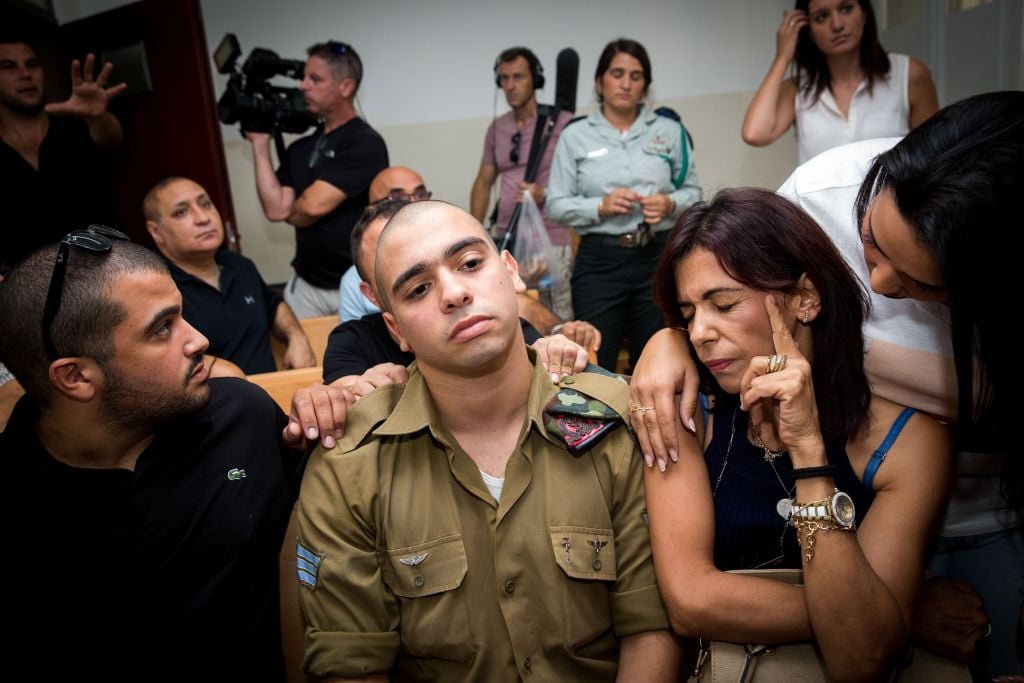
“You know what I told him? Word for word: Place your trust in the IDF, in the chief of staff, in our commanders and soldiers and our justice system,” Netanyahu said. (He went on to compare Azaria’s parents to those of soldiers who die or go missing in combat, for which he apologized Monday following an outcry.)
Opinion polls by the Israel Democracy Institute think tank reveal a political logic to Netanyahu’s simultaneous support for Azaria and the army. A large majority of Israelis both “justify” the shooting by Azaria and trust the Israel Defense Forces.
“With that phone call, I think Netanyahu was speaking to his support base of right-wing voters, who support Elor Azaria in very high numbers,” Chanan Cohen, a researcher at the Israel Democracy Institute who co-authored the August Peace Index, told JTA. “On the other hand, he doesn’t want to contradict the IDF’s position, which is very clear.”
Here are four numbers that tell the story of how Israelis feel about the Azaria case and perhaps help explain Netanyahu’s phone call.
65% of Jewish Israelis support what Azaria did
The March 24 shooting by Azaria instantly made international headlines, thanks to a video shot at the scene by the Israeli human rights group B’Tselem. The Palestinian attacker had stabbed Azaria’s fellow platoon member in Hebron, a predominantly Palestinian city where hundreds of Israeli settlers live under heavy military protection.
Azaria testified in July that he had feared the attacker would detonate a bomb on his body. The prosecution has argued the soldier acted out of a desire for vengeance.
Along with then-defense minister Moshe Ya’alon and the army, Netanyahu initially came out against Azaria, saying, “What happened in Hebron doesn’t represent the values of the IDF.”
But for most Israelis, the shooting isn’t so simple. Sixty-five percent of Jewish Israelis “justify” Azaria’s act — 42% strongly and 23% moderately — according to an August survey by the Israel Democracy Institute. The think tank’s Peace Index surveys 600 Israelis at the end of every month, with a 4.1% margin of error.

Many of Azaria’s supporters don’t seem to care if he’s innocent or not. Forty-seven percent of Israeli Jews support killing a captured Palestinian attacker who no longer poses a threat, compared to 45% who would hand the attacker over to legal authorities, the survey found. Among right-wingers, 83% justify the shooting by Azaria and 62% favor executing Palestinian attackers in principle.
“There is some empathy with the soldier partly because many Israelis and their children have served in the IDF, and they try to think what they would have done in the same situation,” Efraim Yaar, a sociologist at Tel Aviv University who helps lead the Israel Democracy Index’s Peace Index, told JTA. “All this of course is inflamed by basic hostility to Palestinian terrorists.”
87% of Jewish Israelis trust the army
By calling Azaria’s father on March 31, a week after the shooting, Netanyahu moved toward the center of public opinion and his right-wing political base. According to Haaretz, he told the elder Azaria, “As a father of a soldier, I understand your distress.”
Such an exhortation resonates with many Israelis. Eighty-seven percent of Jewish Israelis trust the army “a lot” or “quite a lot,” according to the August Peace Index.
Forty-five percent of them “put a lost of trust” and 35% “put quite a lost of trust” in the army.At the same time, Netanyahu told Charlie Azaria, by Haaretz’s account: “I trust the IDF, the chief of staff and the investigation 100%, and I think that you as well should trust the commanders and the examination.”
Netanyahu reportedly added, “The Israeli people must remain united around its army because we have only one army and many great challenges ahead.”
49% of the far right thinks the army doesn’t represent Israel
Although trust in the army is high across the political spectrum, it is lowest among right-wing Israelis — at 85% compared to 91% among centrists and leftists, the August Peace Index found.
According to the July Peace Index, far right-wingers are also the most likely to say the army does not reflect the values of Israeli society. Forty-nine percent of them feel that way. Just 38% feel the opposite — that the army represents Israel — compared to 49% of the public.
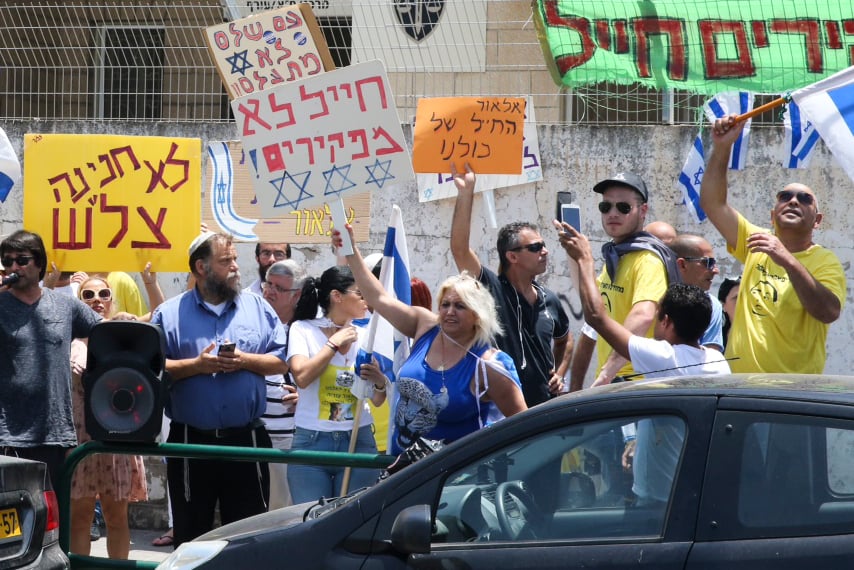
Those Israelis were likely well represented among the some 1,000 people who rallied on behalf of Elor Azaria the week after the shooting. Gathered outside the military court where he was appearing before a judge on March 29, some in the crowd yelled racist slogans against Arabs and invoked the ultra-nationalist Kahane movement.
Avigdor Liberman, a hard-line nationalist politician, told demonstrators that the charges against Azaria were baseless and said he did “not trust” Ya’alon based on his handling of the affair.
Two days after the rally, Netanyahu called Charlie Azaria. Two months later, Liberman replaced Ya’alon as defense minister.
About 2,000 people rallied for Azaria in Tel Aviv
Despite the widespread support for Azaria, Israelis don’t seem ready to take to the streets en masse to protest his prosecution.
“Ultimately, the majority of the Israeli public will accept the verdict because of the overall legitimacy of the IDF,” Yaar said. “This is an institution that Israelis see as more important than any other for Israel’s very existence.”
A rally for Azaria at Rabin Square in central Tel Aviv in April was something of a flop. Organizers had expected tens of thousands to show up and police had planned accordingly, but only about 2,000 did by Israeli media estimates. Pop stars who had been slated to appear pulled out, and few mainstream figures showed up.
Speaking from the stage, Charlie Azaria told the largely empty pavilion: “You cannot believe the amount of people here. All the sane people are here.”