In violent Hebron, warring neighbors argue over ‘who started it’
Jewish settlers and Palestinians coexist disharmoniously in a fractured city that has come to symbolize the latest unrest
HEBRON, West Bank — A petty but deadly argument over who “started it” has been raging for decades in the divided city of Hebron. Palestinians attack Jewish settlers and soldiers, claiming settlers attacked them, while Jewish settlers attack Palestinians and claim the Palestinians attacked them first.
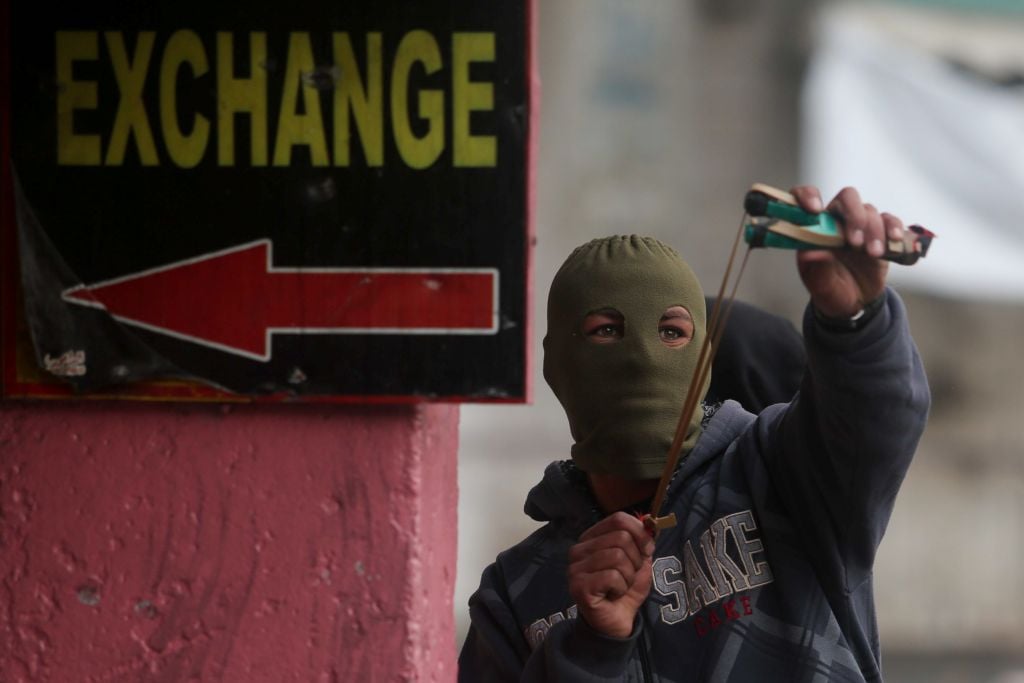
During the past month and a half of turmoil, there have been at least 20 stabbing and shooting attacks against Israeli civilians and soldiers, and violent demonstrations by Arab residents — including stone throwing and firebombs — take place almost daily.
An IDF soldier and two Jewish teenagers were shot and injured on Friday in the city, where large numbers of Jews had come for Shabbat in an annual tradition connected to that week’s Torah portion, which recounts the patriarch Abraham’s purchase of a plot of land in the area for use as a burial vault. Today it’s known as the Cave of the Patriarchs.
The IDF meanwhile has stepped up security measures, arresting dozens of residents and severely limiting the movement of Palestinians who live in the old city of Hebron. Settlers from the city and the nearby Kiryat Arba settlement have also attacked some Palestinian residents, throwing rocks and shouting “Death to Arabs.”
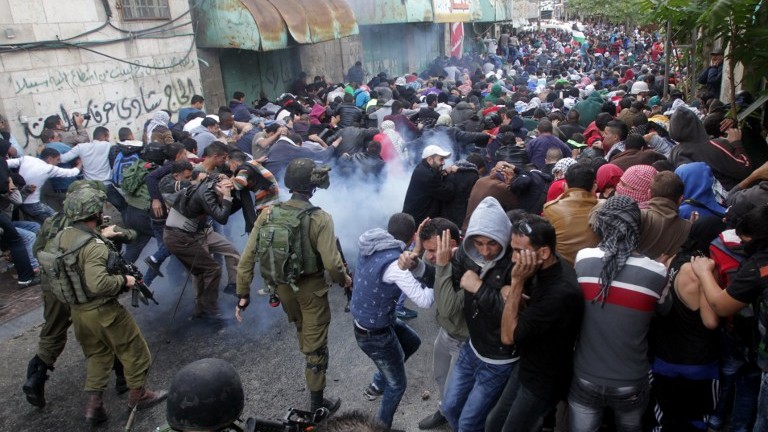
The small Jewish minority of approximately 600 people and the Palestinian majority of 175,000 residents are as separated as neighbors can be, both in geography and mindset.
In just the old city, where the Jewish settlement is situated, the IDF and Border Police have set up 102 checkpoints. The Shavei Hevron Yeshiva, a Jewish educational institution in the city, is ringed by razor wire and completely blocked off from the surrounding Palestinian neighborhoods. But perhaps more extreme than the physical barriers separating the two populations is how the residents — or at least their leaders and spokespeople — describe the current reality in the city. At times the narratives differ so wildly that they wind up being exactly contradictory. It is the Rashomon effect run amok.
Palestinian leaders and activists, when not outright denying that stabbing attacks are taking place, claim they are the result of the IDF and police failing to defend Palestinians from attacks by Israeli settlers.
“People are acting out of despair,” Issa Amro, the 35-year-old leader of the Palestinian “Youth Against Settlements” organization, told The Times of Israel.
Despite identifying with the attackers’ motivation, Amro says he advocates nonviolence. “If I see anyone about to carry out an attack, I will stop them,” he said.
Settler leaders, meanwhile, claim the so-called “price tag” attacks, acts of vandalism and violence against Palestinians by Jewish extremists, are the result of Arab violence.
“When the state isn’t strong enough, there will be instances of vigilantism,” Yishai Fleisher, a right-wing activist and spokesperson for the Hebron Jewish community, said, adding that those attacks against Palestinians are something “which we deplore.”
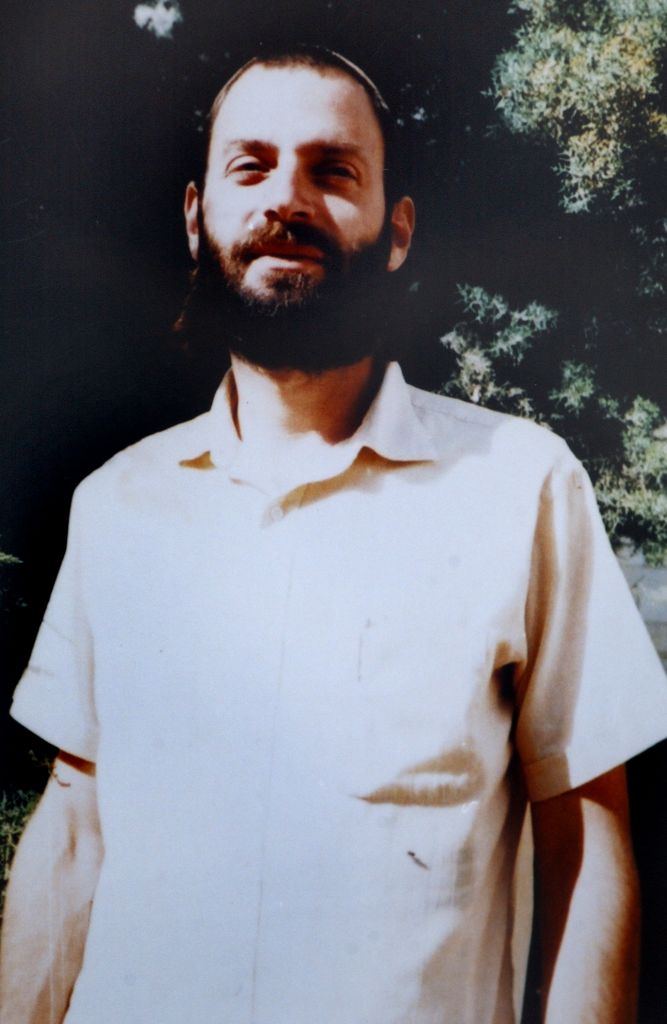
Arab leaders like Kamel Hemeid, the PA governor of the Hebron area, make frequent reference to the 1994 Tomb of the Patriarchs massacre in which Baruch Goldstein, a member of Meir Kahana’s Kach party, opened fire in the Ibrahimi mosque, killing 29 worshipers and wounding another 125.
In contrast, Fleisher and Noam Arnon, another spokesperson for the Jewish community, recall the 1929 Hebron massacre, in which Muslim residents killed nearly 70 Jews in the city and expelled the remainder of the Jewish population.
To an extent, however, the question of “who started it” doesn’t matter today. Even if the original instigator could be found by some objective third party, the Jewish and Palestinian residents of Hebron appear too entrenched in their respective bunkers to budge.
Invented violence
Palestinian activists and Palestinian Authority leadership continue to deny that attacks against Israeli civilians and soldiers are taking place, claiming that the knives photographed at the scenes of attack were planted and that car-ramming attacks were accidents.
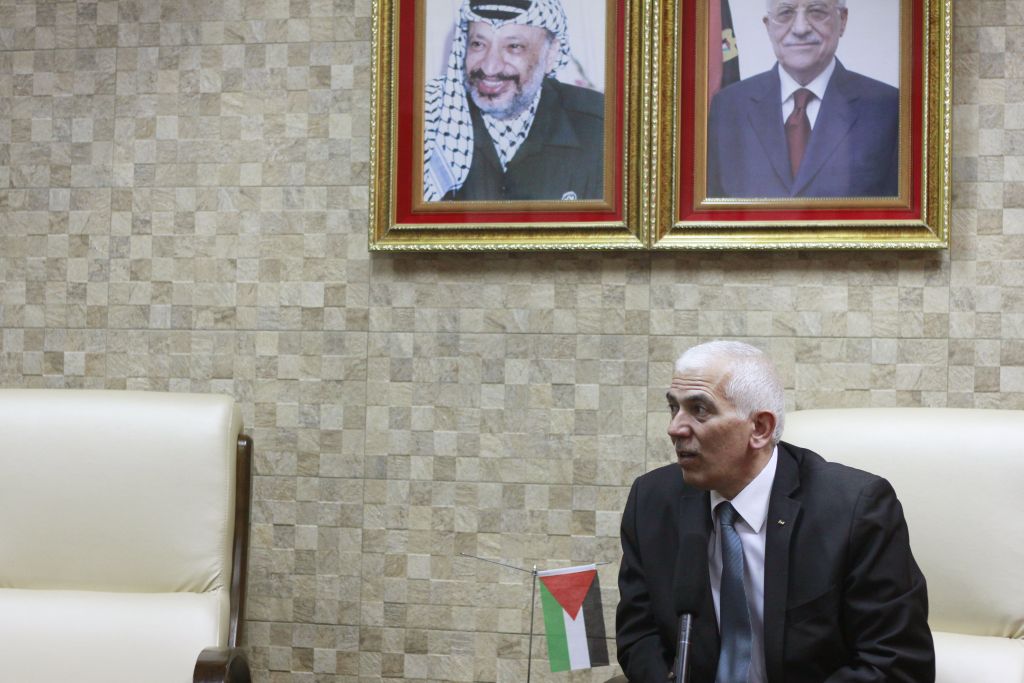
“According to us, nothing has happened,” Governor Kamel Hemeid told The Times of Israel at his office in Hebron last week.
“The knives are all the same,” Hemeid offered as proof of Israel’s deception. “They have the same shape, and they are types of knives that Palestinians don’t use.”
Amro, the Palestinian activist from Hebron, even released a video last month purportedly showing an IDF soldier passing a knife to another soldier and planting it near the body of a Palestinian who had been shot by a Jewish resident of Hebron, though the IDF quickly denied the accusation, saying the object passed was a radio and that nothing was placed on the ground.
When pressed or faced with irrefutable evidence of stabbings, Hemeid and Amro claim the attackers posed no credible to threat to soldiers and police officers.
“They are only 17 or 18 or 19 years old,” Hemeid said of the attackers, intentionally or unintentionally ignoring the fact that the IDF soldiers and border guards who are being attacked are in the exact same age range.
“They don’t deserve to be killed only for having a knife,” Amro said.
Both Amro and Hemeid also cite the comparatively low numbers of Jewish deaths in Hebron — two Israelis, compared to almost 20 Palestinians — as proof of this. What they neglect, however, is that in some of these attacks, death and injury have been prevented only due to the soldiers’ protective ceramic vests, not for lack of trying.
A preventable uprising
Sheikh Abu Khader Jabari, the head of one of the largest Palestinian families in the West Bank and Jerusalem, told The Times of Israel that this escalation in violence was predictable and preventable.
During last summer’s Gaza war, Jabari met with IDF officials and warned them of impending turmoil.
“One IDF official asked me, ‘Do you think there is a possibility of another intifada?'” Jabari related through a translator.
“I told him, ‘Yes. Soon, maybe in the next few months,'” the aging sheikh said.
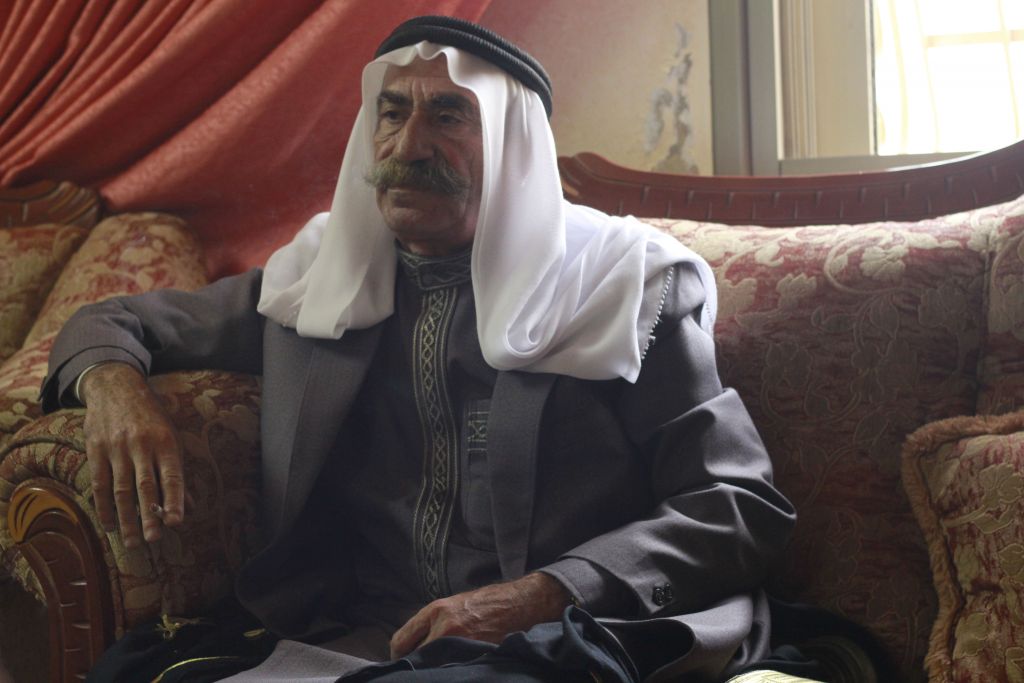
Oft-heard allegations of Jewish attempts to take over the Temple Mount and attacks against Palestinians by Jewish settlers have been the catalysts for this recent terror spree, Jabari said. But the true cause of it, he explained, is a stalled peace process and a desperate economic situation.
“Young people see no horizon. They have no future. There are university graduates with no jobs. People with an MA or a BA are selling fruit and vegetables in the street,” Jabari said.
“There is about 40 percent unemployment among the young people,” he added.
In the face of what they see as constant attempts by Israel to humiliate and assault them through checkpoints and arrests, and with little hope for a better tomorrow, those young people are turning to the knife, Jabari said.
Although he “doesn’t like to see blood,” Jabari said he tries to understand the reasons why Palestinian youths are going out and attacking Israeli civilians and soldiers.
“They’d rather die with dignity than live under these conditions,” he said.
Last month military officials sat down again with Jabari, whose clan consists of 25,000-30,000 members in Hebron and Jerusalem.
“I asked one of them if he wanted the uprising to continue,” Jabari said.
“The officer responded in Arabic, ‘La samaha Allah,'” a phrase that means God forbid, Jabari recalled.
“But everything they’ve done has only heated up the situation,” he said.
From delaying the release of Palestinians’ bodies to demolishing the houses of convicted terrorists, the result has only been more unrest, Jabari charged.
“By knocking down the house, you are giving them a gift,” he said. Charitable donations and Palestinian Authority money often allow families of attackers to build nicer homes than they had before.
“They knock down a two-bedroom house, and the family gets a mansion,” Jabari said. “Do you see people sleeping in the streets?”
Palestinian grievances
The governor, the activist and the sheikh all pointed to the occupation and the “violent settlers” as the ultimate cause of the current unrest, though their answers were vague on why attacks were carried out in Rishon Lezion, Netanya and other Israeli cities far away from the West Bank.
The problem, they said, beyond the general accusation that Israelis are trying to take over Palestinian land, is that there is no functioning system in place to protect Arabs from Jewish extremists.
The Shin Bet struggles to enter and break up the so-called “hilltop youth,” young Jewish settlers who carry out acts of violence and vandalism against Palestinians. The Israel Police in the West Bank, known in accordance with the traditional Jewish name for the region as the Judea and Samaria Division, have a laughably low rate of clearing cases of Jewish violence against Palestinians.
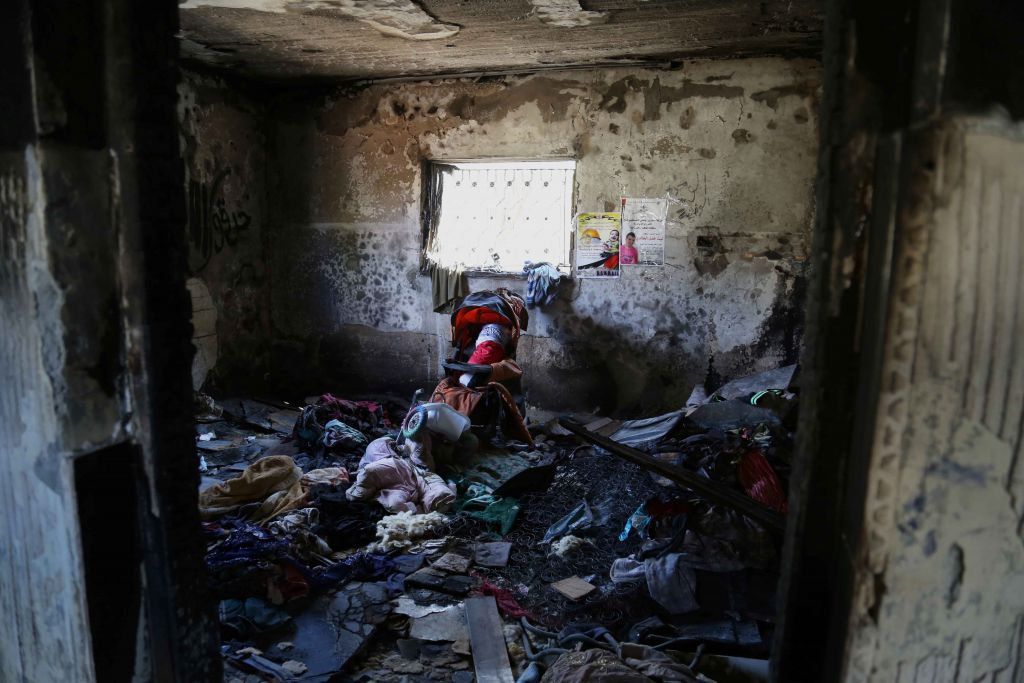
Over 100 days have passed since the deadly firebombing of the Dawabsha family home in the West Bank village of Duma, which killed an 18-month-old infant and his parents and left a four-year-old with severe burns, and the Jewish attackers have yet to be brought to justice. Though Israeli law enforcement knows which general group is responsible, the state lacks sufficient evidence to formally charge the attackers, Defense Minister Moshe Ya’alon announced on Monday.
From 2005 to 2014, the Yesh Din human rights organization tracked 1,045 Palestinian complaints against Jewish settlers and found that only 7.4 percent resulted in indictments. From 2013 to 2014, of over 150 complaints filed by Palestinians, only two indictments were filed by the Judea and Samaria Police Division.
Sheikh Jabari was one of the traditional leaders of Hebron who was thrown out of power following the 1993 Oslo Accords, which granted political control of the West Bank to the Palestinian Authority. As such, he still holds a negative view of the PA and its leader Mahmoud Abbas, who Jabari says should step down. But even he said the PA should be given more power to protect Palestinians.
“I might disagree with the PA, but I told the Israelis that they are not giving enough room to the PA for it to act,” Jabari said.
The sheikh recalled an incident from months before, in which Jewish residents of the West Bank settlement of Kiryat Arba threw rocks and set fire to Hebron residents’ fields.

According to Jabari, the army did not react until he approached the commanding officer and told him, “If you don’t protect us against these settlers, we will defend ourselves against them and we will not be doing it with just rocks.
“If you are smart, you will know what I mean by defend ourselves,” Jabari recalled telling him.
The officer took the unsubtle hint at an escalation of violence and possible use of firearms, and quickly set his troops to breaking up the settlers’ demonstration, Jabari said.
More needs to be done to crack down on the incidences of Jewish extremism in the West Bank, Jabari argued.
“If Israeli policies continue as they are, the uprising will continue,” he added.
‘We’re not afraid’
The Jewish residents of Hebron have no intention of leaving the settlement in light of the recent violence against civilians and soldiers, Noam Arnon, spokesperson for the settlement assured The Times of Israel.
“The Jewish community of Hebron has gone through tough times in the past, but we’re not afraid. We’re not terrified,” Arnon, who has lived in Hebron since the 1970s, said.
site
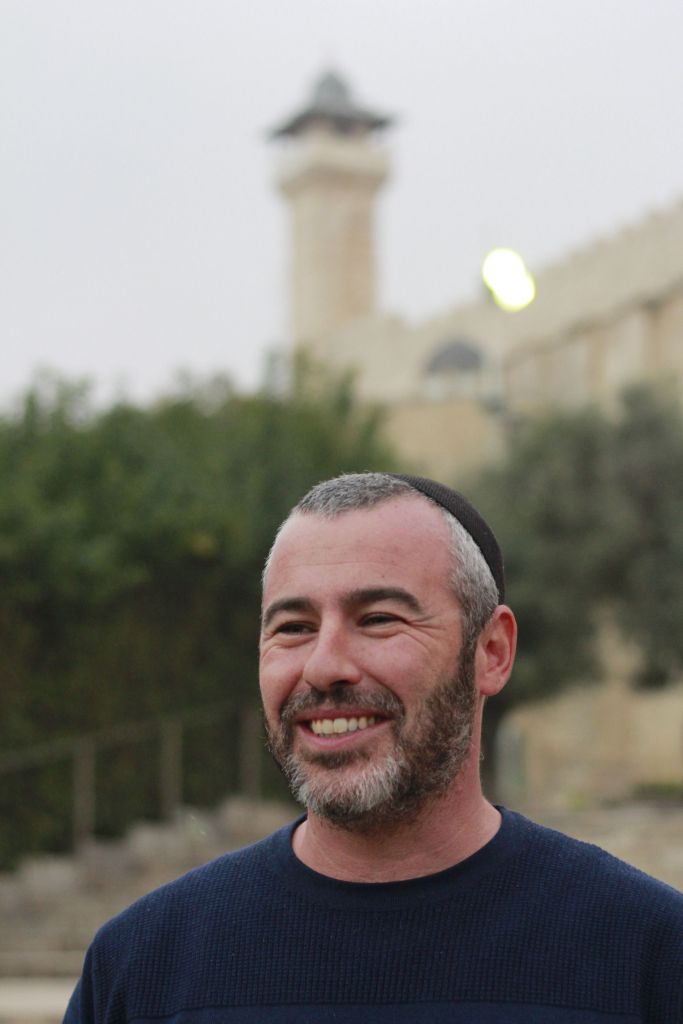
“The people here are hardcore,” Yishai Fleisher, the group’s international spokesman who lives in the Maale HaZeitim Jewish settlement inside an Arab neighborhood of East Jerusalem, said. “We’ve been attacked before, but we’ve gotten through.”
Arnon, who referred to Sheikh Jabari as a personal friend, also criticized Mahmoud Abbas’ Palestinian Authority and its assumption of power in the West Bank following the Oslo Accords.
“The PA’s agenda is not an agenda of peace. It’s an agenda of ethnically cleansing Judea and Samaria of Jews,” he said.
The violence, Arnon and Fleisher said, has been inspired by Palestinian Authority incitement and propaganda coming from the Islamic State terror group.
Though Arnon recognized that the more strinent security measures in Hebron has had a negative effect on the Palestinian population, he denied responsibility for the closures and checkpoints.
“We didn’t close things, the government did. We are very sorry about that, but it doesn’t change our dedication,” he said.
“But [checkpoints] are the result of the wave of terror,” Arnon added.
Palestinians, meanwhile, cite the checkpoints as a cause — not a result — of the terror, a daily humiliation that only instills in them a hatred for IDF soldiers and Jewish settlers.
And so the opposing viewpoints continue. There is, however, one thing the two sides can agree on: Something has to change.