Israel fears rallies will break out of Strip, even if protesters don’t
Organizers insist that the March of Return will be peaceful, but the greater threat to Israel may be a non-violent struggle spreading to the West Bank
Organizers of the March of Return planned for Gaza Friday have insisted in recent days that their mass protest near the border fence will be nonviolent, and that they have no interest in crossing into Israel.
Even the Hamas terror group, the de facto ruler of the Strip, says it will deploy security forces to ensure demonstrators don’t reach the border.
In Israel, though, media hype has helped contribute to a feeling that the event is something akin to a planned invasion.
While the attention paid to protest may have led to Israeli army preparations, putting pressure on Gazans to make sure it does not get out of hand, hysteria over the event may have also helped it gain in popularity.
The large protest has grown only larger as Israeli coverage has created interest from Palestinians, though most Gazans are nonplussed over the hysteria in response to a non-violent march.
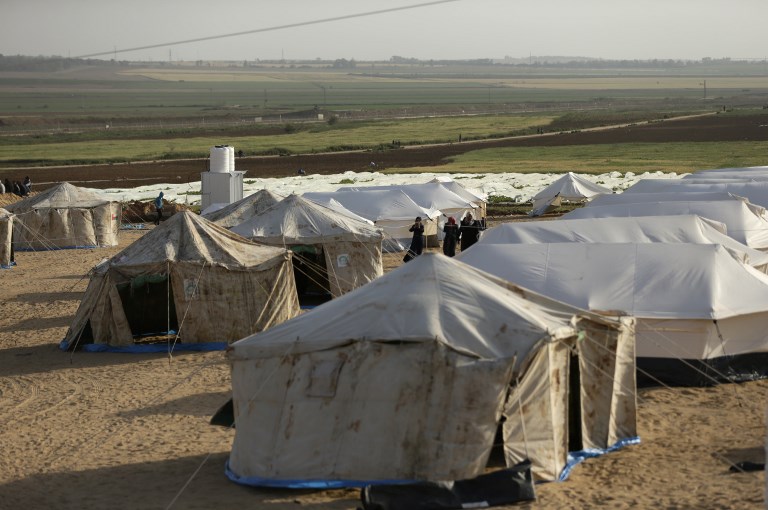
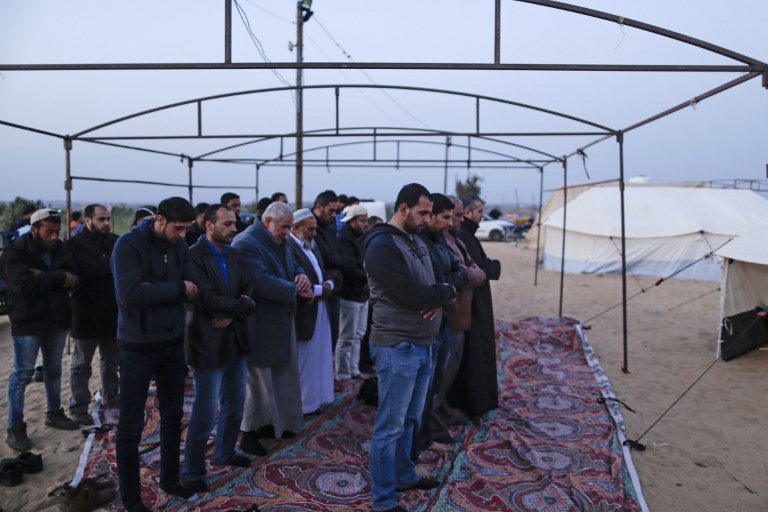
Many entire families plan to join in the march on Friday after prayers, and the vast majority of people have no intention of approaching the border fence. They only want to come to the tent cities set up some distance from the border, they say.
A spokesperson for the march said on Thursday that the protest will take place 700 meters (2,300 feet) from the border. “Our struggle will be unarmed, and we will not use rocks,” he said. “This is a struggle for photos, cameras, and words, and its strength will be in the great number of participants.”
Of course, several demonstrators may try to reach the fence and some may actually make it, sparking an Israeli response via riot control methods such as tear gas, and the possibility of deadly force.
While casualties will give Israel a black eye in the international community, the bigger fear is that the protest stays large and non-violent and spreads beyond Gaza to the West Bank.
The concept of non-violent struggle is not new, and was not invented for the March of Return. It was already around during the First Intifada, and from time to time was raised, but only as an idea, during the Second Intifada.
Marwan Barghouti, the Fatah leader who is serving time in an Israeli jail for orchestrating five murders and was responsible, among other things, for turning the Second Intifada into a series of terror attacks, has increasingly advocated for non-violent Palestinian protest in recent years.
The success of an event like this march in Gaza, with hundreds of thousands of participants, could encourage other young Palestinians to instigate similar marches toward checkpoints or Israeli settlements in the West Bank, amplifying pressure on Israel beyond anything its seen in recent years.
A dress rehearsal
Hamas’s decision to ostensibly endorse non-violent protest is not being made because the terror group has suddenly had a change of heart about the efficacy of attacks, and violence could easily ensue if things go too wrong or too right.
Firstly, Hamas is not interested at the moment in a major confrontation with Israel. But in the event Israel’s riot dispersal methods end up creating too many casualties, the terror group could respond by firing rockets or ramping up violence in other ways.
But even if non-violence holds, it may not stay that way.
Friday’s march is but a mere dress rehearsal for the main event planned for six weeks from now, when mass protests are planned for Nakba Day, as Palestinians mark the “catastrophe” of the creation of Israel and ensuing war. The day is also when the US will inaugurate its new embassy in Jerusalem.
At that point, Hamas is expected to ease up on protesters, allowing them a more free hand to rush the border or protest how they see fit.
Should the earlier non-violent protests manage to attract large numbers, the demonstration in mid-May, when violence could easily ensue, will be all the messier.