In Syrian barrage, a confident message signed by Iran and Russia
The fire that hit Israel Saturday was likely no accident, especially as Assad is riding high with the help of his friends
It’s not clear if the sudden barrage of rockets “bleeding” into Israel from Syria Saturday had anything to do with the presence in Damascus of Iran’s defense chief. But given Iran’s seemingly unstoppable drive to entrench itself militarily in the region, the Syrian regime’s newfound confidence, and some other suspicious factors, it’s likely the volley was more than just an accident.
Though inadvertent fire has hit Israel in the past, this incident doesn’t fit that mold, and seems more like a Syrian attempt to send a message. First, there’s the timing — around 5 a.m. Most of the fighting in the Syrian civil war has taken place in the daylight hours, certainly not before the crack of dawn. Second, none of the previous inadvertent volleys consisted of five consecutive rockets.
Indeed, the incident appears to be connected to the anti-aircraft fire Syria directed at Israeli jets flying a reconnaissance mission over Lebanon last week, and a more aggressive recent tone from Damascus.
These developments are evident of the boost in self-confidence the Syrian regime is experiencing. Just Saturday, Assad’s army captured the Christian town of Qaryatayn, which had previously been taken by Islamic State and used as a base for the terror group. Assad may feel that victory in the civil war is within his reach thanks to having Tehran by his side, along with Shiite militias from Iraq, Pakistan and Afghanistan, and 8,000 well-armed Hezbollah fighters. So maybe he considers this a good time to send Israel a defiant message.
It doesn’t hurt that the same day, Iranian defense chief Mahmoud Bagheri signed a memorandum of understanding with his Syrian counterpart, Ali Ayyoub.
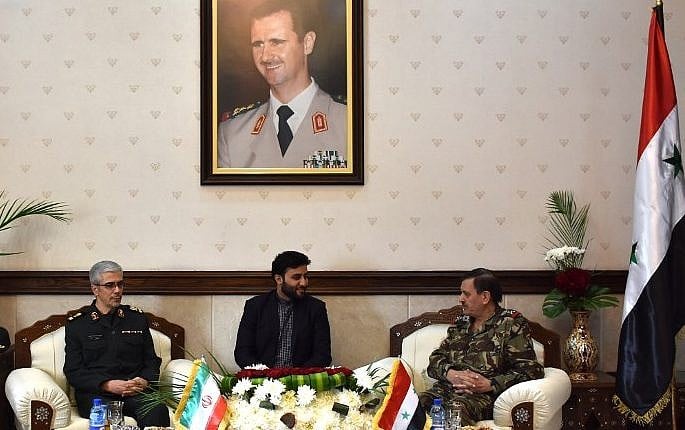
According to the Syria’s state-run SANA news outlet, the memorandum is meant to deepen ties between the countries in intelligence sharing, technology and military to “improve the fight against terror.”
The statement also served as a reminder of how deeply Iran is managing to entrench itself unimpeded in Syria, as the US-led coalition and Kurdish militias wrap up their campaign to drive Islamic State out of the country.
Iran rising
For now, at least, it doesn’t seem there is anybody who can stop the spread of Iran’s influence in the region.
Russia may be willing to turn a blind eye to the next Israeli airstrike, but that won’t torpedo Iran’s plan for Syria, which includes a broad and lasting military presence.
As for the Americans: The US is increasingly seen as unwilling to intervene, even for its allies.
That was made clear by the blind eye the Trump administration turned to the retaking of Iraqi Kirkuk from the Kurdish forces it had backed. The US sold the Kurds down the river in favor of a Baghdad government backed by Shiite militias supported by Iran, if only to keep the Iraqis close to Washington.
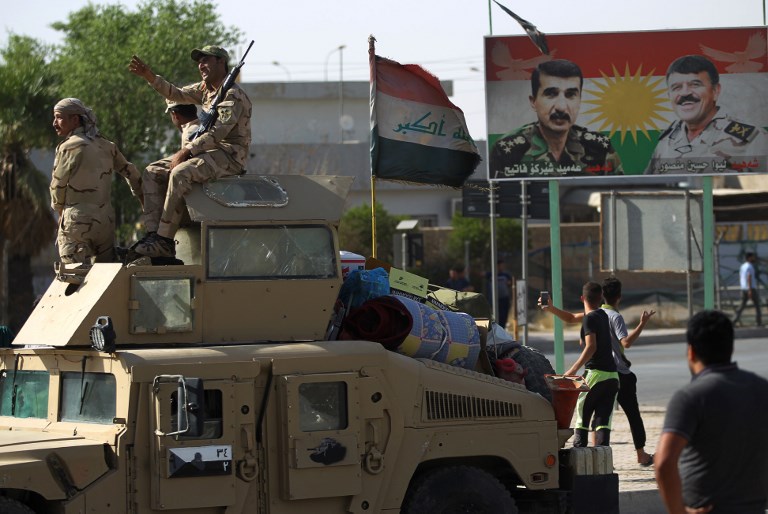
In many ways, the US abandonment of Kirkuk may come to echo the aftermath of the Ghouta chemical attack of 2013, when president Barack Obama failed to enforce his red lines. Then, to Moscow, Damascus and the rest of the Middle East, the lack of action translated into the idea that the US was afraid.
Russia, in contrast, hasn’t hesitated to step in and protect its allies, and it is Moscow’s assistance that is most credited with bringing Assad’s regime back from the dead.
In a roundabout way, Assad has Islamic State to thank for bringing Russia riding in to save him. One of the main reasons for Moscow’s intervention in the war was the fear that IS could spread, both as a military power and as an idea, to the Allawite-majority region near the coast, where Russia has strategically important assets including a naval base.
There’s no reason to assume that had the Syrian regime been battling the Free Syrian Army or another moderate group, the Kremlin would have been so quick to jump into action to back Assad, one of the greatest tyrants of modern history, a man responsible for the death of some half a million people — many through torture, execution, and chemical attacks.
Islamic State may have been the greatest threat to the Assad regime, but it was also his greatest lifeline.
comments