Iran says no military solution to conflict with US as talks remain at dead end
Tehran's top diplomat insists 'only negotiations based on justice and fairness' will end war; Hormuz tanker damaged in attack as Iran vows to keep Strait closed until demands met
Iranian Foreign Minister Abbas Araghchi insisted Sunday that there was no military solution to his country’s conflict with the United States, with talks on ending the war apparently at an impasse.
A campaign of heavy bombardment failed to bring a decisive close to the war launched by the US and Israel in late February, and Washington in recent weeks has dialed back military operations in favor of economic pressure.
“If our enemies again choose the path of military confrontation, our response will be stronger than before, and we will defend ourselves with even more force,” Araghchi said at a gathering of foreign ambassadors.
“There is no military solution, nor any solution based on new sanctions,” he continued, adding that “only negotiations based on justice and fairness” could end the conflict.
The two sides agreed to a memorandum of understanding in June aimed at providing a framework for a permanent resolution, but the deal collapsed, largely due to disagreements over the Strait of Hormuz.
Iran has sought to control the vital shipping lane since the start of the war, and has attacked vessels that attempt to transit without its authorization.
Iran’s Foreign Minister Abbas Araghchi says that there is no military solution to his country’s conflict with the United States, with talks on ending the war apparently at an impasse. pic.twitter.com/vv6dz3Gtm4
— Al Arabiya English (@AlArabiya_Eng) October 4, 2026
Iranian and US officials last week held indirect talks on the sidelines of the UN General Assembly, with Tehran saying it presented seven conditions for reopening the strait. Trump, however, rejected the proposal, while leaving the door open to both further talks and renewed military operations. The US has not struck Iran since September 1.
Also Sunday, Iran’s military said it was working to increase the range of its missile arsenal to better target American forces.
“During this war, we concluded that we absolutely must increase the range of our missiles, and we have now moved in that direction,” Army spokesperson Mohammad Akraminia told Fars news, noting that American forces are now positioned as near as 1,000 kilometers (621 miles) away from the Iranian coast.
US media outlet Axios reported that top Trump cabinet members met Friday to discuss the war in Iran, as well as the conflict in Yemen, where the Tehran-backed Houthis have been fighting government forces and attacking Saudi Arabia.
US Vice President JD Vance chaired the meeting, the news outlet reported, citing people familiar with the matter.
With talks at an impasse, Iran’s parliament speaker Mohammad Bagher Ghalibaf said Sunday that the Strait of Hormuz will not reopen until all seven of Iran’s new conditions are met.
“The Americans, who say something different in the media, have recently put forward proposals through a mediator. But they must understand that the period of dragging out the process and dictating one-sided demands is over,” Ghalibaf was quoted in state media as saying.
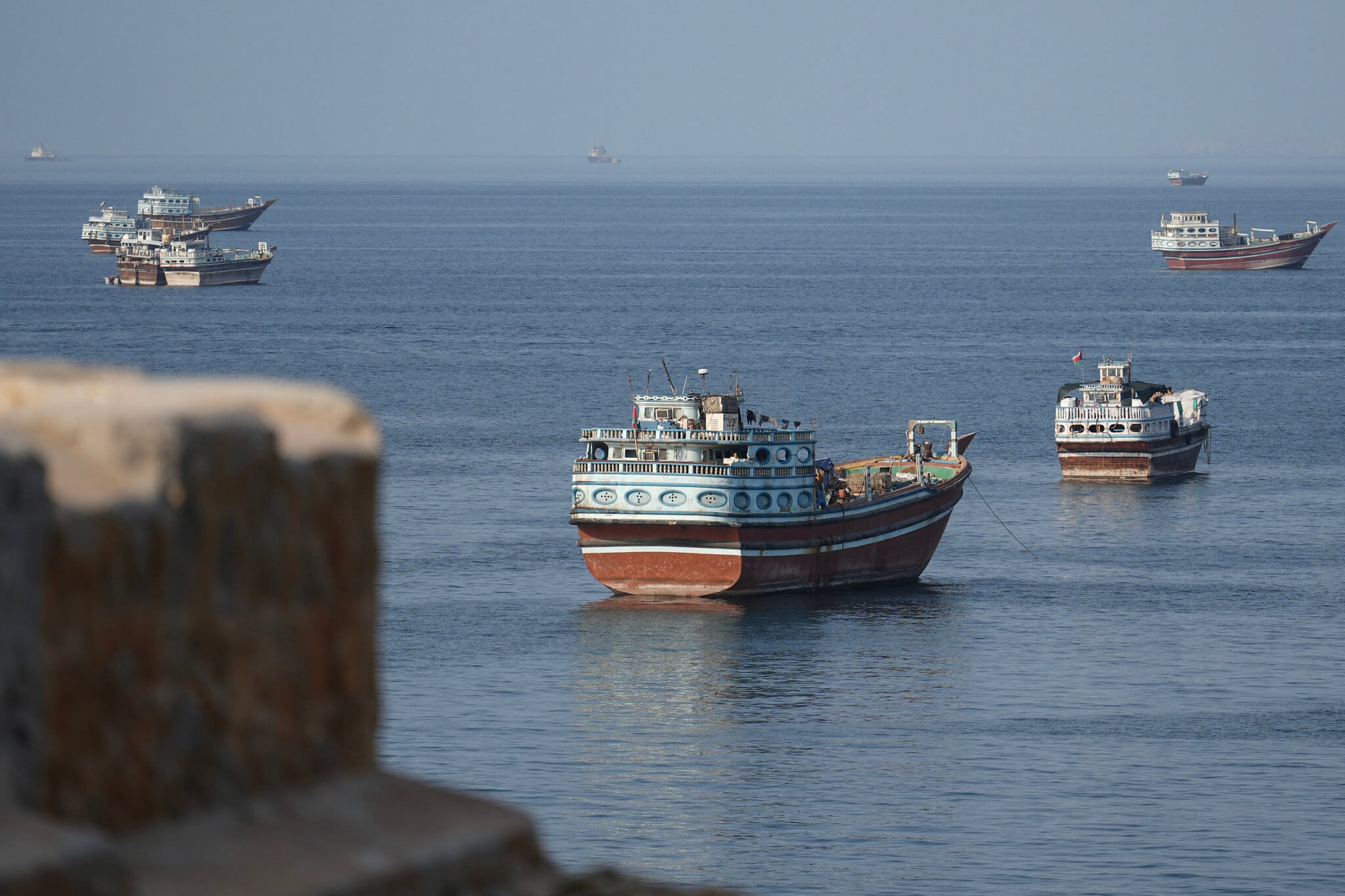
“The position of the Islamic Republic of Iran is completely clear and firm, and the Strait of Hormuz will not be opened until our seven conditions, based on the Islamabad memorandum of understanding, are met,” he said.
Hormuz tanker damaged
Meanwhile, an attack on a tanker in the Strait of Hormuz damaged its engine room, a British maritime agency said Sunday, without specifying when the incident occurred.
Iran has repeatedly targeted vessels in the waterway that it accuses of transiting without its authorization, while the United States has struck ships allegedly attempting to skirt a counterblockade of Iranian ports.
An “unknown projectile” struck the ship but the crew were unharmed, the United Kingdom Maritime Trade Operations Centre (UKMTO) said.
UKMTO WARNING 150-26
Click here to view the full product⤵️https://t.co/cavM9BnZeQ#MaritimeSecurity #MarSec pic.twitter.com/bNxTC8oktw
— UKMTO Operations Centre (@UK_MTO) October 4, 2026
No environmental impact had been recorded from the attack, it added.
The agency did not specify the date of the incident, the vessel’s origin or destination, or whether it was an oil tanker or LNG carrier.
The Strait of Hormuz, through which about one-fifth of the world’s oil and gas transited before the war, remains a key sticking point in negotiations between Iran and the US.