Iran’s foreign minister to join nuke talks Friday
Kerry says Iranian supreme leader's comments backtracking on nuclear inspections won't delay talks
With significant gaps standing in the way of an Iran nuclear deal, foreign ministers at the seven-nation talks are adding their diplomatic muscle to the negotiations ahead of a June 30 target date for an agreement.
France announced Thursday that Foreign Minister Laurent Fabius is joining the talks in Vienna on Saturday. Iranian media reported earlier that Foreign Minister Mohammad Javad Zarif will fly to Vienna on Friday. That’s the day US Secretary of State John Kerry departs Washington for the Austrian capital
Foreign ministers from the four other nations at the negotiating table — Russia, China, Britain and Germany — are also expected to join in as they try to bridge differences between the sides on the limits Tehran must accept on its nuclear program in exchange for the lifting of economic sanctions.
But with Iran apparently backtracking on key points of the emerging deal, the talks could go past the target date. In a speech on Tuesday, Iran’s supreme leader, Ayatollah Ali Khamenei rejected a long-term freeze on nuclear research and insisted that Iran will only sign a deal if international sanctions are lifted first.
He also repeated that military sites and Iranian nuclear scientists will be off limits to UN experts, who would monitor Iranian compliance to any deal while trying to kick-start a moribund probe of suspicions that Tehran worked on atomic arms — allegations Iran denies.
Kerry said Khamenei’s speech was for “domestic political consumption” and that there would not be a deal if Iran reneged on commitments made in an April outline.
Though the official deadline is coming up, a delay up to July 9 is not a deal-breaker. If Congress receives an agreement by then, it has 30 days to review it before President Barack Obama could suspend congressional sanctions.
But postponement beyond that would double the congressional review period to 60 days, giving both Iranian and U.S. opponents more time to work on undermining an agreement.
Iran and the so-called P5+1 group — Britain, China, France, Germany, Russia and the United States — are working to a June 30 deadline to allay international fears that it is seeking a nuclear weapons capability.
Iran denies any such ambition but is eager to secure a lifting of crippling Western economic sanctions imposed over those concerns.
Kerry said Wednesday that the nuclear negotiations will not be affected by recent comments from Iran’s supreme leader who appeared to backtrack on key points of an emerging deal.
Kerry said this week’s speech by Ayatollah Ali Khamenei in which he set out “red lines” for the negotiations, demanding an “immediate” lifting of sanctions by the United States as well as the United Nations in any deal, not deter the talks.
Khamenei also renewed his opposition to any inspection of Iranian “military sites” by the UN watchdog.
Kerry said the speech, along with highlights on Khamenei’s official Twitter feed, were for “domestic political consumption.” And he said that if Iran did backtrack on commitments made in an April outline there would be no deal.
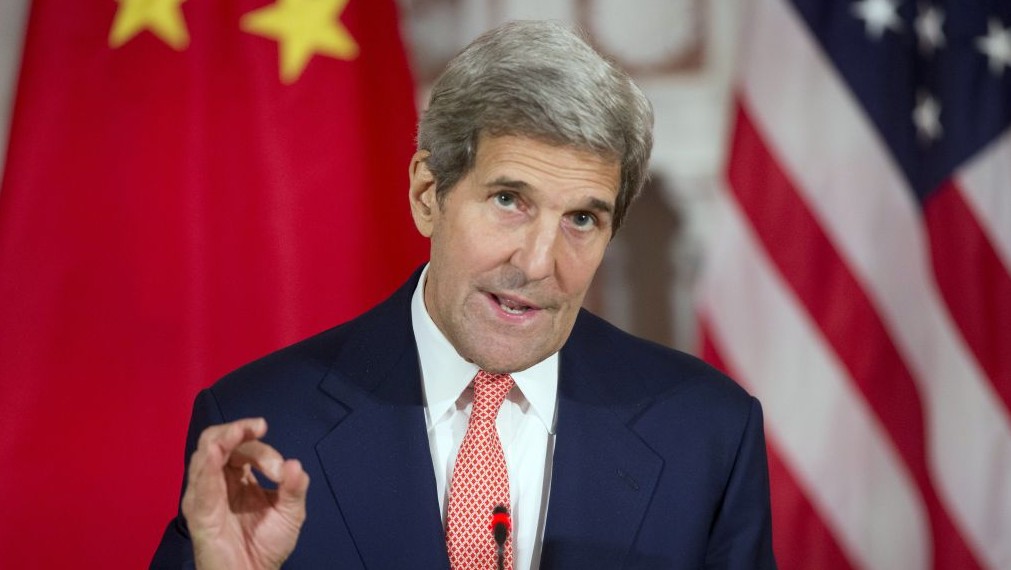
“This is something that’s been going on throughout the negotiations,” Kerry said of the Iranian leader’s remarks. “It is not new. We are not going to be guided by or conditioned by or affected or deterred by some tweet that is for public consumption or domestic political consumption. What matters to us is what is agreed upon within the four corners of a document and that is what is yet to be determined.”
“It may be that the Iranians will not fill out the full measure of what was agreed at Lausanne and, in that case, there will not be an agreement,” he said, referring to the framework reached on April 2 in Lausanne, Switzerland.
In a speech Tuesday, Khamenei rejected a long-term freeze on nuclear research and insisted that Iran will only sign a deal if international sanctions are lifted first.
President Hassan Rouhani said Iran was seeking not only a lifting of sanctions but a rapprochement with the outside world.
“One of the ways of establishing and enhancing national strength is having dialogue with the world over political issues,” IRNA quoted him as saying late on Wednesday.
“And the power of interaction is one of the main elements of national strength,” he added.
“As the leader put it, we want to negotiate. We don’t want to merely take a position, but we seek serious negotiation and fair agreement.”
Kerry said neither he nor President Barack Obama would negotiate in public.
“I am not tweeting,” he said. “I am not making speeches, neither is President Obama.”
The State Department announced in a one-sentence statement that Kerry would depart for Vienna on Friday on his first overseas trip since breaking his leg in a bicycle accident earlier this month after a meeting Zarif in Geneva.