Anti-government protesters storm Baghdad parliament
PM says situation under control after demonstrators enter main chamber of parliament; security forces use tear gas but are largely standing down
Iraq’s prime minister said the situation is under control after thousands of anti-government protesters poured into Baghdad’s Green Zone and stormed parliament, entering the main chamber of the House.
Jubilant crowds, most of them supporters of Shiite cleric Moqtada al-Sadr, invaded the main session hall, shouting slogans glorifying their leader and claiming that they had rooted out corruption.
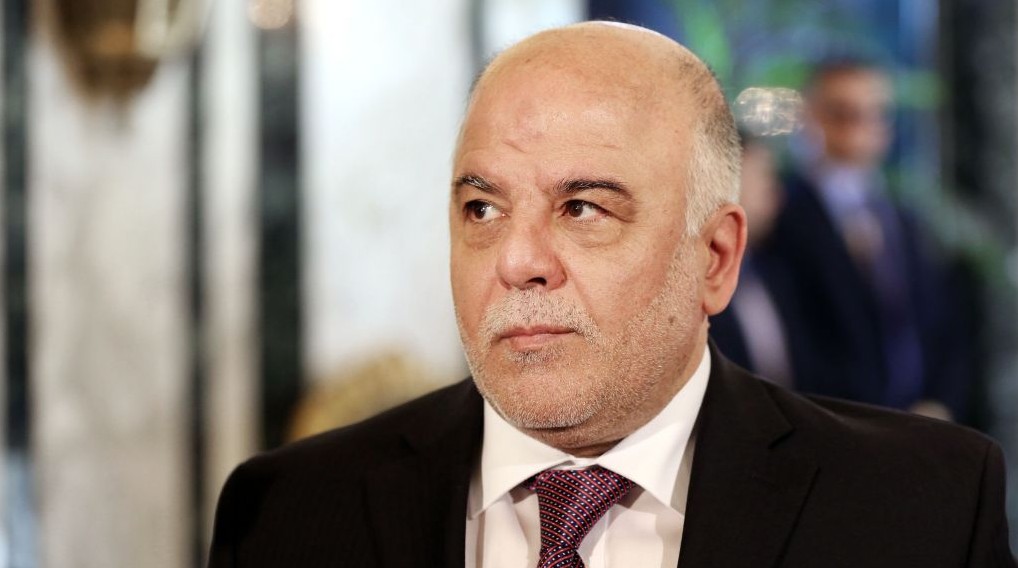
Haider al-Abadi issued a statement saying “the situation in Baghdad is under the control of the security forces.” He called on protesters to demonstrate peacefully without damaging the “property of state institutions.”
Al-Abadi had been set to appear before parliament earlier Saturday to seek approval for the remainder of his cabinet reshuffle, but the session was postponed until next week.
The news of the postponement broke just moments before anti-government protesters began to storm the Green Zone, tearing down walls, in a major escalation of a monthslong political crisis.
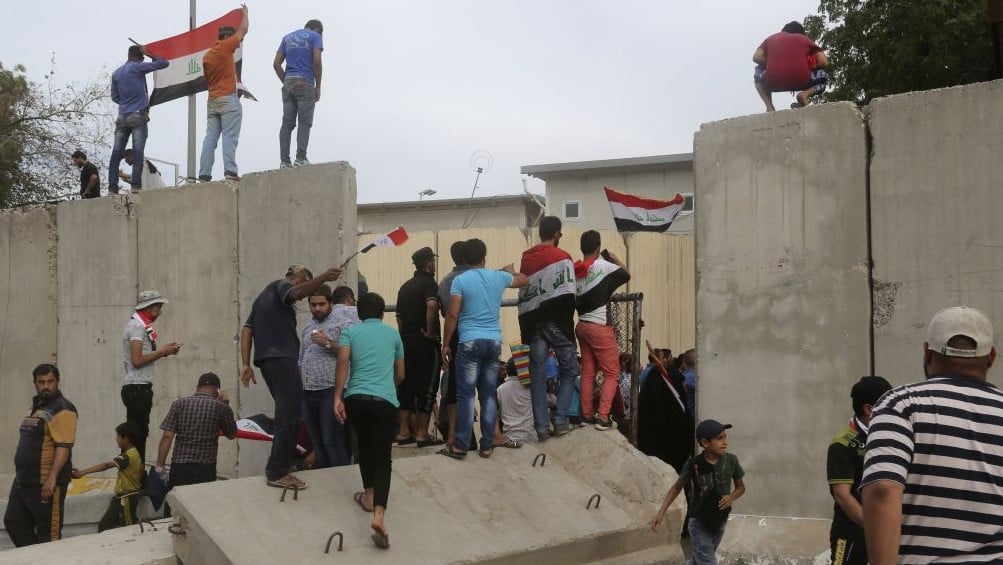
Supporters of Shiite cleric al-Sadr have been holding demonstrations and sit-ins for months to demand an overhaul of Iraq’s corrupt and ineffective political system, but Saturday was the first time they broke into the Green Zone, home to most government ministries and foreign embassies.
Iraqi security forces fired tear gas at one entrance of the zone but appeared to be largely standing down as protesters marched through the area, chanting and waving Iraqi flags. Hundreds were still pouring into the Green Zone as night fell.
Iraq has been mired in a political crisis for months, hindering the government’s ability to combat the Islamic State group — which still controls much of the country’s north and west — or address a financial crisis largely caused by the plunge in global oil prices.
Al-Sadr’s supporters have demanded an overhaul of the political system put in place following the US-led invasion in 2003, in which entrenched political blocs representing the country’s Shiites, Sunnis and Kurds rely on patronage, resulting in widespread corruption and poor public services.
The major blocs have until now stymied the reform efforts of al-Abadi, who has sought to address the protesters’ demands.
Earlier Saturday, al-Sadr repeated accusations that Iraqi politicians are responsible for blocking political reforms. He did not call for an escalation in the protests, but shortly after his remarks, his supporters began scaling the compound’s walls. A group of young men then pulled down a section of concrete blast walls to cheers from the crowd of thousands gathered in the streets outside.
The Green Zone has long been the focus of al-Sadr’s allegations that the government is detached from the people. The compound is off-limits to the vast majority of Iraqis, as security procedures require multiple checks and specific documentation to enter.
Shortly after the breach, cellphone videos uploaded to social media showed dozens of young men running through the halls of parliament, chanting slogans in support of al-Sadr and calling for the government to disband.
“We are all with you (al-Sadr),” one group of men yelled as they entered the building’s main chamber.
Other videos showed a group of young men slapping an Iraqi lawmaker as he attempted to flee the crowd, and protesters mobbing another lawmaker’s motorcade inside the Green Zone. The footage appeared authentic and corresponded with The Associated Press’ reporting.
Iraqi security forces initially responded by tightening security across the capital, sealing off checkpoints leading to the Green Zone and halting traffic on main roads heading into the city, according to the Baghdad Operations Command.
But Iraq’s elite counterterrorism forces, who have in the past been called on to reinforce security in the capital, said they are standing down for now.
“We still view this as a demonstration,” said Sabah al-Numan, spokesman for the counterterrorism forces. “We aren’t taking any part in this as it’s not something regarding terrorism.”
He added, however, that if the unrest escalates his forces may be forced to intervene to “protect the legitimacy of the government.”
The UN mission to Iraq said it was “gravely concerned.” It issued a statement condemning violence against elected officials and urging “calm, restraint and respect for Iraq’s constitutional institutions at this crucial juncture.”
A broad-based protest movement last summer mobilized millions and pressured al-Abadi to submit a series of austerity proposals that he said would also fight corruption. As political progress stalled, al-Sadr’s movement has come to monopolize the protests in recent months.
Al-Abadi presented a second proposal earlier this month to reduce the size of the cabinet and replace political appointees with independent technocrats. But opposition from the very political blocs the proposal aimed to weaken stalled his efforts.
Iraq is meanwhile struggling to maintain security in and around Baghdad, even as it has pushed IS militants back on a number of fronts elsewhere in the country.
Earlier on Saturday, a bombing in a market filled with Shiite civilians in Baghdad killed at least 21 people and wounded at least 42 others, according to police and hospital officials, who spoke on condition of anonymity because they were not authorized to brief reporters.
IS claimed the attack, saying it used a three-ton truck bomb. The extremist group regularly carries out attacks targeting the security forces and the country’s Shiite majority.