Israel offers aid to quake-struck Italy
No deaths initially reported in third massive temblor to rock the country in 2 months; Israeli authorities say tsunami unlikely
Hours after a powerful 6.6 magnitude earthquake struck central Italy early Sunday, Prime Minister Benjamin Netanyahu offered his Italian counterpart assistance in the ongoing rescue operations in the areas hardest hit.
“I would like to say to my friend Matteo Renzi that Israel is prepared to send aid to the best of its ability,” Netanyahu said at the start of the weekly cabinet meeting.
The quake — the third in just over two months — left already-jittery residents panicking and destroyed historic buildings.
Fabrizio Curcio, head of the Italian national civil protection agency, said there did not appear to have been any fatalities after the tremor, which was felt from Rome to Venice, struck at 7:40 a.m.
“We are checking, there are several people injured but for the moment we have had no reports of victims,” he told a press conference in the city of Rieti, in Lazio province.
Sunday’s temblor prompted Italy to issue a tsunami warning for the Mediterranean Sea.
Israeli authorities said the chances of a large wave reaching the country’s shores were extremely low.
Still, a statement from the Defense Ministry said emergency response teams were monitoring potential flooding.
The epicenter of the quake was located at a depth of six kilometers (3.5 miles) north of the small town of Norcia, according to the US Geological Survey, which measured the earthquake’s magnitude at 6.6.
Italy’s institute of geology and vulcanology (IGNV) measured the quake at 6.5 and said it had been preceded by a 6.1 magnitude shock an hour earlier.
It came four days after quakes of 5.5 and 6.1 magnitude hit the same area and nine weeks after nearly 300 people died in an August 24 quake that devastated the tourist town of Amatrice at the peak of the holiday season.
The 13th-century civic tower in Amatrice, which was damaged but left standing by the August quake, collapsed on Sunday.
The 14th-century Basilica of Saint Benedict in the Umbrian mountain town of Norcia, said to be have been the birthplace of the Catholic saint, was also reduced to a pile of rubble.
The church is looked after by an international community of Benedictine monks based in a local monastery which attracts some 50,000 pilgrims every year.
Visibly upset, some of the monks knelt in prayer before the ruins shortly after the quake struck.
‘Everything collapsed’
As with Wednesday’s tremors, the impact was mitigated by the fact that any buildings deemed vulnerable to seismic activity had been evacuated.
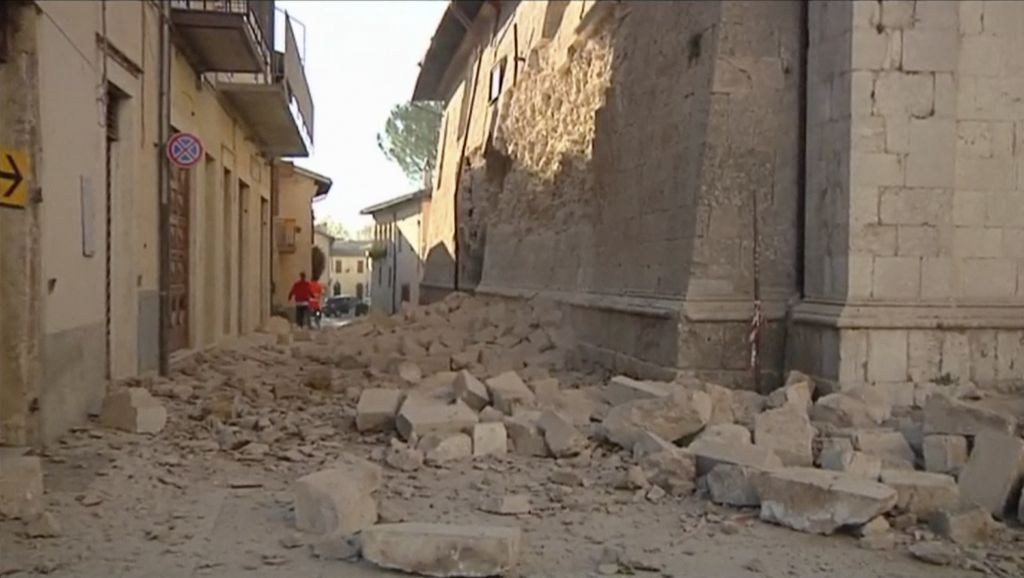
“Everything collapsed. I can see columns of smoke, it’s a disaster, a disaster,” Marco Rinaldi, the mayor of Ussita, one of the pretty mountain villages hit hardest by the last quake, told journalists.
“I was sleeping in my car, I saw hell break out,” he said.
Italy’s civil protection department said there were “checks underway in all the towns affected by this morning’s quake to determine whether there has been any damage to people or buildings.”
The underground rail network in Rome, 120 kilometers from the epicenter, was closed for structural safety checks.