Jolted back to the bad old days
A bus bombing and a tunnel discovery have Israel feeling like it's reliving the Second Intifada and third Gaza war, as pundits parse how much of a game-changer each event is
You can stop almost all the terror attacks in the world, but all it takes is one bomb to turn a pretty copacetic day into a historically crappy one.
Thus was the story of Monday, bookended by the Israeli announcement that it found and thwarted a so-called terror tunnel from Gaza into Israel, and a fiery bus bombing that injured 21 and jolted Jerusalem back to the bad old days of the Second Intifada.
Both stories compete for space on the front pages of Israeli papers Tuesday morning, and papers play up the linkage between them, though not all in the same way. While Israel Hayom sees both stories as flip sides of the same terrible coin (the tunnel discovery as triumph and the bombing as tragedy), Yedioth Ahronoth sees both as failures of the government, with the tunnel representing proof that Israel didn’t deter bupkes with the 2014 war in Gaza.
Reporting on the bus bombing follows the tried and true pattern of a mix of victims’ accounts from hospitals and looking into some unknowns in the wake of the bombing, including who was behind it.
“I got on the number 12 bus with my daughter Eden. She went to sit in the back and I was next to the driver. I hadn’t even managed to sit before I heard a large boom. I looked for my daughter and saw everything was burnt. There was smoke, darkness. I collapsed,” Yedioth quotes a woman named Rachel saying from a hospital bed after she was lightly injured and her 15-year-old daughter more seriously hurt.
Much of the coverage though, focuses not on the trauma from inside the bus, but collective PTSD suffered by a city that experienced a wave of bus bombings a decade ago.
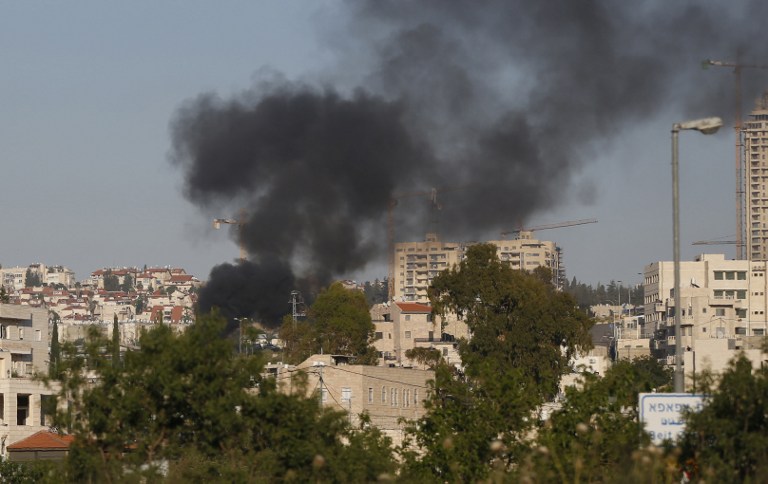
“The tough view of the plume of smoke rising from a burning bus, the discordant sirens of emergency vehicles, and the smell of burnt ash – all of this returned to the capital of Israel yesterday as a bus exploded next to the Talpiot industrial zone in Jerusalem,” Israel Hayom’s lede reads.
But even though the scene looked familiar from afar, Nir Hasson in Haaretz notes that this bombing was not like all other bombings, at least the ones that became all too commonplace during the Second Intifada.
“Burned-out buses by the side of the road surrounded by medics, police and firefighters – sirens wailing in the background. That is the ultimate Jerusalem nightmare. Fifteen years have passed since these scenes were repeating themselves on a weekly basis. Veteran firefighters and medics were standing around the buses Monday and remembering those days, pointing out differences between now and then,” he writes. “With all the similarities, it is important to notice the differences. One of the clearest signs of the terror attacks on buses in those days was the vehicles’ roofs – ripped off by the blast, and parts of the bus that had been hurled great distances. On Monday, the scene looked different. There was broken glass as much as 15 meters away and here and there pieces of plastic, but the frame of the bus was intact. Only the rear showed signs of the blast.”
Though the bus blast leads coverage across the board, the tunnel discovery, kept under wraps for a week, is also played up as a major story, with the technology that led to its discovery hailed as an “underground Iron Dome” anti-missile system by both Israel Hayom and Yedioth.
“The early locating of the tunnel is proof of the large and significant security efforts being made all the time by the army. However, the matter is not finished and politicians need to do everything to allow the quick deployment of the [tunnel blocker] along the whole border,” Israel Hayom’s Gidi Yaroni writes. “The massive blocker, together with new technologies to find tunnels, is an Iron Dome for an underground threat which will change the face of the reality on the ground.”
Yossi Yehoshua in Yedioth counsels against getting too excited about the discovery, though.
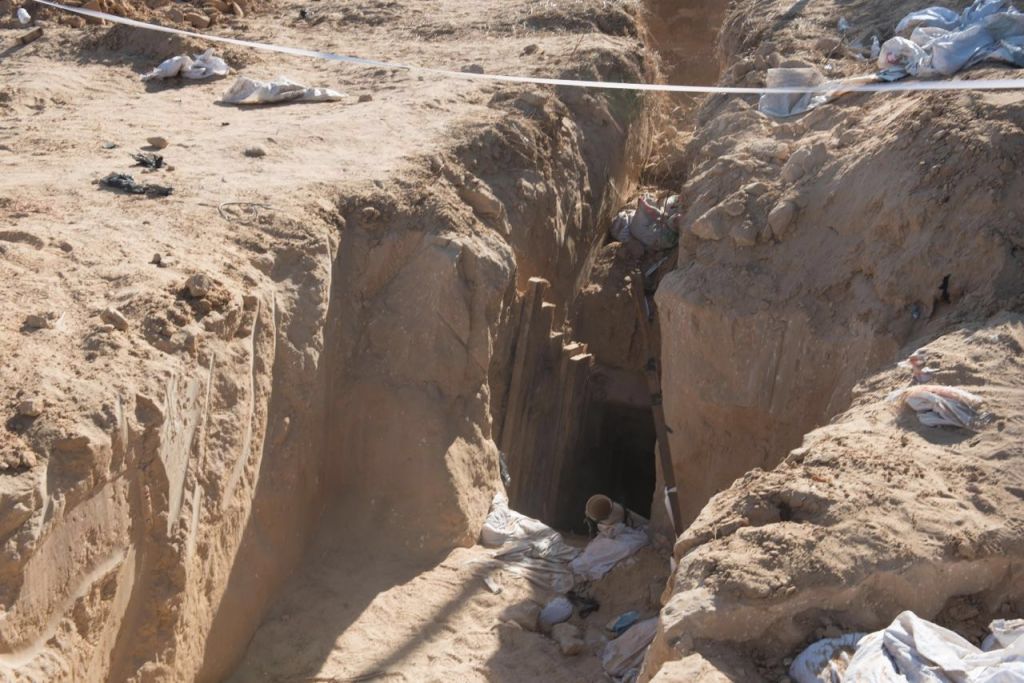
“As of now, there is no technology that can locate 89 percent of the tunnels. The new technology developed indeed discovered a tunnel for the first time, but the problem is that technology doesn’t solve the problem and to ensure quiet here, there is a need for a more complex solution with an emphasis on intelligence and operations,” he writes.
In Haaretz, Amos Harel notes that army officials are not even sure if the tunnel is new or an old one that Israel never found in the 2014 war. Either way, he says, the discovery presents a problem for Israel’s government, new technology notwithstanding.
“If this is indeed an old tunnel, then the government declaration that Israel had located and destroyed all the attack tunnels by the end of the 2014 war was unfounded, and merely reflected the public’s desire to end the war and hear that the mission to eradicate the tunnels was successful. If the tunnel was dug recently, or even if only the part east of the border fence is new, it proves that Israel’s last military operation didn’t convince Hamas to stop taking such risks, and that it still sees the tunnels as a primary method of attack in the future,” he writes.
Harel also attempts to downplay both the tunnel discovery, which he says was expected, and the bombing, which he says was just the first successful bombing attempt after a number of thwarted tries, claiming that neither event changes Israel’s military and diplomatic horizons much.
But for Yedioth’s Sima Kadmon, the two affairs are significant politically, as they both serve as proof of Prime Minister Benjamin Netanyahu’s inability to provide security for Israel’s citizens despite his supposed nickname “Mr. Security.”
“We haven’t managed to deter Gaza. Terror is running rampant in the streets, and any drop in the number of attacks seems to just be anecdotal, as the bus bombing in Jerusalem yesterday proves,” she writes, letting her anti-Netanyahu flag fly. “When you think about the promises Netanyahu made before elections, all the elections he ran in, its not clear what’s more appropriate: to cry or to laugh. The man who cast doubt on the ability of his rivals to bring security fails on the ticket he himself ran on – and wins on time after time. The only question is when the public will stop being convinced by him.”