‘Paris kosher market terrorist was stopped by police days before attacks’
Officers ran Coulibaly's license, received alert that he was on a watch list but let him go after superiors failed to respond, French media reports
The Islamist terrorist who earlier this month killed a policewoman and four Jewish men during a siege at a kosher supermarket in Paris, was reportedly detained by police days before the series of attacks, which were coordinated with the Charlie Hebdo killers, Said and Cherif Kouachi.
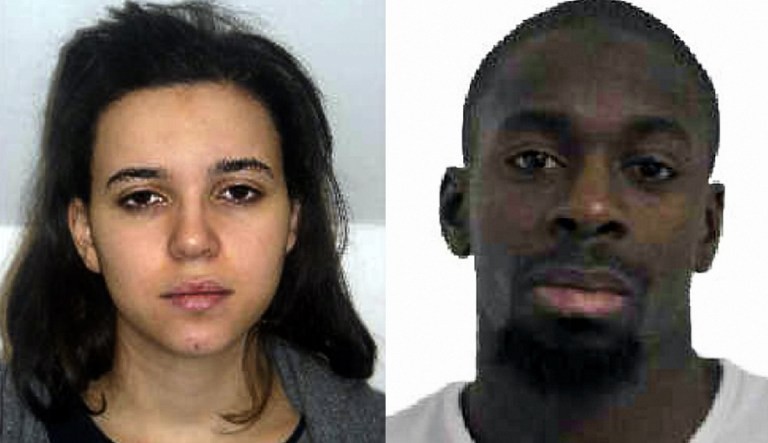
Amedy Coulibaly and his wife Hayat Boumeddiene — today the most wanted woman in France — were stopped by two police officers on December 30 just before noon, in the French capital’s 19th arrondissement, Le Figaro reported, citing a Canard Enchaîné report.
During the routine traffic stop, the officers checked Coulibaly’s driver’s license and ran his name on a wanted persons list, according to the report. An alert popped up describing Coulibaly as a dangerous suspect belonging to an Islamist movement, and instructing officers to attempt to glean information without arousing suspicion. The two policemen alerted their superiors and anti-terror forces but did not receive a response and subsequently let Coulibaly and Boumeddiene go, the report said.
Several hours later, the two would drive to Madrid where Boumedienne is said to have boarded a flight to Istanbul, later crossing the Turkish border into Syria on January 8. That was the same day her husband killed a policewoman in Montrouge, a day after the massacre of 12 people at the Charlie Hebdo offices by the Kouachi brothers, and one day before Coulibaly killed four men at a kosher market and held others hostage for over six hours.
Since the attacks, there has been mounting criticism of French police and intelligence agents for not intervening before since all three gunmen were on police radar and terror watch lists. Cherif Kouachi had been convicted on terrorism charges and Said is believed to have linked up with al-Qaeda forces while in Yemen. Both were on the US no-fly list, according to a senior US official, because of their links to terrorist movements. Coulibaly had met the brothers in prison several years ago.
On Tuesday, French anti-terror prosecutors sought to charge four men in connection with the attacks in Paris, which would be the first suspects charged in the country’s bloodiest terrorist attacks in decades.
The four men awaited an anti-terror judge’s decision early Wednesday on whether to open preliminary investigations against them.
The possible charges were expected just hours before the French government was to unveil new measures aimed at helping head off future attacks, giving police more power to tap phones, monitor Web sites and force Internet companies to block messages of hate posted online.
Prime Minister Manuel Valls will present new security measures Wednesday that will include efforts to increase intelligence-gathering against jihadis and other radicals, block their activities on the Internet, and prevent them from collaborating inside prisons or traveling abroad to fight, President Francois Hollande said.
The court case and the arrests came as Valls urged his nation to do some soul-searching about the country’s deep ethnic divisions and declared that fighting hatred, anti-Semitism and racism was a top priority, especially in France’s impoverished housing projects.
The Paris prosecutor’s office said the four men in court Tuesday were suspected of providing logistical support to Coulibaly, and requested they be detained longer on weapons and terrorism charges.
It is not clear whether the four suspects, all in their 20s, were involved in plotting the attacks or even aware of Coulibaly’s plans.
Five others arrested in the investigation were released without charge, prosecutors said.
No one has been charged with direct involvement in the Jan. 7-9 Paris terror attacks. Coulibaly claimed allegiance to the Islamic State group while the two brothers who attacked the Charlie Hebdo satirical weekly said they were backed by al-Qaida in Yemen.
In Bulgaria, a court on Tuesday agreed to extradite a Frenchman who knew one of the two Kouachi brothers who massacred 12 people at the newspaper. Fritz-Joly Joachin told the Bulgarian court he was innocent and wanted to return to Paris to clear his name.
Valls told journalists Tuesday that the attacks should force France to look at the “apartheid” within. The conservative Socialist whose hard line on Islamic extremism has won many fans said he wasn’t making excuses for crime or terrorism, “but we also have to look at the reality of our country.”
Valls said memories have dimmed of the three weeks of riots by disaffected youths in 2005 that shook France.
“And yet, the stigmas remain … a territorial, social and ethnic apartheid that has imposed itself on our country,” he said.
In response to the 2005 riots, the French government spent hundreds of millions of euros (dollars) to improve conditions in its rundown suburbs, with little success. Unemployment among young people in the housing projects is well above the national average and state buildings are often targeted for vandalism and arson.
“The fight against hatred, anti-Semitism in all its forms, racism — these fights are absolutely urgent,” Valls said. Young people who refused to take part in a national minute of silence for the terror attack victims “are symptoms of something that is not going well.”