Kurds ‘holding out’ in Kobani, says US army
As US and Jordanian aircraft conduct more strikes around Syrian border town, military says local militiamen able to hold IS fighters back
Kurdish forces are “holding out” against the Islamic State group in the Syrian border town of Kobani, and US-led warplanes have intensified bombing raids to push back the jihadists intent on seizing the area, the US military said Wednesday.
US and Jordanian aircraft conducted eight additional strikes on the IS group around Kobani, for a total of 14 coalition strikes for the day and 19 bombing raids near the town since Tuesday, according to US Central Command, which is overseeing the air war and American forces in the Middle East.
“Indications are that Kurdish militia there continue to control most of the city and are holding out against ISIL (IS),” Central Command said in a statement.
The wording was unprecedented for Central Command which until now has provided terse summaries of air strikes without offering assessments of particular battles or indicated where the IS group may be gaining or losing.
“US Central Command continues to monitor the situation in Kobani closely,” it said.
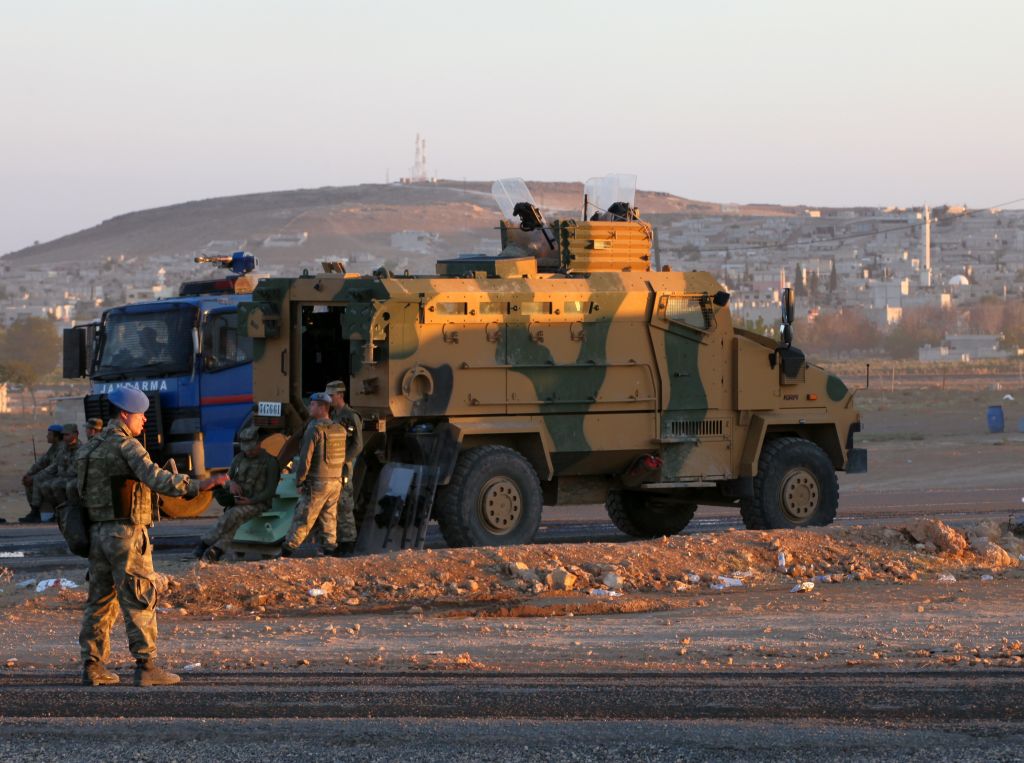
Kobani has become the center of international attention with Kurdish leaders issuing desperate appeals while the fighting has sent some 200,000 people flooding across the border into Turkey.
Demonstrations in Turkey, accusing Ankara of failing to act to save the mostly Kurdish town, have triggered clashes in which at least 19 people were killed.
The latest strikes near Kobani destroyed five armed vehicles, an IS supply depot, a command center, a logistics compound, and eight occupied barracks, Central Command said.
Another air raid southwest of Raqqa destroyed four armed vehicles and damaged two more, it said.
US fighter jets and other aircraft kept up bombing runs in Iraq, with one attack northwest of Ramadi, one in Mosul and another raid south of Kirkuk, it said.
All aircraft “exited the strike areas safely,” it said.
The Pentagon said earlier Wednesday that air power alone could not save Kobani or possibly other towns under attack from the IS group in Syria and Iraq.
The jihadists could only be decisively defeated by “capable” local forces — moderate rebel fighters in Syria and Iraqi government troops and Kurdish forces, spokesman Rear Admiral John Kirby told reporters.
He said it would take time to train and arm forces that could fight effectively and work with US military advisers and aircraft.
Earlier Wednesday, warplanes believed to be of the US-led coalition bombed positions of the Islamic State group near the embattled Syrian Kurdish town, located near the Turkish border. One airstrike, visible from the border, hit a hill and an open space near the town.
Several Syrian human rights groups called on the world to save Kobani from falling into the hands of the jihadist group as the new airstrikes targeted the extremists near the town.
The dramatic appeal by human rights groups came after Islamic State fighters — despite the airstrikes — managed to push into parts of the town, located on the Syria-Turkish border and also known under its Arabic name of Ayn Arab.
Kobani has been under the onslaught of the Islamic State group since mid-September when the militants launched their offensive in the area, capturing several Kurdish villages around the town and bringing Syria’s civil war yet again to Turkey’s doorstep.
The fighting has forced some 200,000 of the town residents and villagers from the area to flee and seek shelter across the frontier in Turkey. Activists also say that more than 400 people have been killed in the fighting.
Also on Wednesday, a US official rebuffed claims that Washington should be doing more to stymie the advance on Kobani, saying the likely fall of the Kurdish city was of little concern.
The unnamed official, speaking to CNN, maintained the Obama administration’s main focus centered on the jihadists’ strategic gains in Iraq.
The official added that the US believed the town would fall into the hands of the Islamic State.
The Kurdish militiamen defending Kobani received some support overnight and Tuesday from the American-led coalition, which carried out six airstrikes against Islamic State operatives around the town, destroying four armed vehicles, damaging a tank and killing fighters, the US military said.
Rather than protecting specific cities or areas, the official said, the US was attempting in its military campaign to curtail the Islamic State’s ability to function as a terror group. He added that airstrikes in Syria had targeted the Islamic State’s senior leadership, oil refineries and infrastructure, according to CNN.
Capturing Kobani would give the Islamic State group, which already rules a huge stretch of territory spanning the Syria-Iraq border, a direct link between its positions in the Syrian province of Aleppo and its stronghold of Raqqa, to the east. It would also give the group full control of a large stretch of the Turkish-Syrian border.
AP and Adiv Sterman contributed to this report.