Martin Amis portrays romance, laughter and death at Auschwitz
A dark comedy, English novelist’s latest is a love story full of intrigue and murder set against the greatest crime of human history
LONDON — Within the network of Nazi prisoner camps, Auschwitz was by far the largest of the metropolises of death and encompassed a guarded area of approximately forty square kilometers. Here was not only the apparatus of death (Auschwitz I, Auschwitz-Birkenau) but all of the infrastructure needed to support the members of the SS and their families who governed the metropolis.
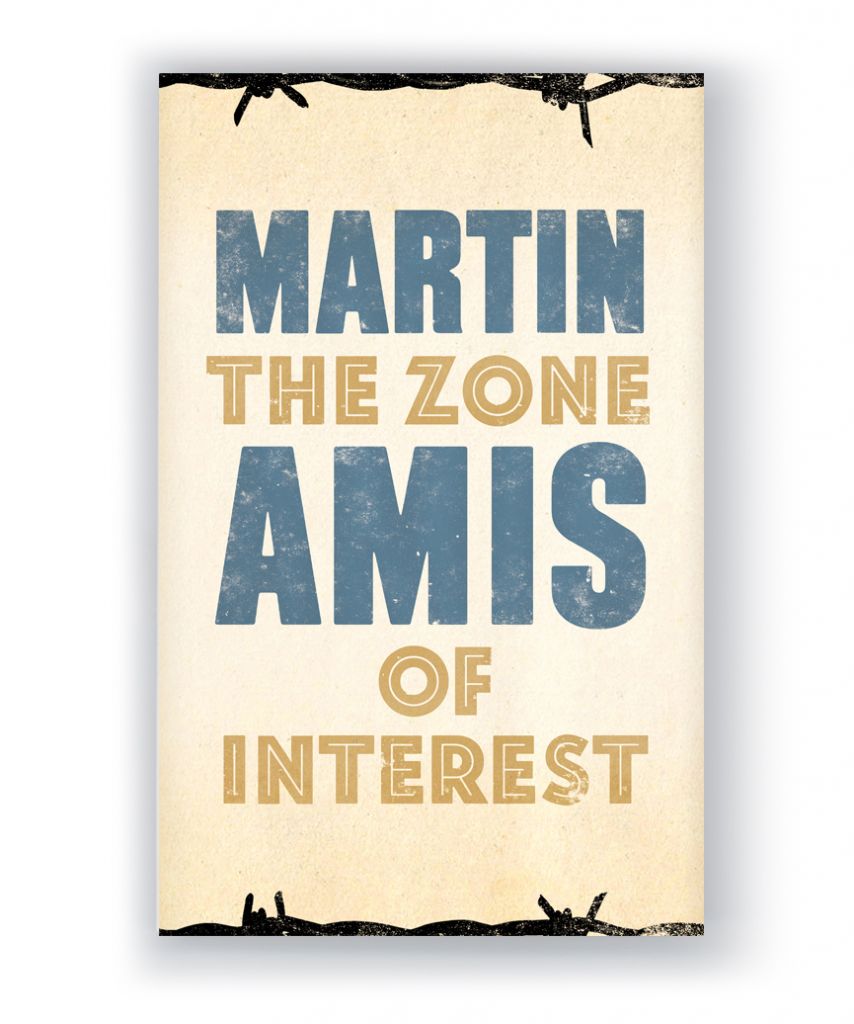
A wheel within a wheel, this area was called the Interessengebiet, the zone of interest, and within it a system of life emerged in tandem — and ruled over — the system of death. It is within this system, this society of Nazi officers, officials, and other halves that Martin Amis – author of “Money,” “London Fields,” and “The Information” – has elected to stage his new novel, published September 30, “The Zone of Interest.”
“I was no stranger to the flash of lightning; I was no stranger to the thunderbolt,” Angelus Thomsen, one of Amis’ three narrators, an officer who takes a particular interest in the operations of Monowitz, says. “Tall, broad, and full, and yet light of foot, in a crenellated white ankle-length dress and a cream-colored straw hat with a black band, she moved in and out of pockets of fuzzy, fawny, leonine warmth. She laughed – head back, with tautened throat.”
The woman Thomsen has fallen for is Hannah Doll, wife of camp commandant Paul Doll. Doll is the second of the novel’s narrators, a delusional drunkard – “nobody can say that I don’t cut a pretty imposing figure on the ramp: chest out, with sturdy fists planted on jodhpured hips, and the soles of my jackboots at least a meter apart” – who displays an amazing detachment not only from the operation he is at the center of but his personal failings as a husband and father. “I am a normal man with normal needs. I am completely normal,” he insists. “This is what nobody seems to understand.”
The third voice comes from inside the camp. Szmul is a Sonderkommandoführer, someone hollowed out by his role in history. “My eyes are like the eyes of Goldilocks compared to the eyes of the Sonderkommandoführer, Szmul,” Doll observes at one point. “His eyes are gone, dead, defunct, extinct. He has Sonder eyes.” Szmul himself says of the Sonderkommando, “we are the saddest men in the Lager. We are in fact the saddest men in the history of the world.”
The way these three characters interweave becomes the foundation for a most strange and peculiar novel, one that cannot be categorized. It is at once a dark comedy with bawdy dialogue, a love story, a novel of intrigue and deception, of murder and self-murder, all set against and within the single greatest crime of human history.
The elements smash together to create disturbing juxtapositions: On the ramp, a “little bent old lady” who has just arrived on a transport from France detaches herself from the crowd, and says to Commandant Doll, “Do you realize that there was no restaurant wagon on this train?” “No restaurant wagon?” Doll replies. “Barbaric.” “No service at all,” she says. “Even in first class!”
Laughter in Auschwitz is daring to attempt – but highly questionable, too.
Should there not be some distinction between the Amis of broken condoms and the Amis of the concentration camp?
Indeed, one of the problems with “The Zone of Interest” is its struggle to find the right voice. For, Amis is a novelist who cannot get out of the way. In the very first chapter, all the signature Amisisms are there on the page. As Sam Leith recently observed in The Guardian, “you could pick out ten sentences of Ian McEwan, a paragraph of Julian Barnes, at random and you would not necessarily be able to identify them as such. A paragraph of Amis, a sentence of Amis, always sounds like Amis.”
Should there not be some distinction between the Amis of broken condoms and the Amis of the concentration camp?

That said, Amis’ attempts at earnestness and seriousness can be exhausting in themselves. He has a tendency to lapse into world-historical dialogue, intended to signify that some force greater than human energy is at work.
It is not a novel without rewards, however. “No-one knows themselves. Who are you? You don’t know. Then you come to the Zone of Interest, and it tells you who you are.” Doll remarks this and, in Doll, Amis fashions a character, a warped and corrupted mind, that gives some insight into how a camp commandant might think and operate.
At an anniversary celebration for the Nuremberg Race Laws, Doll sitting in the audience thinks to himself:
“It was most peculiar. I spent the whole two-and-a-half-hours intently estimating how long it would take to gas the audience, and wondering which of the clothes would be salvageable, and calculating how much their hair and gold filling might fetch… I searched my senses for squeamishness – and squeamishness just wasn’t there,” he says.
“The Zone of Interest” is not the first time Amis has written about the Holocaust. In 1991, Amis published “Time’s Arrow.” One of his most engaging and well-constructed novels, it upends time and examines the life of Doctor Tod T. Friendly, a Nazi war criminal and conductor of medical experiments in Auschwitz, from back to front.
Indeed, there are ideas and motifs that run between the two novels. The deadness of Szmul’s eyes – “the eyes are the windows to the soul, and when the soul is gone the eyes too are untenanted” – is connected to an observation in “Time’s Arrow” where the narrator says, “…there is nothing as naked as human eyes: they haven’t even got skin on them.”
Unfortunately for Amis, in returning to the metropolis of death, “The Zone of Interest” cannot quite replicate the taut structure, absolute clarity, and dark and shocking transgression of “Time’s Arrow.”