Minister pans rights groups for hampering anti-migrant efforts
Silvan Shalom says more Africans coming in, hopes High Court won't block plan to ban asylum-seekers from Tel Aviv, Eilat
Interior Minister Silvan Shalom criticized rights groups for repeatedly stymieing efforts by the government to deal with African migrants in the country, saying more were on their way to Israel following a court ruling that asylum-seekers cannot be held in detention centers for over a year.
In an interview with Army Radio Shalom said he hoped rights groups wouldn’t shoot down a plan to keep away from Tel Aviv and Eilat over a thousand migrants scheduled for release from a detention center.
“Again and again the government decides to legislate laws and again and again they [the rights organizations] petition the High Court… and bring about a canceling of those laws,” he said. “When those laws are canceled they enable those migrants to stay here and prevent Israel from getting them out.”
On Tuesday and Wednesday, 1,200 African migrants held at the Holot detention center in the south are to be released following a High Court decision two weeks ago limiting the time they can be held to no more than a year.
Shalom blamed civil society groups for hampering government efforts to expel the migrants to other countries willing to take them in.
“What we are trying to do is to remove them to a third country,” he said. “The flow [into the country] is getting stronger because of the recent decision. They see that they have the possibility to stay here because we are releasing them.”
Shalom claimed that overnight Sunday nine migrants crossed into the country and that last Thursday night 19 arrived — including two who had previously been in Israel but returned after accepting a cash incentive to leave for a third country.
Israel saw a large influx of tens of thousands of African migrants enter the country over the last decade seeking jobs or asylum, but the numbers dropped dramatically since the construction of a wall on the country’s border with Egypt.
Shalom is hoping to forbid the migrants being released from Holot from traveling to either Tel Aviv and Eilat, both cities that have large migrant communities that have sometimes seen friction with locals opposed to their presence.
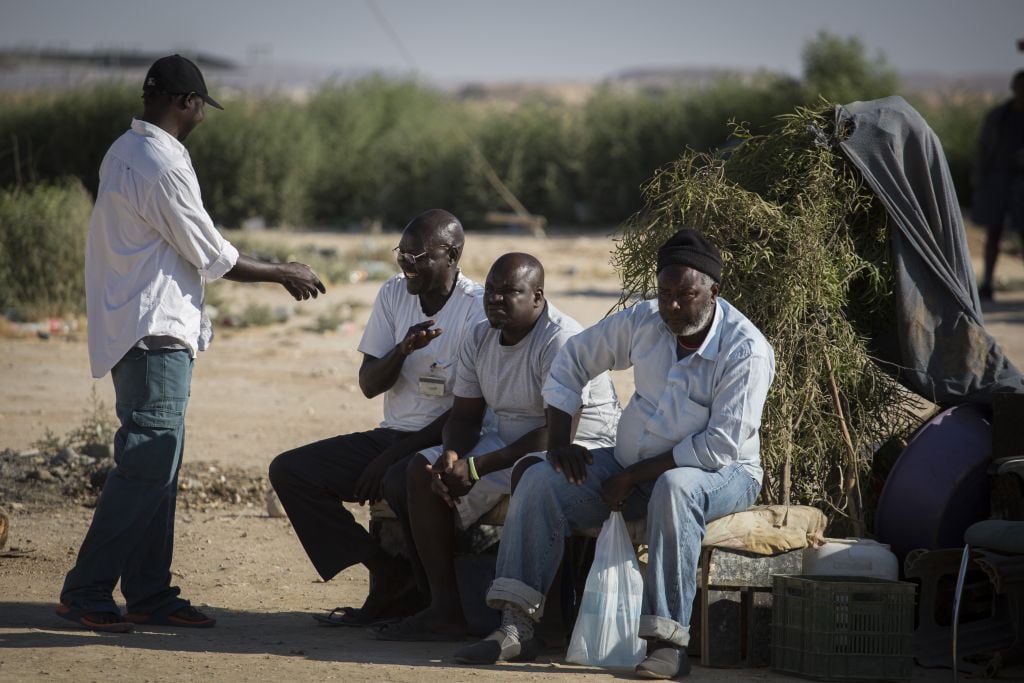
Among the African migrants living in Israel — the vast majority of whom claim asylum-seeker status — more than 90 percent come from Eritrea, Sudan and the Congo. But Israel has recognized fewer than 1% as asylum claimers and, since 2009, less than 0.15% — the lowest rate in the Western world.
The minister asserted that many of the migrants are not true asylum seekers but rather “these are people only looking for work.”
Shalom noted he had spoken with the Eritrean ambassador and was now of the opinion that conditions in the country were not as bad as they are often made out to be, in particular regarding exaggerated claims of compulsory military service spanning decades.
The released migrants will be issued with identity cards and anyone caught in the prohibited cities will be sent to Saharonim Prison in the Negev Desert.
While the Holot facility is an open center — detainees are free to leave during the day, but required to attend a twice-daily roll call — those held in Saharonim are not allowed to leave the compound.
In recent years, an estimated 47,000 African migrants have managed to illegally enter Israel via Egypt, seeking jobs or asylum.
Earlier this month the High Court upheld the Prevention of Infiltration Law after it was challenged by human rights groups, but ruled that the government could not hold migrants in detention facilities for more than 12 months — as opposed to the 20-month period that the government had been imposing.
The Prevention of Infiltration Law seeks to prevent additional illegal immigration to Israel and encourages those already in the Jewish state to leave.
Since 2006, Israel has struggled to establish and implement a clear legal framework to deal with the large influx of migrants, resulting in confusing and often conflicting ad hoc immigration policies. The influx has slowed dramatically of late, as Israel has sealed off its border with Egypt more effectively.
A 2014 amendment to the Anti-Infiltration Law allows the government to offer detainees in Holot an ultimatum: They can take $3,500 in cash and voluntarily return to an unnamed African country (according to press reports, Rwanda), or face indefinite incarceration in Saharonim.