Moshe Kahlon, the Knesset’s new king
PM manages to secure his first coalition partners, who demand a hefty price in return for their support
Behind closed doors and away from the media’s watchful eye, Prime Minister Benjamin Netanyahu on Wednesday finally secured his future coalition’s first partners, the Kulanu party and ultra-Orthodox faction United Torah Judaism, leaving the Hebrew press to analyze the deals and attempt to predict the implications for the character of the next government. The addition of the parties brings Netanyahu’s emerging coalition up to 46 seats, meaning he requires only 15 more to form a government by the May 7 deadline.
“[Moshe] Kahlon gets the right to veto,” Yedioth Ahronoth’s headline announces, referring to a clause in the coalition agreement that would allow the Kulanu party chairman to block bills aimed at curbing the Supreme Court’s powers and to prevent the controversial Jewish State Bill from passing into law in the Knesset. Kulanu will also be given control of the finance, environmental protection, and housing and construction portfolios, and will appoint a head of its choosing for the Israel Land Administration.
Israel Hayom leads with the coalition agreement as well, staying away from any form of commentary as it blandly report, “The government is underway: Kahlon and UTJ have signed.” On its front page, the Netanyahu-friendly paper focuses on the terms of the agreement between Likud and UTJ, according to which several major reforms drafted by the previous government, aimed at integrating the ultra-Orthodox community into Israeli society, will apparently be frozen, including aspects of legislation to phase Haredim into mandatory military or national service. The daily adds that 22 ministers are set to be appointed in the government, 12 of them from the prime minister’s Likud party.

In Haaretz, the main headline highlights Kahlon’s opposition to the Jewish State Bill in its current form and states that the Kulanu party head has agreed to implement widespread reforms in the Communications Ministry. Haaretz reporter Jonathan Lis quotes an unnamed Liked official, who vows that “Netanyahu has groundbreaking plans with regards to communications, and he plans to realize them in full force.” A full-page spread in the paper’s inner section is dedicated to the prime minister’s reforms, which, the Haaretz reporter speculates, may include a breakup of Channel 2 into two separate entities, a refusal to grant Channel 10 a permanent broadcasting permit, and a law which would allow for Israel Hayom to continue its free distribution.
While most of the Hebrew newspaper’s main articles are dedicated to the coalition talks, many of the other reports deal with the state of Israeli backpackers and tourists who had been in Nepal during this week’s devastating earthquakes. Yedioth plays up the feeling of terror experienced by some Israelis as they were waiting to be rescued, specifically noting the hostility of local Nepalese citizens. “We felt that our lives were in danger, because of the Nepalese,” a headline quoting Israeli tourist Guy Zach states. Zach explains that the Israelis in the North Nepali Langtang valley were suspected of stealing food, and were not offered assistance from local soldiers after the quake.
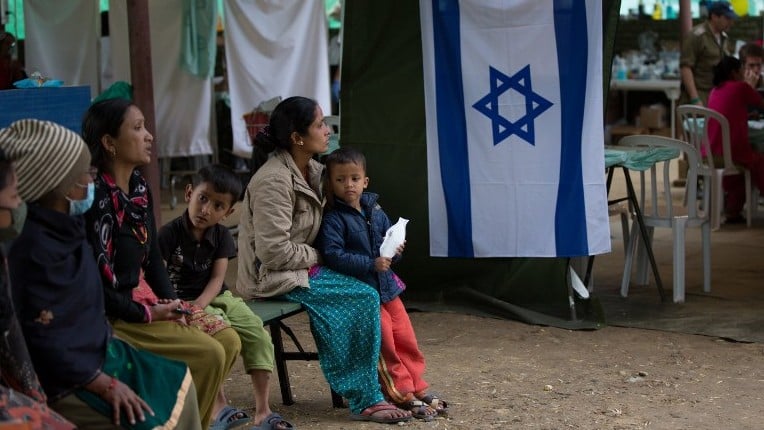
Israel Hayom provides an inside report from the IDF field hospital set up in Kathmandu, writing that the Israeli teams has so far attended to more than 100 Nepali patients. In a smaller article, the daily notes that the IDF rescue team dispatched to Nepal was unable to locate any survivors despite its numerous efforts.
Returningto local news, a Haaretz report on the state of high-school education in East Jerusalem finds a 60% jump in demand for matriculation certificates over the past four years, suggesting a shift in attitudes toward the Israeli establishment among the capital’s Palestinian population. The report adds that in said period, schools offering an education program in line with official Israeli requirements has grown more than sevenfold, from only two to fifteen currently. Also in East Jerusalem news, Haaretz brings a disturbing story detailing the arrest of a six-and-a-half year old Palestinian from the Wadi Joz neighborhood. The child, who was accused of throwing stones at a passing bus, was detained and questioned for nearly eight hours, counter to Israeli law which clearly states that persons of less than 12 years of age cannot be legally arrested.
Yedioth’s amusing back page offers a short but sweet story on Palestinian hair dresser Asma Massimi, who emerged as the victor in an international competition of the Organization Mondiale Coiffure which took place at the Tel Aviv University. Massimi, a native of the West Bank city of Nablus, said her win had “brought a lot of pride to Palestine.” She was awarded a pair of Japanese scissors, valued at NIS 6,000 (about $1,556), a prop which is sure to put her on the cutting edge of her profession.